What Quality Certifications Matter Most When Sourcing Auto Wiring Harnesses?




What Quality Certifications Matter Most When Sourcing Auto Wiring Harnesses?
When sourcing auto wiring harnesses, quality certifications are more than compliance labels—they are critical indicators of product safety, process stability, and supplier reliability. For quality control and safety management teams, understanding which certifications matter most can reduce procurement risk, prevent field failures, and support regulatory alignment. This article outlines the key standards buyers should evaluate before selecting a wiring harness supplier.
If you have ever had to explain a harness-related field issue to a customer, you already know the problem: a supplier shows a stack of certificates, but very few buyers get a clean answer to a simple question. Which certifications actually reduce risk for the program in front of you?
For auto wiring harnesses, the right answer depends on where the harness will be used, which market the vehicle serves, and whether the assembly carries power, signals, or high voltage. A cabin infotainment harness, an engine compartment harness, and a battery pack high-voltage harness do not carry the same compliance burden. That is where many sourcing mistakes start: treating all harness suppliers as if one certificate package covers every application.
Start with the certification that tells you how the factory is run
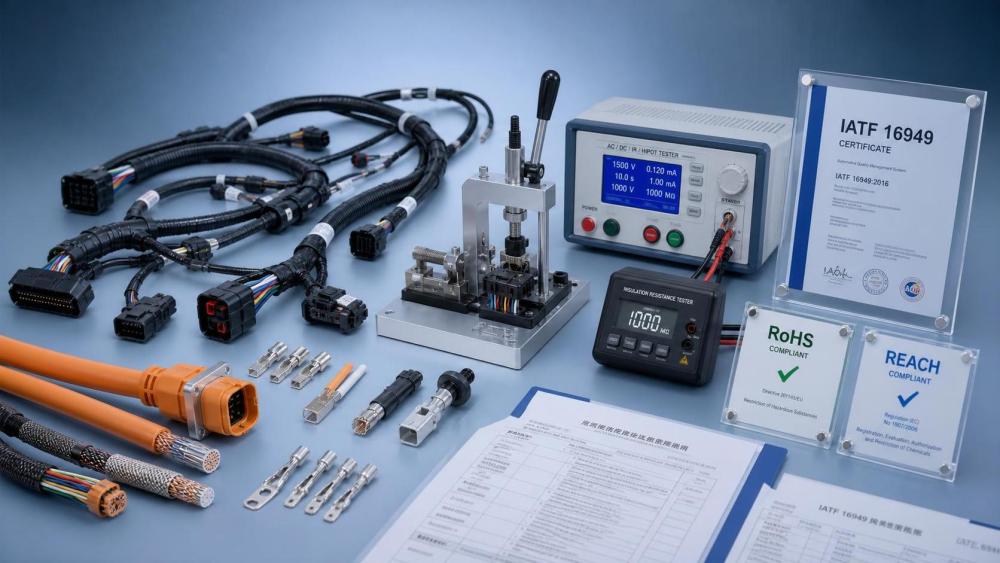
For most automotive buyers, IATF 16949 is still the first document to check. Not because it guarantees a good harness on its own, but because it tells you whether the supplier operates under the automotive quality management framework expected by OEMs and Tier 1s. If a manufacturer of auto wiring harnesses does not hold IATF 16949, that does not automatically mean the product is bad. It does mean your audit burden goes up, especially if the harness is vehicle-grade rather than aftermarket-grade.
What matters here is not only that the certificate exists, but that its scope matches the product and site you are buying from. Buyers sometimes accept a group-level certificate and skip the site check. Then they discover that the certified plant is in one city, while the actual harness build is being done somewhere else or outsourced in part. Read the scope line carefully. It should cover the manufacturing location and the relevant automotive products or processes.
A practical check: ask for the certificate number, issuing body, validity date, and the exact manufacturing address. Then compare that with the quotation, PPAP package if applicable, and shipping documents. If those do not line up, pause there.
ISO 9001 is useful, but it is not enough for automotive risk
You will still see many harness suppliers presenting ISO 9001 as their main quality credential. For non-automotive cable assemblies, that may be acceptable. For automotive applications, especially anything tied to safety, power distribution, or durable vehicle electronics, ISO 9001 alone is a weak screening threshold.
This is where quality and safety teams need to be strict. ISO 9001 shows a general quality system. It does not replace automotive-specific expectations around traceability, change control, defect prevention, process capability, or customer-specific requirements. If your sourcing target only has ISO 9001, treat that supplier as a higher-risk candidate and expand your audit into process controls, crimp validation, terminal pull-force records, test coverage, and lot traceability.
Environmental compliance is not optional paperwork
For export programs, RoHS and REACH compliance come up early, and for good reason. Harnesses contain copper, insulation, jackets, tapes, connectors, seals, clips, overmolds, and often plating or flame-retardant materials. Any one of these can trigger a declaration issue.
The mistake here is accepting a one-line statement that says “RoHS compliant” without substance. Ask whether the supplier can provide a material declaration, supplier declarations from sub-tier component makers, or third-party test reports where appropriate. The same applies to REACH SVHC communication. Since the candidate list updates over time, old declarations should not be treated as permanent proof.
For programs shipping into the EU, this is procurement risk, not just legal housekeeping. A harness that passes electrical testing can still become a blocked shipment if substance compliance records are incomplete.
For high-voltage harnesses, ask a different set of questions
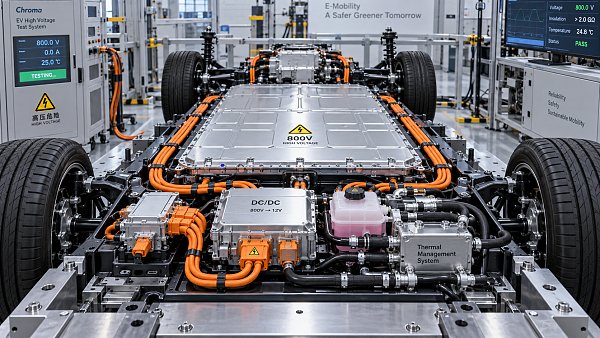
Once you move into EV and hybrid platforms, the discussion changes. High-voltage auto wiring harnesses are not judged only by basic quality certification. Buyers should verify how the supplier manages insulation integrity, shielding performance, connector interface validation, and test methods tied to the vehicle platform or customer specification.
There is no single global certificate that magically proves a high-voltage harness is fit for every EV application. In practice, you will need to review a combination of customer drawings, component approvals, material specifications, product validation reports, and often standards referenced by the OEM or Tier 1. Depending on market and application, suppliers may refer to standards such as LV 214, USCAR test methods, or OEM-specific validation requirements. Those references must be checked against the actual customer program because they are not universally interchangeable.
So when a supplier says “we are certified for EV harnesses,” do not stop there. Ask what test regime they follow for dielectric withstand, insulation resistance, sealing, vibration, temperature cycling, and shielding continuity. If the answer stays vague, the certificate set is probably carrying more weight in the sales pitch than it deserves.
UL recognition matters in some projects, but buyers often overgeneralize it
UL can be relevant, especially when harnesses are used in equipment, charging-related systems, certain electronics assemblies, or applications where North American customer requirements call for recognized components. But UL is not a universal pass ticket for every automotive wiring harness. In vehicle programs, OEM and automotive standard compliance may matter more than a standalone UL mark.
The useful question is narrower: does the wire, connector, tubing, or assembled harness need UL recognition or listing for this end use? If yes, confirm the relevant file numbers and component coverage. If no, do not let a supplier distract from more important automotive validation evidence.
Safety and process certifications around the factory still matter
For quality control managers, ISO 14001 and ISO 45001 are not usually the deciding factors in awarding a harness project, but they should not be ignored. A supplier handling cutting, stripping, crimping, soldering, ultrasonic welding, taping, overmolding, and electrical testing at scale needs stable environmental and occupational controls. Poor housekeeping and weak EHS discipline tend to show up later as process drift, contamination, handling damage, or inconsistent workmanship.
These certificates do not prove product quality. They do help you judge whether the plant is managed with enough rigor for long-running automotive supply. On a tight supplier shortlist, that can be a useful differentiator.
Do not confuse component certifications with harness assembly capability
This is a common sourcing trap. A supplier may use certified wires, approved terminals, and branded connectors, but the final harness can still fail because of poor crimp height control, wrong applicator setup, damaged seals, routing strain, missing cavity plugs, or weak test coverage.
In other words, certification on parts does not replace process qualification on the assembly line. Ask for evidence of crimp cross-section validation, pull-force verification, continuity and hipot testing where required, error-proofing on terminal loading, and revision control for work instructions. If the supplier cannot connect certification documents to actual process discipline, you are only seeing half the picture.
A short checklist that actually helps during supplier screening
- Confirm whether the manufacturing site for the quoted auto wiring harnesses is covered by IATF 16949 or only ISO 9001.
- Check certificate scope, address, issuing body, and validity date. Do not rely on a group certificate without site verification.
- For EU-facing programs, request current RoHS and REACH declarations tied to the actual bill of materials.
- For high-voltage harnesses, ask which validation standards or customer specs were used and request supporting test records.
- If the supplier mentions UL, verify that it applies to your end use rather than assuming it adds general automotive compliance value.
- Review change management. A certified plant can still create risk if sub-tier connector, terminal, or resin changes are poorly controlled.
- Check traceability depth: lot tracking for wire, terminals, seals, connectors, and finished harnesses is often more useful than a glossy certificate pack.
Market differences are real, and buyers should account for them
A harness supplier serving domestic aftermarket demand may not be organized the same way as one shipping to an OEM in Europe, the United States, Japan, or South Korea. Documentation depth, PPAP readiness, IMDS support, sub-supplier control, and familiarity with customer-specific requirements can vary a lot even when the visible certificates look similar.
That is why quality teams should treat certification review as the start of supplier qualification, not the end. In some programs, especially safety-relevant or EV-related ones, it is worth combining the document review with a process audit and a sample validation plan before nomination.
One more practical point: standards references can differ by OEM and region, and some customer requirements are proprietary or program-specific. Where a supplier cites internal customer approvals or unnamed platform standards, mark those items as 【待核实】 until your team sees the underlying requirement flowdown.
What usually matters most in the end
If the goal is to reduce sourcing risk for auto wiring harnesses, the certifications that usually carry the most weight are IATF 16949 for automotive quality system credibility, RoHS and REACH for material compliance where required, and application-specific validation evidence for high-voltage or safety-relevant harnesses. UL can be important in the right project, but it is often misunderstood. ISO 9001 remains a baseline, not a strong endpoint.
The more experienced buying teams do one thing differently: they never read certificates in isolation. They match each certificate to the plant, the product family, the target market, and the actual failure risks of the harness. That is the habit that prevents paperwork from replacing judgment.
Have questions about this sector analysis, or seeking best practices specific to your niche? Drop us a line below and let the senior consultants at GAC assist you.
“We respect your privacy. Your information is strictly confidential.”
Related News
- 00
0000-00
How to assess vendor lock-in in a software-defined vehicle platform - 00
0000-00
How ISO 26262 guides functional safety in steer-by-wire systems - 00
0000-00
How to evaluate a steering angle sensor manufacturer's accuracy claims - 00
0000-00
How to diagnose CAN bus faults in a hybrid vehicle control unit - 00
0000-00
How does battery cooling pipe diameter affect coolant pressure drop?
Weekly Insights
Stay ahead with our curated technology reports delivered every Monday.
Recommended News
 How to assess vendor lock-in in a software-defined vehicle platformAssess Software-Defined Vehicle platform lock-in with practical tests for API portability, data access, update control, and exit costs. Learn how to choose a platform with a proven exit path.Author:Time:Oct 27, 2026
 How ISO 26262 guides functional safety in steer-by-wire systemsExplore steering systems functional safety through ISO 26262. Learn how hazard analysis, fault-tolerant design, and validation build a stronger steer-by-wire safety case.Author:Time:Oct 26, 2026
 How to evaluate a steering angle sensor manufacturer's accuracy claimsEvaluate steering angle sensor manufacturer accuracy claims with practical checks on calibration, latency, and test evidence. Compare suppliers confidently and avoid costly selection mistakes.Author:Time:Oct 25, 2026
 How to diagnose CAN bus faults in a hybrid vehicle control unitDiagnose Hybrid Vehicle Systems control unit CAN bus faults with step-by-step power, wiring, and waveform checks. Find the root cause and avoid unnecessary replacement.Author:Time:Oct 24, 2026
 How does battery cooling pipe diameter affect coolant pressure drop?Battery Cooling Pipe diameter affects coolant pressure drop and pump power. Explore sizing calculations and practical tips to optimize EV battery cooling and compare options with confidence.Author:Time:Oct 23, 2026
 How to assess PPAP readiness of automotive sensor system manufacturersAssess Automotive Sensor Systems manufacturers for PPAP readiness. Learn to verify production evidence, measurement capability, validation, and traceability to reduce sourcing risks.Author:Time:Oct 22, 2026
 What to ask an FPC connector manufacturer about reliability testingChoosing an FPC Connector manufacturer? Learn what to ask about reliability testing, failure limits, and traceable results to reduce design risks and select with confidence.Author:Time:Oct 21, 2026
 How to verify vehicle fitment for an aftermarket AC evaporatorNavigating the evaporator aftermarket? Verify vehicle fitment with VIN data, OE numbers, and physical interface checks. Use this guide to avoid costly mismatches and order confidently.Author:Time:Oct 20, 2026
 How electric compressor speed affects EV battery cooling capacityElectric compressor technology: battery cooling depends on more than RPM. Discover how speed, refrigerant flow, and system limits affect EV cooling capacity and energy efficiency.Author:Time:Oct 19, 2026
 How to verify a variable frequency compressor supplier’s efficiency claimsVerify a variable frequency compressor supplier’s efficiency claims using COP boundaries, matched test conditions, and duty-cycle data. Learn how to choose with confidence.Author:Time:Oct 18, 2026
 How bend radius affects FPC reliability in automotive camera modulesAutomotive FPC applications: camera module reliability starts with bend radius. Learn how stack-up, strain, and validation guide robust designs and help prevent costly failures.Author:Time:Oct 17, 2026
 How to diagnose intermittent loss of electric power steering assistMaster power steering system diagnostics to trace intermittent EPS assist loss. Learn proven checks for voltage, wiring, and fault codes to avoid costly guesswork.Author:Time:Oct 16, 2026
 How to size automotive power modules for electric compressorsSize automotive power modules for electric compressors with confidence. Learn how voltage, phase current, losses, and cooling shape reliable selection—and avoid costly oversizing.Author:Time:Oct 15, 2026
 Why automotive power electronics are shifting to silicon carbideAutomotive Power Electronics are shifting to silicon carbide. Discover how SiC can cut losses, boost EV power density, and reshape cooling, reliability, and system costs.Author:Time:Oct 14, 2026
 How EV adoption shapes the electrically driven compressor marketExplore how EV adoption shapes the electrically driven compressor market, from battery cooling and heat pumps to supplier margins. Discover the drivers of profitable growth.Author:Time:Oct 13, 2026
 How to size a PTC heater for reliable EV cabin heatingPTC Heater sizing for EV cabins: learn how to balance defrost performance, heat-pump integration, airflow, voltage range, and battery power for reliable winter comfort.Author:Time:Oct 12, 2026
 What determines the cooling output of electric automotive AC compressors?Automotive air conditioning compressors electric systems: explore how speed, voltage, refrigerant, controls, and heat exchangers shape EV cooling capacity and efficiency.Author:Time:Oct 11, 2026
 What makes a touchscreen media head unit responsive enough for daily use?Touchscreen media head unit performance explained: discover what delivers fast starts, smooth maps, reliable phone pairing, and responsive daily driving.Author:Time:Oct 10, 2026
 How Does a Battery Management System Communicate Cooling Demand?How does a battery management system communicate cooling demand? Explore CAN signals, thermal priorities, fault handling, and EV cooling control strategies.Author:Time:Oct 20, 2026
 Can a Domain Controller Share a Cooling Loop with Other Electronics?Can a domain controller share a cooling loop with other electronics? Explore thermal zoning, flow control, safety priorities, and reliable vehicle electronics cooling strategies.Author:Time:Oct 19, 2026
 What Causes Domain Controller Overheating During Summer Testing?What causes domain controller overheating in summer testing? Explore heat load, airflow, installation, software factors, and practical fixes.Author:Time:Oct 18, 2026
 Is a Head-Up Display Hard to Integrate with Different Windshields?Is a head-up display difficult to integrate with different windshields? Discover how glass geometry, coatings, and calibration affect HUD clarity, cost, and production readiness.Author:Time:Oct 17, 2026
 What Should Be Checked Before Selecting an Automotive Head Unit?What should be checked before selecting an automotive head unit? Explore compatibility, performance, cybersecurity, compliance, and supplier support.Author:Time:Oct 16, 2026
 Is Steer-by-Wire More Expensive Than an EPS Steering System?Is steer-by-wire more expensive than an EPS steering system? Explore the true costs, safety demands, software value, and when SbW justifies its premium.Author:Time:Oct 15, 2026
 Which Automotive Electronics Need Validation for 800V Platforms?What automotive electronics should be validated for 800V platforms? Explore critical checks for harnesses, power electronics, thermal systems, safety, and EMC.Author:Time:Oct 14, 2026
 How Do Automotive Compressor Export Requirements Vary by Market?How do automotive compressor export requirements vary by market? Explore key compliance rules for refrigerants, EV safety, OEM approvals, labeling, and customs.Author:Time:Oct 13, 2026
 What Documents Are Needed to Export Automotive Thermal Components?What documents are needed to export automotive thermal components? Explore customs, compliance, technical records, and shipping tips to prevent costly delays.Author:Time:Oct 12, 2026
 How Often Should an EV Air Conditioning Compressor Be Inspected?How often should an EV air conditioning compressor be inspected? Discover recommended service intervals, warning signs, and expert care tips to protect cooling performance and EV reliability.Author:Time:Oct 11, 2026
 How resolution and refresh rate affect vehicle dashboard displaysCompare resolutions and refresh rates of vehicle dashboard displays to optimize readability, motion, latency, and cockpit performance. Explore the right specs for every vehicle display.Author:Time:Oct 20, 2026
 How to size power solutions for automotive head-up display systemsHeads-up display systems power solutions: learn how to size automotive HUD power architectures for startup, brightness, thermal limits, EMC, protection, and reliable vehicle operation.Author:Time:Oct 19, 2026