How to verify vehicle fitment for an aftermarket AC evaporator




An aftermarket AC evaporator can match a vehicle’s year, make, and model yet still arrive with the wrong tube connections, sensor position, or mounting geometry. The mismatch may only become obvious after the HVAC housing is opened, leaving a workshop waiting for another part and procurement teams handling a difficult return.
Verify fitment through three linked checks: the vehicle’s exact HVAC configuration, the applicable OE service part number, and the replacement’s physical interfaces. Use VIN-linked catalog information to narrow the application, confirm any part-number supersessions, then compare supplier drawings against the original specification or removed assembly. In the evaporator aftermarket, a catalog match is a starting point—not sufficient evidence to release an order.
Start with the vehicle specification, not the product photograph
A product image rarely reveals differences between evaporators used within the same model range. Vehicles sharing a badge may have different HVAC housings because of market specification, steering position, production changes, or optional rear air conditioning. Engine and trim information can help identify the application, but neither reliably defines the evaporator on its own.
Build a vehicle record before requesting quotations. Include:
- The full VIN, supplied through an appropriate business channel.
- Production date and original sales market, rather than registration year alone.
- Left-hand-drive or right-hand-drive configuration.
- Front or rear evaporator position and any auxiliary air-conditioning equipment.
- HVAC option codes or housing identification where available.
- Refrigerant type from the vehicle label or service information.
Use this information in an OE parts catalog or a reliable VIN-linked catalog that exposes application notes. A basic VIN decoder may identify the model and powertrain without identifying the installed HVAC option. Ask specifically whether the lookup resolves the evaporator variant, rather than accepting “VIN checked” as a complete answer.
Automatic climate control, dual-zone operation, and heat-pump equipment deserve attention when the catalog distinguishes them. However, do not assume each feature requires a different evaporator: some configurations share a core, while others do not. The relevant evidence is the application record for that vehicle.
Establish the OE reference and resolve conflicting numbers
The most useful reference is the current OE service part number for the specified vehicle and evaporator position. Numbers visible on the removed component may instead identify a manufacturing assembly, supplier component, or HVAC housing. They remain useful clues, but need to be checked against the service catalog.
Record both the original reference and any documented replacement number. A supersession can mean a direct replacement, but it can also involve revised seals, a different valve, or installation instructions. Confirm whether the replacement is supplied as a bare core or a larger assembly before comparing supplier offers.
When a supplier lists several OE numbers against one aftermarket SKU, request the application boundaries behind that cross-reference. A consolidated replacement may legitimately cover several vehicles, but the supplier should explain whether the interfaces are identical or whether additional components are required.
Do not treat two aftermarket cross-reference lists as independent confirmation when both may reproduce the same catalog data. Stronger evidence combines the vehicle-specific OE reference with a controlled supplier drawing and, where available, a documented sample comparison.
Compare the interfaces that determine whether it will install
Overall dimensions alone cannot establish fitment. Two cores can have similar envelopes while their tube ends sit at different heights or angles. Conversely, measuring the old assembly with foam and brackets attached can make a correct replacement appear undersized.
Request a dimensioned drawing with its revision identifier. The drawing should state measurement datums, units, and tolerances. Compare like with like: bare-core dimensions against bare-core dimensions, and complete assembly dimensions against the corresponding assembly.
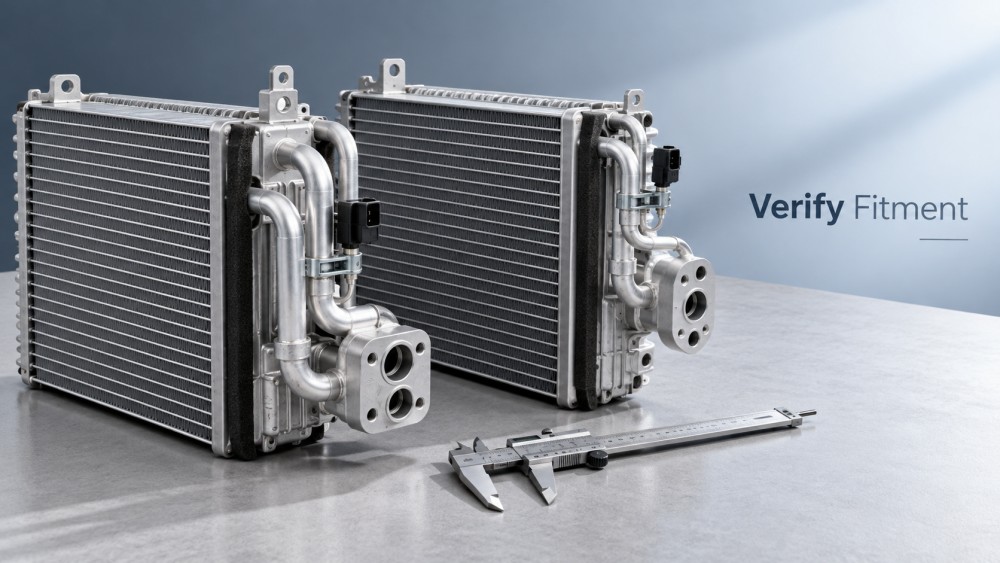
Connection details deserve close-up photographs as well as dimensions. Confirm O-ring seat geometry and fastener alignment, not merely tube diameter. An adapter, reshaped tube, or improvised bracket is not evidence of direct fit. Any proposed modification requires an approved installation method and a clear allocation of responsibility.
Photographs should show the actual supplied variant from several orientations, ideally with a scale visible. Generic images can conceal the very distinction being checked. For critical offsets and connection positions, use drawings or measured inspection results rather than estimating from perspective.
Distinguish design differences from installation problems
A removed evaporator is valuable comparison evidence, but it may have bent tubes, damaged brackets, compressed foam, or previous repair modifications. Photograph its installed orientation before removal where practical. Use undamaged locating surfaces as reference points, and investigate any disagreement between the old part and the catalog instead of automatically copying it.
Minor differences in fin appearance or manufacturing method do not automatically establish incompatibility. They also do not prove equivalent performance. Separate the question “Will it install correctly?” from “Will it deliver suitable thermal and durability performance?” Each requires its own evidence.
Check what the quoted assembly actually includes
One quotation may cover only the evaporator core, while another includes the expansion valve, insulation, brackets, or seals. Without an explicit supply scope, a lower price may simply shift missing components and assembly work to the installer.
Ask the supplier to identify included items and any original parts that must be transferred. Confirm whether seals are supplied separately and whether replacement foam needs application according to a defined layout. Missing perimeter sealing can allow air to bypass the core even when the metal assembly fits inside the housing.
The expansion valve requires particular care. Matching its bolt pattern does not establish that the supplied valve is appropriate for the vehicle’s refrigerant and operating requirements. Where a valve is included, request its application reference; where it is excluded, verify compatibility with the valve specified for the vehicle.
Refrigerant suitability should be documented for the replacement, not inferred from the vehicle list alone. Material compatibility, pressure capability, and relevant validation evidence belong in technical approval. On electrified vehicles, avoid assuming that all components associated with cabin cooling are interchangeable with those in a conventional A/C arrangement.
Turn supplier assurances into an approval record
“Fits this model” is difficult to audit and leaves considerable room for misunderstanding. A purchase decision should refer to identifiable documents and the precise supplier SKU being ordered.
- Application confirmation: the vehicle configuration, evaporator position, production restrictions, and OE references covered by the offered part.
- Controlled product definition: a drawing revision, actual-part photographs, and a list of included components.
- Verification evidence: dimensional inspection records or an identified fitment evaluation, with its scope explained.
- Technical suitability: stated refrigerant application and relevant leak, pressure, corrosion, or performance evidence, where required by the purchasing specification.
- Traceability and change control: product identification, batch traceability, and notification requirements for changes affecting approved interfaces.
Different records answer different questions. A leak-test result does not establish mounting compatibility, and a dimensional inspection does not establish cooling capacity. Likewise, a successful installation on one vehicle does not validate every application in a broad catalog range.
For a new supplier or an unresolved variant, approve a sample before committing to volume. The evaluation should check housing closure, line alignment, valve mounting, sensor installation, and sealing provisions. If operational verification is needed, define it separately from the static fit check. Refrigerant recovery, evacuation, charging, and system testing require appropriate equipment and qualified personnel under applicable requirements.
Use clear release, hold, and rejection criteria
Procurement teams need a decision rule that does not depend on the urgency of a workshop booking. Set acceptance criteria before the order is placed, particularly where evaporator replacement involves substantial interior disassembly.
Release the order when the vehicle configuration and OE application are resolved, the replacement interfaces match the approved specification, and the supply scope is understood. For an already validated SKU, confirm that the current shipment remains tied to the approved design.
Hold the order when a production breakpoint is unclear, a supersession has unexplained installation requirements, or drawings omit a critical connection dimension. Ask for the missing evidence specifically. A hold should identify a question that can be closed, such as whether the tube center spacing matches the specified expansion valve.
Reject the proposed direct-fit substitution when installation requires unsupported tube bending, housing cutting, improvised sealing, or forced line alignment. These are not minor catalog discrepancies. They can load connections, compromise sealing, or prevent correct assembly.
Document any approved exception against the exact application rather than silently expanding the part’s vehicle coverage. A replacement accepted for one HVAC configuration should not automatically become the purchasing standard for every vehicle with the same model name.
Keep the evidence connected to the delivered part
Fitment approval loses value if receiving staff cannot distinguish the approved variant from a similar one. Include the supplier SKU, drawing revision, OE reference, assembly scope, and agreed identification requirements on the purchasing record. Preserve the supplier’s written application confirmation alongside them.
At receipt, compare labeling, connection orientation, included hardware, and visible mounting features with the approved sample or inspection record. Apply the agreed inspection plan to critical dimensions, and keep protective caps in place until installation. Packaging damage around projecting tubes warrants examination before the part reaches the workshop.
If a mismatch is reported, capture the VIN-linked configuration, received part identification, and photographs showing the disputed interface against a defined datum. Classify whether the cause is application selection, catalog data, manufacturing variation, packaging damage, or installation. Correct the affected record and quarantine uncertain stock where necessary; changing only the next purchase order leaves the same fitment error available for another vehicle.
Have questions about this sector analysis, or seeking best practices specific to your niche? Drop us a line below and let the senior consultants at GAC assist you.
“We respect your privacy. Your information is strictly confidential.”
Related News
- 00
0000-00
How to assess a smart cockpit electronics manufacturer's integration capability - 00
0000-00
How does a shielded HSD cable reduce interference in vehicles? - 00
0000-00
What drives demand for scroll compressors in the automotive market? - 00
0000-00
Does AEC-Q200 apply to flexible printed circuits? - 00
0000-00
How does production volume affect automotive flexible electronics costs?
Weekly Insights
Stay ahead with our curated technology reports delivered every Monday.
Recommended News
 How to assess a smart cockpit electronics manufacturer's integration capabilityAssess a smart cockpit electronics manufacturer's integration capability with practical checks for interfaces, testing, safety, cybersecurity and supplier support.Author:Time:Nov 18, 2026
 How does a shielded HSD cable reduce interference in vehicles?Discover how a shielded HSD cable reduces vehicle interference, and learn why connector design, routing, and testing matter for reliable high-speed data links.Author:Time:Nov 17, 2026
 What drives demand for scroll compressors in the automotive market?Explore the scroll compressor for automobile market and discover how EV adoption, heat pumps, efficiency, and supplier capabilities shape demand.Author:Time:Nov 16, 2026
 Does AEC-Q200 apply to flexible printed circuits?Flexible Printed Circuit AEC-Q200 requirements explained: discover which components qualify and how to assess automotive FPC reliability.Author:Time:Nov 15, 2026
 How does production volume affect automotive flexible electronics costs?Explore how production volume affects automotive flexible electronics cost, from tooling and yield to testing. Compare quotes and negotiate smarter.Author:Time:Nov 14, 2026
 How much does an in-vehicle infotainment system cost to replace?Explore in-vehicle infotainment cost, from affordable repairs to factory replacements. Compare options, installation fees, and compatibility before you buy.Author:Time:Nov 13, 2026
 How does condenser efficiency affect heat pump performance?Discover how condenser high efficiency can improve heat pump performance, reduce compressor power, and boost heating COP—plus the trade-offs to watch.Author:Time:Nov 12, 2026
 What does each FAKRA cable color code mean?FAKRA cable color code explained: Explore common connector colors, typical uses and key compatibility checks before choosing a replacement.Author:Time:Nov 11, 2026
 How to compare noise ratings for battery coolant pumpsCompare coolant pump low noise ratings with confidence. Learn how test conditions, hydraulic duty, tonal noise and installation affect your choice.Author:Time:Nov 10, 2026
 How bright should automotive display systems be in sunlight?Automotive Display Systems need more than brightness to stay readable in sunlight. Discover why 1,000 nits is a starting point and how to evaluate glare and heat.Author:Time:Nov 09, 2026
 How heat pumps improve the efficiency of EV thermal systemsEV Thermal Systems use heat pumps to reduce heating energy demand. Explore how they work, where they excel, and what limits efficiency in cold weather.Author:Time:Nov 08, 2026
 Can a smart cockpit platform support multiple displays?Can a smart cockpit platform support multiple displays? Explore key requirements for performance, safety, connectivity, and supplier evaluation.Author:Time:Nov 07, 2026
 How is automotive connector vibration resistance tested?Automotive connector vibration resistance testing reveals hidden contact failures. Explore test profiles, continuity monitoring and pass criteria.Author:Time:Nov 06, 2026
 How heat pumps save energy in automotive cabin climate systemsAutomotive Cabin Climate Systems energy saving starts with smarter heat pump design. Explore real-world efficiency, cold-weather trade-offs, and testing tips.Author:Time:Nov 05, 2026
 Is an EV heat pump worth it for winter driving range?Is a heat pump worth using in a cold-climate EV? Discover how it affects winter range, when it pays off, and what to check before buying.Author:Time:Nov 04, 2026
 When should you use 50-ohm coaxial cable instead of 75-ohm?Coaxial cable 50 ohm or 75 ohm? Learn when to use each, avoid impedance mismatches, and choose the right cable for reliable RF and video performance.Author:Time:Nov 03, 2026
 How to select a high temperature motor harness for an EVChoose the right high temperature motor harness for your EV. Compare thermal limits, current capacity, shielding, routing, and validation evidence.Author:Time:Nov 02, 2026
 How much does electric power steering replacement cost?Electric power steering price typically ranges from $1,000 to $3,000 for major replacements. Discover cost factors, repair options, and tips for comparing quotes.Author:Time:Nov 01, 2026
 How to size an EV A/C compressor for the required cooling capacitySize an EV A/C Compressor with confidence. Explore cooling loads, performance maps and power limits to select the right compressor for your vehicle.Author:Time:Oct 31, 2026
 How to choose the right pitch for an FPC board connectorFPC board connector pitch affects space, assembly and reliability. Learn how to compare options and select the best fit for your design.Author:Time:Oct 30, 2026
 How zonal design affects harness routing in high-voltage EV architecturesExplore high-voltage electrical architecture zonal design and its impact on EV harness routing. Discover key trade-offs in cable length, safety, thermal performance, and service access.Author:Time:Oct 29, 2026
 How tariffs affect costs in global automotive parts supply chainsNavigate tariffs in the global automotive parts trade supply chain. Learn to compare landed costs, manage duty exposure, and uncover smarter sourcing strategies to protect your margins.Author:Time:Oct 28, 2026
 How to assess vendor lock-in in a software-defined vehicle platformAssess Software-Defined Vehicle platform lock-in with practical tests for API portability, data access, update control, and exit costs. Learn how to choose a platform with a proven exit path.Author:Time:Oct 27, 2026
 How ISO 26262 guides functional safety in steer-by-wire systemsExplore steering systems functional safety through ISO 26262. Learn how hazard analysis, fault-tolerant design, and validation build a stronger steer-by-wire safety case.Author:Time:Oct 26, 2026
 How to evaluate a steering angle sensor manufacturer's accuracy claimsEvaluate steering angle sensor manufacturer accuracy claims with practical checks on calibration, latency, and test evidence. Compare suppliers confidently and avoid costly selection mistakes.Author:Time:Oct 25, 2026
 How to diagnose CAN bus faults in a hybrid vehicle control unitDiagnose Hybrid Vehicle Systems control unit CAN bus faults with step-by-step power, wiring, and waveform checks. Find the root cause and avoid unnecessary replacement.Author:Time:Oct 24, 2026
 How does battery cooling pipe diameter affect coolant pressure drop?Battery Cooling Pipe diameter affects coolant pressure drop and pump power. Explore sizing calculations and practical tips to optimize EV battery cooling and compare options with confidence.Author:Time:Oct 23, 2026
 How to assess PPAP readiness of automotive sensor system manufacturersAssess Automotive Sensor Systems manufacturers for PPAP readiness. Learn to verify production evidence, measurement capability, validation, and traceability to reduce sourcing risks.Author:Time:Oct 22, 2026
 What to ask an FPC connector manufacturer about reliability testingChoosing an FPC Connector manufacturer? Learn what to ask about reliability testing, failure limits, and traceable results to reduce design risks and select with confidence.Author:Time:Oct 21, 2026
 How to verify vehicle fitment for an aftermarket AC evaporatorNavigating the evaporator aftermarket? Verify vehicle fitment with VIN data, OE numbers, and physical interface checks. Use this guide to avoid costly mismatches and order confidently.Author:Time:Oct 20, 2026