Can a Domain Controller Share a Cooling Loop with Other Electronics?




Can a domain controller share a cooling loop with other electronics? In many modern vehicles, the answer is yes—but only when the loop is designed around the most temperature-sensitive and safety-relevant device, not simply around the most convenient plumbing route.
As centralized E/E architectures bring cockpit controllers, ADAS compute units, gateways, power conversion modules, and high-voltage systems closer together, a separate cooling circuit for every electronic module is rarely practical. Shared liquid cooling can reduce hose count, pump duplication, packaging pressure, and service complexity. Yet a domain controller is not just another heat source. It may be responsible for vehicle communications, safety monitoring, automated-driving functions, cockpit operation, or several of these tasks at once. A poorly managed shared loop can turn a modest thermal disturbance elsewhere in the vehicle into a performance, reliability, or functional-safety concern at the controller.
The real engineering question is therefore not whether components can share coolant. It is whether their temperature limits, duty cycles, coolant exposure risks, failure modes, and control priorities are compatible enough to share the same thermal circuit.
When Shared Cooling Makes Sense
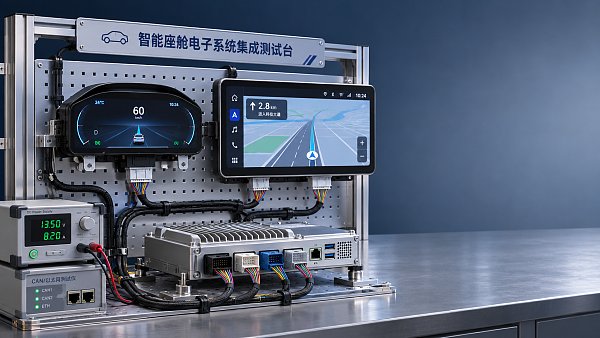
A shared cooling loop is often a reasonable choice when the domain controller and adjacent electronics operate in similar temperature ranges and are installed in the same physical zone. Examples may include a central vehicle computer paired with an infotainment processor, Ethernet switch, telematics module, smart cockpit display controller, or camera-processing electronics. These devices may have different heat profiles, but they generally benefit from coolant temperatures below the levels tolerated by many underhood power components.
In a centralized cockpit or compute enclosure, liquid cooling can be especially attractive where air cooling would require large heat sinks, high fan noise, or difficult duct routing. A shared cold plate and short coolant path can make a dense module arrangement more realistic, particularly as processors, AI accelerators, high-speed communication chips, and memory modules add heat to the same package.
Shared loops also become more appealing when a vehicle already has an established low-temperature cooling circuit. Rather than creating an entirely separate circuit for every controller, engineers can integrate electronics into a managed branch of an existing thermal system, provided that flow and temperature are controllable.
However, “shared” does not have to mean “uncontrolled.” The most successful designs usually share pumps, heat exchangers, reservoirs, or coolant infrastructure while preserving some thermal independence through valves, bypasses, branches, local restrictions, and software-based thermal management.
The First Rule: Design for the Weakest Thermal Link
Domain controllers typically contain high-value semiconductor devices that can tolerate short thermal peaks but may reduce performance, shorten lifetime, or trigger protection strategies when exposed to sustained high temperatures. Their sensitivity is not defined by processor temperature alone. Memory, power-management ICs, connectors, PCB materials, solder joints, and electromagnetic shielding all have their own limits.
If a domain controller shares a loop with another electronic device, the system must be evaluated against the most restrictive component requirement. This includes:
- Maximum coolant inlet temperature at the controller cold plate;
- Allowable coolant temperature rise across the controller;
- Peak and continuous heat rejection under real driving conditions;
- Warm-up behavior after parking in high ambient temperatures;
- Thermal performance during charging, towing, hill climbing, or high-compute ADAS operation;
- Degradation behavior if a pump, valve, chiller, fan, or temperature sensor fails.
One common mistake is to validate the loop at nominal power only. A central compute platform may look comfortable during normal navigation or infotainment use, then face its highest load while the battery loop is also under pressure, the cabin heat pump is active, and the vehicle is moving slowly on a hot day. Thermal architecture must be tested as a system, not as a collection of components with separate laboratory curves.
Not Every Electronic Load Belongs in the Same Circuit
Compatibility depends heavily on what else is connected to the loop. Low-voltage controllers, cockpit electronics, and communication modules may share a circuit with a domain controller relatively easily. Higher-power devices create more difficult trade-offs.
A traction inverter and motor cooling circuit may operate at temperatures that are acceptable for power electronics but too warm for a compute-heavy domain controller. Conversely, an electronics loop optimized for stable low temperatures may impose unnecessary cooling capacity and control complexity on a less temperature-sensitive subsystem.
This is why many new energy vehicle thermal systems use thermal zones rather than one fully common loop. A valve manifold, integrated thermal valve, plate heat exchanger, or chiller connection can allow loops to exchange heat when conditions are favorable while preventing one subsystem from overheating another.
Coolant Temperature Is Only Part of the Story
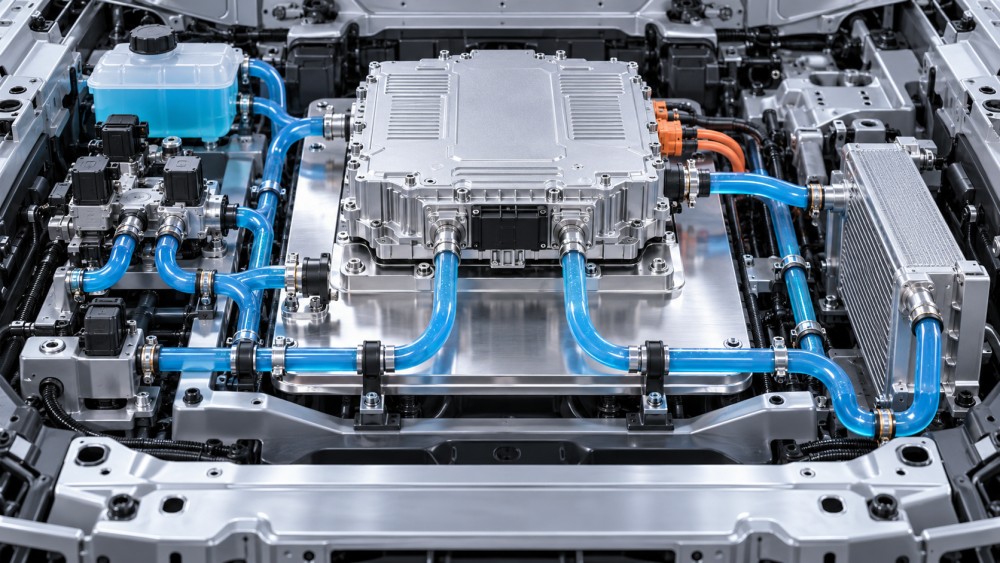
Two loops can show the same average coolant temperature and still perform very differently at the controller. Flow balance, local pressure drop, cold-plate geometry, heat source placement, and coolant distribution determine whether the processor receives stable cooling or develops local hot spots.
For a domain controller, engineers should examine the entire thermal path: silicon junction to package, thermal interface material, heat spreader, cold plate, coolant channel, hose routing, radiator or chiller, and finally ambient air or refrigerant-side heat rejection. A strong radiator cannot compensate for an uneven cold plate, and a high-flow pump cannot fix poor flow distribution between parallel branches.
Parallel branch arrangements are popular because they can give each module cooler inlet fluid. They also require careful hydraulic balancing. If one branch has lower resistance, it may receive more flow while another branch—possibly the domain controller—receives less than expected. Series arrangements are simpler to control but make downstream devices dependent on the heat added by upstream loads. In practice, a controller often belongs near the beginning of a series path or on a prioritized parallel branch.
Prioritization Matters More Than Simple Plumbing
A vehicle thermal management controller should understand which electronic function is most critical at a given moment. During DC fast charging, battery temperature control may take priority. During automated driving operation, the ADAS or central compute controller may need protected cooling capacity. During a parked software update, the thermal demand may be lower, but low-noise and low-energy operation may become more important.
This is where integrated thermal valves and intelligent control logic become valuable. Instead of treating coolant routing as fixed hardware, the vehicle can regulate flow paths according to component temperatures, predicted power demand, ambient conditions, battery state, cabin comfort demand, and fault status. The goal is not merely to keep every module cool; it is to allocate limited cooling capacity intelligently.
For example, a shared electronics loop may use a bypass during cold ambient conditions to help modules reach a stable operating range, then open a radiator branch or refrigerant-assisted chiller path as compute load rises. If another device causes a rapid coolant temperature increase, a valve strategy can protect the domain controller by increasing its flow, isolating a hot branch, or bringing in additional heat-rejection capacity.
Electrical Isolation and Coolant Quality Cannot Be Treated as Secondary Details
When coolant circulates around high-voltage components or densely packed electronics, fluid selection and leak management are central design topics. Conventional water-glycol coolant provides strong heat transfer, but it is electrically conductive enough that leakage, contamination, or insulation breakdown can create serious risks. The risk is especially relevant where high-voltage harnesses, power electronics, connectors, and cooling interfaces share confined packaging space.
A domain controller itself may be low voltage, but it can sit close to high-voltage distribution units, DC/DC converters, electric compressors, or battery-related equipment. The cooling loop must therefore account for insulation monitoring strategy, coolant conductivity limits where relevant, compatible metals and polymers, corrosion inhibitors, contamination control, and service fill procedures.
Cold plates, quick connectors, seals, hose materials, and manifold assemblies must also be compatible with the selected coolant throughout the vehicle’s intended life. Galvanic corrosion is not an abstract laboratory problem: mixed materials, poor grounding assumptions, degraded inhibitor chemistry, and trapped air can gradually change flow or create particles that clog fine coolant channels.
Leak detection should match the consequences of the installation. A small seep near a non-critical auxiliary module is inconvenient; the same leak inside a sealed central compute enclosure can damage electronics before the driver notices anything. Depending on architecture, practical measures may include pressure-decay testing, coolant level monitoring, local humidity or leak sensors, drip guidance, connector placement below sensitive boards, and enclosure drainage paths.
Functional Safety Changes the Decision
For controllers associated with braking coordination, steer-by-wire, ADAS, vehicle motion control, or safety gateways, thermal design must support the intended safety concept. A shared cooling loop introduces common-cause dependencies: one pump failure, blocked channel, stuck valve, radiator obstruction, or coolant loss may affect multiple functions at once.
That does not automatically rule out sharing. It means the architecture must show how the controller remains safe when cooling performance is reduced. Possible approaches include thermal derating, redundant pumps, alternate flow paths, independent temperature sensing, local heat capacity, reduced-compute fallback modes, or separation of safety-critical and comfort-oriented cooling branches.
A central controller should not be allowed to silently throttle until a safety function becomes unreliable. Its software needs credible temperature sensing, diagnostics for sensor plausibility, defined warning thresholds, and coordinated responses across vehicle control domains. In other words, thermal behavior belongs in the functional safety discussion from the beginning—not after mechanical packaging is frozen.
A Practical Architecture Review Before Committing to a Shared Loop
Before approving a common loop, OEMs and suppliers can use a focused review rather than relying on a general assumption that “electronics cooling is electronics cooling.” Start by mapping all heat sources over time, including standby, peak compute, charging, summer soak, winter warm-up, and degraded operation. Then identify the maximum allowed coolant inlet temperature for every module and compare those limits with the temperature delivered by the proposed shared circuit.
Next, evaluate hydraulic behavior at minimum and maximum pump speed. Confirm that the domain controller receives its required flow even when valves switch positions, coolant viscosity changes with temperature, or parallel branches age differently. Simulations are useful, but vehicle-level validation remains essential because airflow through the front-end module, heat-pump operation, grille shutters, and real road loads can alter the result.
Finally, review failure containment. Ask a direct question: if the shared loop is unavailable, which functions degrade, how quickly, and what remains operational? If the answer is unclear, the loop architecture is not mature enough for a safety-critical controller.
The Bottom Line for Automotive Electronics Cooling
Can a domain controller share a cooling loop with other electronics? Yes, and it will become increasingly common as vehicles consolidate compute power and seek more compact thermal systems. But a shared loop should be treated as a controlled thermal network, not a cost-saving shortcut.
The strongest designs separate thermal priorities even when they share hardware. They protect sensitive controllers from hotter loads, balance flow across branches, use intelligent valves and control logic, manage coolant quality, and plan for faults before the vehicle reaches production. For engineers sourcing battery liquid cooling hardware, integrated thermal valves, electric compressor solutions, high-voltage harness interfaces, or central compute cooling assemblies, the key is to evaluate the complete vehicle thermal ecosystem. A domain controller can share the loop—but it should never be asked to share another component’s thermal risk without a clear engineering margin.
Have questions about this sector analysis, or seeking best practices specific to your niche? Drop us a line below and let the senior consultants at GAC assist you.
“We respect your privacy. Your information is strictly confidential.”
Related News
- 00
0000-00
How to assess a smart cockpit electronics manufacturer's integration capability - 00
0000-00
How does a shielded HSD cable reduce interference in vehicles? - 00
0000-00
What drives demand for scroll compressors in the automotive market? - 00
0000-00
Does AEC-Q200 apply to flexible printed circuits? - 00
0000-00
How does production volume affect automotive flexible electronics costs?
Tags
- thermal systems
- electric compressors
- high-voltage harness
- steer-by-wire
- domain controller
- automotive electronics
- domain controllers
- thermal valves
- smart cockpit
- Integrated Thermal Valve
- Thermal Management Controller
- Electric Compressor
- Cockpit Display
- battery liquid cooling
- vehicle thermal management
- vehicle motion control
- smart cockpit display
- Can a domain controller share a cooling loop with other electronics?
Weekly Insights
Stay ahead with our curated technology reports delivered every Monday.
Recommended News
 How to assess a smart cockpit electronics manufacturer's integration capabilityAssess a smart cockpit electronics manufacturer's integration capability with practical checks for interfaces, testing, safety, cybersecurity and supplier support.Author:Time:Nov 18, 2026
 How does a shielded HSD cable reduce interference in vehicles?Discover how a shielded HSD cable reduces vehicle interference, and learn why connector design, routing, and testing matter for reliable high-speed data links.Author:Time:Nov 17, 2026
 What drives demand for scroll compressors in the automotive market?Explore the scroll compressor for automobile market and discover how EV adoption, heat pumps, efficiency, and supplier capabilities shape demand.Author:Time:Nov 16, 2026
 Does AEC-Q200 apply to flexible printed circuits?Flexible Printed Circuit AEC-Q200 requirements explained: discover which components qualify and how to assess automotive FPC reliability.Author:Time:Nov 15, 2026
 How does production volume affect automotive flexible electronics costs?Explore how production volume affects automotive flexible electronics cost, from tooling and yield to testing. Compare quotes and negotiate smarter.Author:Time:Nov 14, 2026
 How much does an in-vehicle infotainment system cost to replace?Explore in-vehicle infotainment cost, from affordable repairs to factory replacements. Compare options, installation fees, and compatibility before you buy.Author:Time:Nov 13, 2026
 How does condenser efficiency affect heat pump performance?Discover how condenser high efficiency can improve heat pump performance, reduce compressor power, and boost heating COP—plus the trade-offs to watch.Author:Time:Nov 12, 2026
 What does each FAKRA cable color code mean?FAKRA cable color code explained: Explore common connector colors, typical uses and key compatibility checks before choosing a replacement.Author:Time:Nov 11, 2026
 How to compare noise ratings for battery coolant pumpsCompare coolant pump low noise ratings with confidence. Learn how test conditions, hydraulic duty, tonal noise and installation affect your choice.Author:Time:Nov 10, 2026
 How bright should automotive display systems be in sunlight?Automotive Display Systems need more than brightness to stay readable in sunlight. Discover why 1,000 nits is a starting point and how to evaluate glare and heat.Author:Time:Nov 09, 2026
 How heat pumps improve the efficiency of EV thermal systemsEV Thermal Systems use heat pumps to reduce heating energy demand. Explore how they work, where they excel, and what limits efficiency in cold weather.Author:Time:Nov 08, 2026
 Can a smart cockpit platform support multiple displays?Can a smart cockpit platform support multiple displays? Explore key requirements for performance, safety, connectivity, and supplier evaluation.Author:Time:Nov 07, 2026
 How is automotive connector vibration resistance tested?Automotive connector vibration resistance testing reveals hidden contact failures. Explore test profiles, continuity monitoring and pass criteria.Author:Time:Nov 06, 2026
 How heat pumps save energy in automotive cabin climate systemsAutomotive Cabin Climate Systems energy saving starts with smarter heat pump design. Explore real-world efficiency, cold-weather trade-offs, and testing tips.Author:Time:Nov 05, 2026
 Is an EV heat pump worth it for winter driving range?Is a heat pump worth using in a cold-climate EV? Discover how it affects winter range, when it pays off, and what to check before buying.Author:Time:Nov 04, 2026
 When should you use 50-ohm coaxial cable instead of 75-ohm?Coaxial cable 50 ohm or 75 ohm? Learn when to use each, avoid impedance mismatches, and choose the right cable for reliable RF and video performance.Author:Time:Nov 03, 2026
 How to select a high temperature motor harness for an EVChoose the right high temperature motor harness for your EV. Compare thermal limits, current capacity, shielding, routing, and validation evidence.Author:Time:Nov 02, 2026
 How much does electric power steering replacement cost?Electric power steering price typically ranges from $1,000 to $3,000 for major replacements. Discover cost factors, repair options, and tips for comparing quotes.Author:Time:Nov 01, 2026
 How to size an EV A/C compressor for the required cooling capacitySize an EV A/C Compressor with confidence. Explore cooling loads, performance maps and power limits to select the right compressor for your vehicle.Author:Time:Oct 31, 2026
 How to choose the right pitch for an FPC board connectorFPC board connector pitch affects space, assembly and reliability. Learn how to compare options and select the best fit for your design.Author:Time:Oct 30, 2026
 How zonal design affects harness routing in high-voltage EV architecturesExplore high-voltage electrical architecture zonal design and its impact on EV harness routing. Discover key trade-offs in cable length, safety, thermal performance, and service access.Author:Time:Oct 29, 2026
 How tariffs affect costs in global automotive parts supply chainsNavigate tariffs in the global automotive parts trade supply chain. Learn to compare landed costs, manage duty exposure, and uncover smarter sourcing strategies to protect your margins.Author:Time:Oct 28, 2026
 How to assess vendor lock-in in a software-defined vehicle platformAssess Software-Defined Vehicle platform lock-in with practical tests for API portability, data access, update control, and exit costs. Learn how to choose a platform with a proven exit path.Author:Time:Oct 27, 2026
 How ISO 26262 guides functional safety in steer-by-wire systemsExplore steering systems functional safety through ISO 26262. Learn how hazard analysis, fault-tolerant design, and validation build a stronger steer-by-wire safety case.Author:Time:Oct 26, 2026
 How to evaluate a steering angle sensor manufacturer's accuracy claimsEvaluate steering angle sensor manufacturer accuracy claims with practical checks on calibration, latency, and test evidence. Compare suppliers confidently and avoid costly selection mistakes.Author:Time:Oct 25, 2026
 How to diagnose CAN bus faults in a hybrid vehicle control unitDiagnose Hybrid Vehicle Systems control unit CAN bus faults with step-by-step power, wiring, and waveform checks. Find the root cause and avoid unnecessary replacement.Author:Time:Oct 24, 2026
 How does battery cooling pipe diameter affect coolant pressure drop?Battery Cooling Pipe diameter affects coolant pressure drop and pump power. Explore sizing calculations and practical tips to optimize EV battery cooling and compare options with confidence.Author:Time:Oct 23, 2026
 How to assess PPAP readiness of automotive sensor system manufacturersAssess Automotive Sensor Systems manufacturers for PPAP readiness. Learn to verify production evidence, measurement capability, validation, and traceability to reduce sourcing risks.Author:Time:Oct 22, 2026
 What to ask an FPC connector manufacturer about reliability testingChoosing an FPC Connector manufacturer? Learn what to ask about reliability testing, failure limits, and traceable results to reduce design risks and select with confidence.Author:Time:Oct 21, 2026
 How to verify vehicle fitment for an aftermarket AC evaporatorNavigating the evaporator aftermarket? Verify vehicle fitment with VIN data, OE numbers, and physical interface checks. Use this guide to avoid costly mismatches and order confidently.Author:Time:Oct 20, 2026