How Often Should an EV Air Conditioning Compressor Be Inspected?




An EV air conditioning compressor should usually receive a basic visual and functional inspection at every scheduled vehicle service, with a more thorough thermal-system inspection about once a year. Vehicles used in very hot climates, dense urban traffic, ride-hailing, delivery work, or long daily routes may justify checks every six months. The owner’s manual and the vehicle manufacturer’s service schedule always take priority, because compressor design, refrigerant type, high-voltage architecture, and diagnostic procedures vary by model.
The question becomes urgent when cabin cooling weakens, the system cycles irregularly, range drops noticeably while A/C is running, or an unfamiliar whine appears during compressor operation. In an EV, the compressor is not simply a comfort component. It can be part of a wider thermal-management system that affects cabin cooling, battery temperature control, heat-pump operation, and high-voltage system reliability. A small leak, contaminated oil, loose connector, or deteriorating insulation issue can become more expensive when left until complete failure.
A practical inspection interval for normal and demanding use
There is no single calendar interval that fits every EV. A sensible service plan separates quick condition checks from deeper diagnostic work. The goal is to identify early changes without opening a sealed refrigerant circuit unnecessarily.
Routine inspection does not mean evacuating and recharging the refrigerant every year. An intact sealed system should not need refrigerant added merely because time has passed. Unnecessary opening of the circuit can introduce moisture, air, debris, or an incompatible lubricant. Service equipment and procedures must match the specific EV refrigerant and oil requirements.
Why electric compressor inspections need a different approach
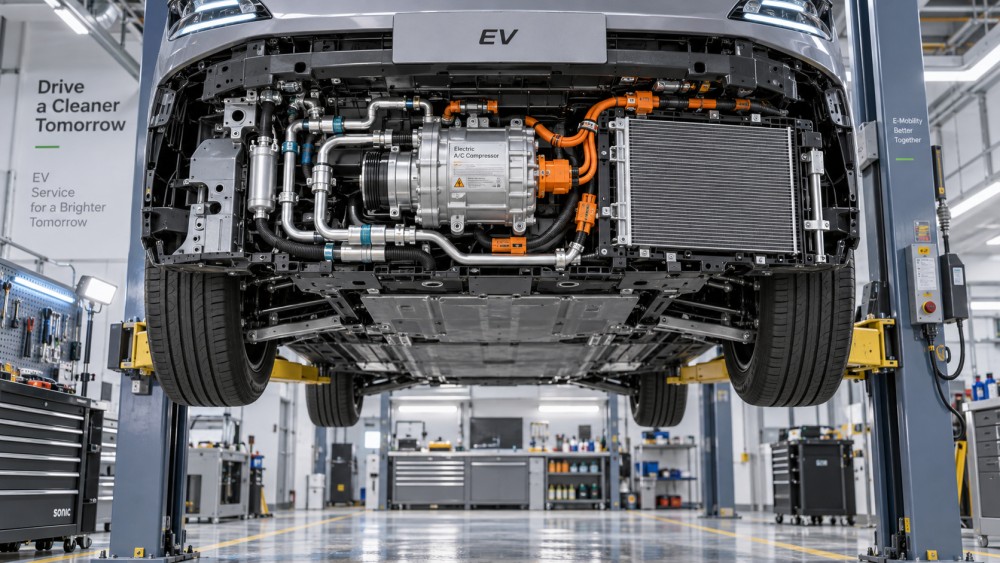
A conventional belt-driven compressor depends on an engine and mechanical drive components. An electric A/C compressor contains an electric motor and often power electronics within or near the compressor assembly. It may operate at high voltage and can continue working when the traction motor is not running. That design changes both failure modes and service precautions.
Technicians need to look beyond cooling performance. The inspection may involve high-voltage interlock circuits, orange cable routing, low-voltage control wiring, connector seals, grounding arrangements where specified, and diagnostic communication. Compressor speed, current demand, pressure behavior, temperature sensor readings, and insulation-related diagnostic information can reveal problems before the cabin feels warm.
Oil handling is especially important. Many electric compressors use a specified electrically insulating lubricant, often a particular type of POE oil. Mixing in oil intended for a conventional system can reduce dielectric properties and may damage the compressor or create electrical leakage concerns. Recovery machines, service hoses, containers, and tools should be managed to prevent cross-contamination between systems using different lubricants or refrigerants.
Start with the symptoms that should move an inspection forward
A scheduled interval is useful, but certain signs justify an earlier inspection. Reduced cooling is the most obvious one, yet it is not the only trigger. Some faults initially appear as inconsistent cooling: cold air at low load, then warmer air after driving, charging, or sitting in traffic. This can point to pressure control issues, condenser airflow problems, sensor errors, thermal derating, or compressor protection logic rather than a simple lack of refrigerant.
- New noise: A smooth electric compressor can produce a faint high-pitched operating sound, but rattling, grinding, knocking, harsh vibration, or a sudden change in tone warrants attention.
- Repeated cooling interruptions: Air that turns warm and then cool again may indicate a control issue, overpressure protection event, temperature-related shutdown, or intermittent electrical connection.
- Fault messages or warning lamps: HVAC, thermal-management, battery, or high-voltage warnings should be read with an appropriate diagnostic tool rather than cleared and ignored.
- Visible traces near fittings: Oily residue around refrigerant lines, service ports, compressor joints, or the condenser can suggest a leak, although confirmation requires proper testing.
- Recent impact or water exposure: Road debris, curb strikes, floodwater, and collision damage can affect wiring, line routing, compressor mounts, and protective shields.
- Unexpected energy use: Increased HVAC energy consumption may have several causes, including extreme weather, but persistent changes alongside weak cooling deserve a system review.
Do not assume a strange A/C symptom is always a compressor failure. A blocked condenser, inoperative cooling fan, faulty pressure sensor, restricted expansion device, damaged harness, poor connector seal, or software-related control issue can create similar symptoms. Replacing the compressor before confirming the root cause risks repeating the failure.
What a useful inspection should actually include
A competent EV A/C inspection begins with vehicle-specific preparation. The technician confirms the refrigerant designation, lubricant specification, service-port arrangement, safety procedures, and whether the climate system shares components with the battery or heat-pump circuit. High-voltage safety procedures, including de-energizing where required by the manufacturer, must be followed before handling high-voltage components or connectors.
1. Record the operating condition before disassembly
The first step is to verify the complaint or establish a baseline. This may include checking ambient conditions, requested cabin temperature, vent temperature trend, compressor command, compressor speed, system pressures where appropriate, and related fault codes. A diagnostic scan can show whether the control unit is commanding the compressor, limiting operation, or detecting an electrical or thermal fault.
Reading live data matters because a system can have adequate refrigerant but still be restricted by an implausible sensor reading or protective strategy. The technician should also determine whether the vehicle is in cooling mode, dehumidification mode, heat-pump operation, or a battery-conditioning event, since these modes can change expected behavior.
2. Inspect the compressor, mounts, lines, and surrounding area
With the system safe to inspect, attention turns to physical condition. The compressor housing should be checked for impact marks, cracks, corrosion, loose mounting hardware, and signs of refrigerant oil. Refrigerant pipes and hoses should be examined for abrasion, kinks, crushed sections, poor retention clips, and contact with sharp edges. On underbody-mounted systems, missing shields can expose components to water and debris.
Condenser condition is also relevant. Bent fins, mud, leaves, road film, or damaged airflow shutters can raise operating pressure and make the compressor work harder. Cleaning must be performed carefully; aggressive tools can flatten fins or damage nearby sensors and wiring.
3. Check electrical connections without treating them as ordinary wiring
Inspect high-voltage connectors for damaged locks, compromised seals, corrosion, heat discoloration, moisture ingress, or strain on the cable. Low-voltage control connectors and harness clips also matter because a loose signal connection can imitate a compressor fault. Any insulation or resistance test must use the manufacturer-approved method and equipment. Applying an unsuitable test voltage to sensitive electronics can cause damage or produce misleading results.
The inspection should include an assessment of compressor mounting and vehicle vibration paths. Repeated vibration can fatigue brackets, loosen fasteners, or stress cables. A noise complaint may originate from a loose shield or mount rather than internal compressor damage.
4. Confirm refrigerant circuit integrity carefully
Leak testing should be based on symptoms, observed residue, pressure behavior, or repair history—not performed casually as a substitute for diagnosis. The approved procedure may involve electronic leak detection, ultraviolet dye where permitted, pressure testing with the correct gas, or vacuum-hold testing after repair. Each method has limitations, so the result should be interpreted with the vehicle’s service procedure.
When recovery or recharge is necessary, the recovered quantity, oil condition, and any debris found can provide useful clues. Metallic particles or unusual contamination may indicate internal compressor damage, but the response should follow the manufacturer’s guidance for flushing, replacing related components, and protecting the replacement unit. Simply fitting a new compressor into a contaminated circuit can lead to a repeat failure.
Inspection frequency should change with how the vehicle is used
An EV operating mainly on short city trips in mild weather may place modest demand on the cooling system. The same vehicle used in hot, stop-and-go traffic can run its compressor frequently to cool the cabin and support thermal management. Long periods of idling are less relevant to an EV than to an internal-combustion vehicle, but low-speed driving still reduces natural airflow through the condenser and can increase fan and compressor workload.
Frequent DC fast charging can also make thermal-system performance more important, even though it does not automatically mean the A/C compressor is faulty or needs replacement sooner. Where the compressor participates in battery cooling, technicians should consider the wider thermal circuit, charging history, ambient temperature, and diagnostic data rather than examining the cabin side alone.
Vehicles parked outdoors near coastal areas or driven on salted roads deserve closer visual checks. Corrosion around connectors, fasteners, and line brackets can develop before cooling output changes. After water intrusion or flood exposure, inspection should not wait for the next annual service because electrical connectors and insulation-related components may be affected.
Owner checks versus professional work
Owners can observe cooling consistency, unusual sound, warning messages, puddles or oily residue, and damage visible from a safe distance. Keeping the condenser area clear of leaves and avoiding direct high-pressure spraying at connectors can also help. However, refrigerant handling, high-voltage connector work, insulation testing, and compressor replacement are not ordinary DIY tasks.
Do not remove orange high-voltage covers, loosen refrigerant fittings, or add aftermarket sealants. Refrigerant can cause injury, incorrect oil can compromise an electric compressor, and sealants may contaminate recovery equipment. A system that is merely blowing warm air may have a simple airflow or sensor issue, but that conclusion requires proper diagnosis.
Questions that often come up during EV A/C service
Does a quiet compressor mean it is healthy?
Not necessarily. Some electric compressors operate very quietly, and electronic or refrigerant-control faults may occur without obvious noise. Stable cooling performance, correct diagnostic readings, sound wiring condition, and absence of leaks provide a better assessment than sound alone.
Should the compressor be inspected before summer only?
A pre-summer performance check is sensible, particularly in hot regions, but it should not replace year-round observation. Heat-pump operation, windshield dehumidification, battery thermal control, and charging-related cooling can use related components outside the summer season.
Can low refrigerant be topped up without finding the leak?
It should not be treated as a routine fix. Refrigerant does not normally get consumed. If the charge is low, the system should be checked for leakage and repaired according to the applicable service procedure before it is recharged.
When is immediate service appropriate?
Arrange prompt diagnosis after a high-voltage or thermal-system warning, sudden loss of cooling combined with abnormal noise, visible damage to refrigerant lines or orange cables, evidence of fluid leakage, collision impact near the front-end thermal pack, or water exposure affecting the underbody or connector areas.
Have questions about this sector analysis, or seeking best practices specific to your niche? Drop us a line below and let the senior consultants at GAC assist you.
“We respect your privacy. Your information is strictly confidential.”
Related News
- 00
0000-00
How to assess a smart cockpit electronics manufacturer's integration capability - 00
0000-00
How does a shielded HSD cable reduce interference in vehicles? - 00
0000-00
What drives demand for scroll compressors in the automotive market? - 00
0000-00
Does AEC-Q200 apply to flexible printed circuits? - 00
0000-00
How does production volume affect automotive flexible electronics costs?
Weekly Insights
Stay ahead with our curated technology reports delivered every Monday.
Recommended News
 How to assess a smart cockpit electronics manufacturer's integration capabilityAssess a smart cockpit electronics manufacturer's integration capability with practical checks for interfaces, testing, safety, cybersecurity and supplier support.Author:Time:Nov 18, 2026
 How does a shielded HSD cable reduce interference in vehicles?Discover how a shielded HSD cable reduces vehicle interference, and learn why connector design, routing, and testing matter for reliable high-speed data links.Author:Time:Nov 17, 2026
 What drives demand for scroll compressors in the automotive market?Explore the scroll compressor for automobile market and discover how EV adoption, heat pumps, efficiency, and supplier capabilities shape demand.Author:Time:Nov 16, 2026
 Does AEC-Q200 apply to flexible printed circuits?Flexible Printed Circuit AEC-Q200 requirements explained: discover which components qualify and how to assess automotive FPC reliability.Author:Time:Nov 15, 2026
 How does production volume affect automotive flexible electronics costs?Explore how production volume affects automotive flexible electronics cost, from tooling and yield to testing. Compare quotes and negotiate smarter.Author:Time:Nov 14, 2026
 How much does an in-vehicle infotainment system cost to replace?Explore in-vehicle infotainment cost, from affordable repairs to factory replacements. Compare options, installation fees, and compatibility before you buy.Author:Time:Nov 13, 2026
 How does condenser efficiency affect heat pump performance?Discover how condenser high efficiency can improve heat pump performance, reduce compressor power, and boost heating COP—plus the trade-offs to watch.Author:Time:Nov 12, 2026
 What does each FAKRA cable color code mean?FAKRA cable color code explained: Explore common connector colors, typical uses and key compatibility checks before choosing a replacement.Author:Time:Nov 11, 2026
 How to compare noise ratings for battery coolant pumpsCompare coolant pump low noise ratings with confidence. Learn how test conditions, hydraulic duty, tonal noise and installation affect your choice.Author:Time:Nov 10, 2026
 How bright should automotive display systems be in sunlight?Automotive Display Systems need more than brightness to stay readable in sunlight. Discover why 1,000 nits is a starting point and how to evaluate glare and heat.Author:Time:Nov 09, 2026
 How heat pumps improve the efficiency of EV thermal systemsEV Thermal Systems use heat pumps to reduce heating energy demand. Explore how they work, where they excel, and what limits efficiency in cold weather.Author:Time:Nov 08, 2026
 Can a smart cockpit platform support multiple displays?Can a smart cockpit platform support multiple displays? Explore key requirements for performance, safety, connectivity, and supplier evaluation.Author:Time:Nov 07, 2026
 How is automotive connector vibration resistance tested?Automotive connector vibration resistance testing reveals hidden contact failures. Explore test profiles, continuity monitoring and pass criteria.Author:Time:Nov 06, 2026
 How heat pumps save energy in automotive cabin climate systemsAutomotive Cabin Climate Systems energy saving starts with smarter heat pump design. Explore real-world efficiency, cold-weather trade-offs, and testing tips.Author:Time:Nov 05, 2026
 Is an EV heat pump worth it for winter driving range?Is a heat pump worth using in a cold-climate EV? Discover how it affects winter range, when it pays off, and what to check before buying.Author:Time:Nov 04, 2026
 When should you use 50-ohm coaxial cable instead of 75-ohm?Coaxial cable 50 ohm or 75 ohm? Learn when to use each, avoid impedance mismatches, and choose the right cable for reliable RF and video performance.Author:Time:Nov 03, 2026
 How to select a high temperature motor harness for an EVChoose the right high temperature motor harness for your EV. Compare thermal limits, current capacity, shielding, routing, and validation evidence.Author:Time:Nov 02, 2026
 How much does electric power steering replacement cost?Electric power steering price typically ranges from $1,000 to $3,000 for major replacements. Discover cost factors, repair options, and tips for comparing quotes.Author:Time:Nov 01, 2026
 How to size an EV A/C compressor for the required cooling capacitySize an EV A/C Compressor with confidence. Explore cooling loads, performance maps and power limits to select the right compressor for your vehicle.Author:Time:Oct 31, 2026
 How to choose the right pitch for an FPC board connectorFPC board connector pitch affects space, assembly and reliability. Learn how to compare options and select the best fit for your design.Author:Time:Oct 30, 2026
 How zonal design affects harness routing in high-voltage EV architecturesExplore high-voltage electrical architecture zonal design and its impact on EV harness routing. Discover key trade-offs in cable length, safety, thermal performance, and service access.Author:Time:Oct 29, 2026
 How tariffs affect costs in global automotive parts supply chainsNavigate tariffs in the global automotive parts trade supply chain. Learn to compare landed costs, manage duty exposure, and uncover smarter sourcing strategies to protect your margins.Author:Time:Oct 28, 2026
 How to assess vendor lock-in in a software-defined vehicle platformAssess Software-Defined Vehicle platform lock-in with practical tests for API portability, data access, update control, and exit costs. Learn how to choose a platform with a proven exit path.Author:Time:Oct 27, 2026
 How ISO 26262 guides functional safety in steer-by-wire systemsExplore steering systems functional safety through ISO 26262. Learn how hazard analysis, fault-tolerant design, and validation build a stronger steer-by-wire safety case.Author:Time:Oct 26, 2026
 How to evaluate a steering angle sensor manufacturer's accuracy claimsEvaluate steering angle sensor manufacturer accuracy claims with practical checks on calibration, latency, and test evidence. Compare suppliers confidently and avoid costly selection mistakes.Author:Time:Oct 25, 2026
 How to diagnose CAN bus faults in a hybrid vehicle control unitDiagnose Hybrid Vehicle Systems control unit CAN bus faults with step-by-step power, wiring, and waveform checks. Find the root cause and avoid unnecessary replacement.Author:Time:Oct 24, 2026
 How does battery cooling pipe diameter affect coolant pressure drop?Battery Cooling Pipe diameter affects coolant pressure drop and pump power. Explore sizing calculations and practical tips to optimize EV battery cooling and compare options with confidence.Author:Time:Oct 23, 2026
 How to assess PPAP readiness of automotive sensor system manufacturersAssess Automotive Sensor Systems manufacturers for PPAP readiness. Learn to verify production evidence, measurement capability, validation, and traceability to reduce sourcing risks.Author:Time:Oct 22, 2026
 What to ask an FPC connector manufacturer about reliability testingChoosing an FPC Connector manufacturer? Learn what to ask about reliability testing, failure limits, and traceable results to reduce design risks and select with confidence.Author:Time:Oct 21, 2026
 How to verify vehicle fitment for an aftermarket AC evaporatorNavigating the evaporator aftermarket? Verify vehicle fitment with VIN data, OE numbers, and physical interface checks. Use this guide to avoid costly mismatches and order confidently.Author:Time:Oct 20, 2026