How EV adoption shapes the electrically driven compressor market




EV adoption expands the electrically driven compressor market by changing both the source of demand and the work a compressor must perform. Battery-electric vehicles need air conditioning without an engine-driven belt, while many hybrid platforms need cooling when the engine is off. On vehicles with integrated thermal management, the same compressor can also support battery cooling and heat pump heating. This creates opportunities beyond replacing a conventional air-conditioning component.
Demand growth, however, does not automatically translate into stronger supplier margins. Vehicle production volumes, thermal architecture, qualification requirements, and pricing all affect the commercial outcome. A useful market assessment separates three questions: how many vehicles need an electric compressor, what specification each platform requires, and which suppliers can deliver that specification profitably.
EV sales create demand, but powertrain mix determines its scale
A conventional automotive air-conditioning compressor is commonly driven mechanically by the engine. An electric compressor uses an electric motor, allowing operation independently of engine speed. That independence is essential in battery-electric vehicles and useful in hybrids that regularly switch off their engines.
The distinction matters when interpreting electrification forecasts. Battery-electric vehicle production provides a relatively direct demand signal for automotive electric compressors. Plug-in hybrids also create opportunities because cabin cooling must remain available during electric driving. Full hybrids can use electric compressors to maintain comfort during engine-off operation, but equipment choices depend on the platform. Mild-hybrid growth should not automatically be treated as equivalent compressor demand.
Broad “electrified vehicle” totals can therefore overstate the addressable market if they combine architectures with different requirements. A stronger forecast connects expected vehicle output to the compressor configuration used on each platform.
Timing also matters. A platform announcement is an early signal; a supplier nomination indicates a more concrete opportunity; sustained vehicle production supports recurring demand. Treating all three as equivalent can inflate near-term revenue expectations.
The compressor becomes part of a wider thermal system
In an EV, cabin comfort and battery temperature management draw on the same limited energy supply. The compressor’s role can consequently extend beyond cooling passengers. In systems with a refrigerant-to-coolant chiller, the refrigerant circuit helps remove heat from battery coolant when ambient cooling alone is insufficient.
This does not mean every liquid-cooled battery needs compressor-assisted cooling at all times. Cooling requirements depend on ambient temperature, battery heat generation, charging conditions, and system design. During demanding operation or fast charging, however, the ability to provide active cooling can influence how the vehicle manages battery temperature and charging performance.
A heat pump adds another operating role. It uses a refrigerant cycle to move heat into the cabin, with the compressor supplying the work that makes this possible. Some architectures can also recover heat from vehicle components. The commercial consequence is a broader specification: the compressor may need to perform across cooling and heating conditions, variable pressure ratios, and changing combinations of thermal demand.
More thermal functions do not necessarily mean more compressors per vehicle. An integrated system may use one compressor with valves, heat exchangers, and controls to serve several functions. The opportunity can appear as greater technical content and integration responsibility per unit, rather than a proportional increase in unit count.
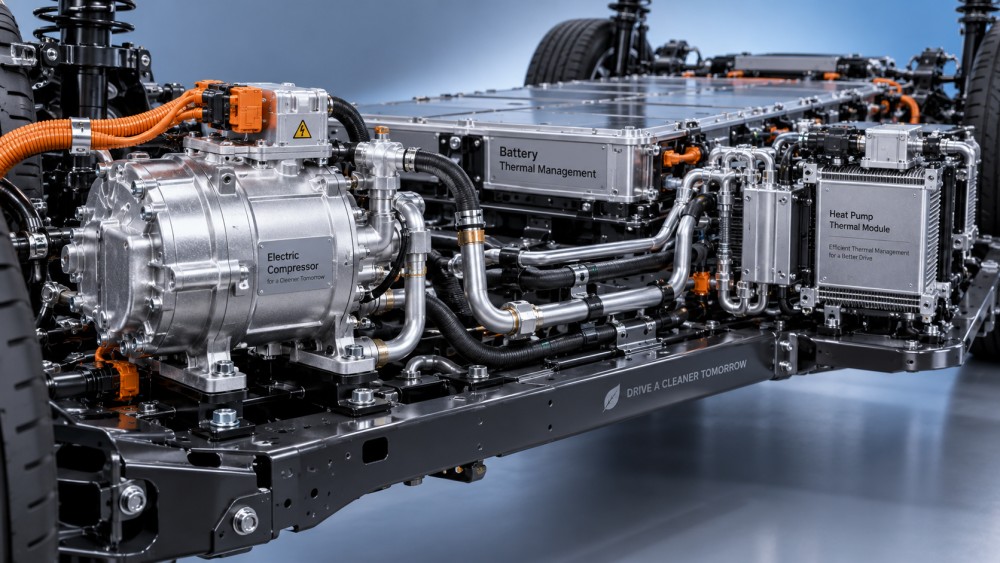
This distinction is important when estimating market value. Compressor revenue, heat pump system revenue, and complete thermal management revenue cover different product boundaries. Adding forecasts with overlapping boundaries can count the same hardware more than once.
Efficiency gains matter only within the vehicle’s operating conditions
Electric compressor efficiency matters because thermal management consumes battery energy. Yet a single efficiency figure provides a weak basis for comparing commercial opportunities. A unit that performs well at one cooling condition may be less effective at low speed, under high thermal load, or during cold-weather heating.
The useful comparison is an operating map: how much heating or cooling the system delivers, how much electrical power it draws, and how performance changes across expected conditions. Motor efficiency, inverter losses, compression performance, and control strategy all contribute to the result.
Vehicle use changes the value of these characteristics. A passenger vehicle in a hot climate may place greater emphasis on cabin pull-down and sustained cooling. A vehicle designed for frequent fast charging may require stronger support for battery cooling. Cold-weather operation places greater importance on heat pump performance and the interaction with supplemental heating.
These priorities create room for differentiated products, but they also limit universal claims. A premium compressor offers commercial value when its capabilities solve a platform requirement. Extra capability that the vehicle rarely uses may be difficult to justify under price pressure.
Noise and vibration deserve similar attention. Without continuous engine noise, compressor tones can become more noticeable, particularly when the vehicle is stationary. Acoustic performance therefore depends on speed control, mounting, refrigerant pulsation, and vehicle integration as well as the compressor itself.
High-voltage architecture changes supplier requirements
Electric compressors combine mechanical compression with motors, power electronics, and electronic controls. That combination broadens the capabilities needed to compete. Mechanical durability remains necessary, but electrical insulation, electromagnetic compatibility, inverter thermal management, diagnostics, and communication interfaces also influence platform suitability.
Higher-voltage vehicle architectures introduce another source of differentiation. A compressor must match the vehicle’s actual voltage range and electrical environment. Compatibility involves more than a nominal voltage label: connectors, insulation design, power electronics, protection functions, and control integration must work together.
A higher-voltage platform does not automatically require greater cooling capacity. Voltage compatibility and thermal output are separate specification questions. Confusing them can lead to misleading assumptions about product value or development cost.
Refrigerant choice adds another layer. Operating pressures, lubricant compatibility, sealing requirements, and compressor design can vary with the refrigerant. Moving between refrigerant systems is not simply a matter of changing the charge. Regional requirements and vehicle architecture can therefore divide the market into product families that are not directly interchangeable.
For an established mechanical compressor manufacturer, entering this market may require substantial capability development or partnerships. For an electric compressor specialist, the challenge is translating technical competence into repeatable automotive production, durable field performance, and competitive cost.
Regional opportunities depend on production location and sourcing strategy
The regional opportunity follows vehicle manufacturing and supplier access more closely than consumer registrations alone. Vehicles sold in one country may be assembled elsewhere, with compressors sourced through an established global platform contract. A large EV sales market therefore does not automatically provide an equally accessible market for local compressor suppliers.
China, Europe, North America, and other automotive manufacturing regions should be assessed through their platform pipelines, thermal specifications, and sourcing structures. The relevant questions concern where vehicles will be assembled, which suppliers already hold nominations, and whether new programs allow alternative sourcing.
Localization can change the competitive position. Nearby production may reduce logistics exposure, simplify engineering support, and improve response during a launch. Those benefits must be weighed against factory utilization, local component availability, and the cost of maintaining consistent quality across sites.
Export opportunities also depend on integration support. A competitively priced compressor can still be difficult to adopt if documentation, calibration assistance, warranty handling, or engineering response is inadequate. Automotive customers need a component that works within their development and production processes, as well as one that meets a specification sheet.
Regional differences in climate, charging use, vehicle size, and heat pump adoption can further change the product mix. Market comparisons become more useful when they distinguish basic cooling applications from demanding integrated thermal systems.
Growing volumes can coexist with difficult supplier economics
The electrically driven compressor market can expand while individual suppliers face margin pressure. As designs mature and competing products become available, customers may seek lower prices, common components, and simpler integration. A technically demanding product is not automatically protected from cost competition.
At the same time, automotive qualification and development absorb resources before meaningful production revenue arrives. Validation, tooling, software integration, launch support, and manufacturing preparation can all create costs ahead of volume. Delayed vehicle launches or production below expectations weaken the economics of those commitments.
A platform award is therefore more informative when considered alongside its expected volume range, pricing terms, engineering obligations, and investment requirements. Dedicated capacity creates greater exposure when it has limited use outside one program. A flexible product family may spread development and manufacturing costs across several platforms, although each application can still require validation.
Integrated thermal modules can also shift who captures value. When a system supplier packages the compressor with valves, heat exchangers, and controls, it may gain more influence over component selection. A compressor producer can access broader demand through that relationship while accepting a different level of pricing power and customer visibility.
The aftermarket usually develops on a different timeline. New EV production creates original-equipment demand immediately, while replacement demand depends on the installed fleet, vehicle age, repair practices, and warranty arrangements. Service access also requires attention to high-voltage handling, lubricant compatibility, and diagnostic procedures. It should be evaluated as a separate channel.
Build the market case around platforms and commercial exposure
A practical evaluation begins with named vehicle programs and confirmed thermal requirements. Broad adoption trends establish direction; platform details determine the reachable opportunity. The following sequence helps connect those two levels:
- Define the product boundary. Distinguish automotive electric compressors from industrial compressors and separate component revenue from complete thermal system revenue.
- Map actual fitment. Identify powertrain type, compressor count, heat pump use, battery cooling arrangement, refrigerant, and electrical architecture.
- Assess supplier access. Examine nominations, qualification progress, integration capability, production readiness, and regional support.
- Test the economics under different volumes. Include price pressure, launch delays, capacity utilization, engineering costs, and warranty exposure.
- Track evidence that changes the outlook. Production starts, sourcing changes, platform revisions, and localization decisions carry more commercial weight than general expansion announcements.
GACT’s coverage of electric compressors, heat pumps, battery liquid cooling, integrated thermal valves, and high-voltage harnesses can help connect component developments with the wider vehicle architecture. Reading these categories together supports a clearer view of whether a technology update expands compressor demand, changes specifications, or shifts value toward an integrated system supplier.
The strongest opportunity combines a growing set of vehicle applications with specifications that a supplier can meet at sustainable cost. Before committing to a market estimate, identify the platforms behind it, the thermal functions their compressors must support, and the commercial terms under which those units will reach production.
Have questions about this sector analysis, or seeking best practices specific to your niche? Drop us a line below and let the senior consultants at GAC assist you.
“We respect your privacy. Your information is strictly confidential.”
Related News
- 00
0000-00
How to assess a smart cockpit electronics manufacturer's integration capability - 00
0000-00
How does a shielded HSD cable reduce interference in vehicles? - 00
0000-00
What drives demand for scroll compressors in the automotive market? - 00
0000-00
Does AEC-Q200 apply to flexible printed circuits? - 00
0000-00
How does production volume affect automotive flexible electronics costs?
Weekly Insights
Stay ahead with our curated technology reports delivered every Monday.
Recommended News
 How to assess a smart cockpit electronics manufacturer's integration capabilityAssess a smart cockpit electronics manufacturer's integration capability with practical checks for interfaces, testing, safety, cybersecurity and supplier support.Author:Time:Nov 18, 2026
 How does a shielded HSD cable reduce interference in vehicles?Discover how a shielded HSD cable reduces vehicle interference, and learn why connector design, routing, and testing matter for reliable high-speed data links.Author:Time:Nov 17, 2026
 What drives demand for scroll compressors in the automotive market?Explore the scroll compressor for automobile market and discover how EV adoption, heat pumps, efficiency, and supplier capabilities shape demand.Author:Time:Nov 16, 2026
 Does AEC-Q200 apply to flexible printed circuits?Flexible Printed Circuit AEC-Q200 requirements explained: discover which components qualify and how to assess automotive FPC reliability.Author:Time:Nov 15, 2026
 How does production volume affect automotive flexible electronics costs?Explore how production volume affects automotive flexible electronics cost, from tooling and yield to testing. Compare quotes and negotiate smarter.Author:Time:Nov 14, 2026
 How much does an in-vehicle infotainment system cost to replace?Explore in-vehicle infotainment cost, from affordable repairs to factory replacements. Compare options, installation fees, and compatibility before you buy.Author:Time:Nov 13, 2026
 How does condenser efficiency affect heat pump performance?Discover how condenser high efficiency can improve heat pump performance, reduce compressor power, and boost heating COP—plus the trade-offs to watch.Author:Time:Nov 12, 2026
 What does each FAKRA cable color code mean?FAKRA cable color code explained: Explore common connector colors, typical uses and key compatibility checks before choosing a replacement.Author:Time:Nov 11, 2026
 How to compare noise ratings for battery coolant pumpsCompare coolant pump low noise ratings with confidence. Learn how test conditions, hydraulic duty, tonal noise and installation affect your choice.Author:Time:Nov 10, 2026
 How bright should automotive display systems be in sunlight?Automotive Display Systems need more than brightness to stay readable in sunlight. Discover why 1,000 nits is a starting point and how to evaluate glare and heat.Author:Time:Nov 09, 2026
 How heat pumps improve the efficiency of EV thermal systemsEV Thermal Systems use heat pumps to reduce heating energy demand. Explore how they work, where they excel, and what limits efficiency in cold weather.Author:Time:Nov 08, 2026
 Can a smart cockpit platform support multiple displays?Can a smart cockpit platform support multiple displays? Explore key requirements for performance, safety, connectivity, and supplier evaluation.Author:Time:Nov 07, 2026
 How is automotive connector vibration resistance tested?Automotive connector vibration resistance testing reveals hidden contact failures. Explore test profiles, continuity monitoring and pass criteria.Author:Time:Nov 06, 2026
 How heat pumps save energy in automotive cabin climate systemsAutomotive Cabin Climate Systems energy saving starts with smarter heat pump design. Explore real-world efficiency, cold-weather trade-offs, and testing tips.Author:Time:Nov 05, 2026
 Is an EV heat pump worth it for winter driving range?Is a heat pump worth using in a cold-climate EV? Discover how it affects winter range, when it pays off, and what to check before buying.Author:Time:Nov 04, 2026
 When should you use 50-ohm coaxial cable instead of 75-ohm?Coaxial cable 50 ohm or 75 ohm? Learn when to use each, avoid impedance mismatches, and choose the right cable for reliable RF and video performance.Author:Time:Nov 03, 2026
 How to select a high temperature motor harness for an EVChoose the right high temperature motor harness for your EV. Compare thermal limits, current capacity, shielding, routing, and validation evidence.Author:Time:Nov 02, 2026
 How much does electric power steering replacement cost?Electric power steering price typically ranges from $1,000 to $3,000 for major replacements. Discover cost factors, repair options, and tips for comparing quotes.Author:Time:Nov 01, 2026
 How to size an EV A/C compressor for the required cooling capacitySize an EV A/C Compressor with confidence. Explore cooling loads, performance maps and power limits to select the right compressor for your vehicle.Author:Time:Oct 31, 2026
 How to choose the right pitch for an FPC board connectorFPC board connector pitch affects space, assembly and reliability. Learn how to compare options and select the best fit for your design.Author:Time:Oct 30, 2026
 How zonal design affects harness routing in high-voltage EV architecturesExplore high-voltage electrical architecture zonal design and its impact on EV harness routing. Discover key trade-offs in cable length, safety, thermal performance, and service access.Author:Time:Oct 29, 2026
 How tariffs affect costs in global automotive parts supply chainsNavigate tariffs in the global automotive parts trade supply chain. Learn to compare landed costs, manage duty exposure, and uncover smarter sourcing strategies to protect your margins.Author:Time:Oct 28, 2026
 How to assess vendor lock-in in a software-defined vehicle platformAssess Software-Defined Vehicle platform lock-in with practical tests for API portability, data access, update control, and exit costs. Learn how to choose a platform with a proven exit path.Author:Time:Oct 27, 2026
 How ISO 26262 guides functional safety in steer-by-wire systemsExplore steering systems functional safety through ISO 26262. Learn how hazard analysis, fault-tolerant design, and validation build a stronger steer-by-wire safety case.Author:Time:Oct 26, 2026
 How to evaluate a steering angle sensor manufacturer's accuracy claimsEvaluate steering angle sensor manufacturer accuracy claims with practical checks on calibration, latency, and test evidence. Compare suppliers confidently and avoid costly selection mistakes.Author:Time:Oct 25, 2026
 How to diagnose CAN bus faults in a hybrid vehicle control unitDiagnose Hybrid Vehicle Systems control unit CAN bus faults with step-by-step power, wiring, and waveform checks. Find the root cause and avoid unnecessary replacement.Author:Time:Oct 24, 2026
 How does battery cooling pipe diameter affect coolant pressure drop?Battery Cooling Pipe diameter affects coolant pressure drop and pump power. Explore sizing calculations and practical tips to optimize EV battery cooling and compare options with confidence.Author:Time:Oct 23, 2026
 How to assess PPAP readiness of automotive sensor system manufacturersAssess Automotive Sensor Systems manufacturers for PPAP readiness. Learn to verify production evidence, measurement capability, validation, and traceability to reduce sourcing risks.Author:Time:Oct 22, 2026
 What to ask an FPC connector manufacturer about reliability testingChoosing an FPC Connector manufacturer? Learn what to ask about reliability testing, failure limits, and traceable results to reduce design risks and select with confidence.Author:Time:Oct 21, 2026
 How to verify vehicle fitment for an aftermarket AC evaporatorNavigating the evaporator aftermarket? Verify vehicle fitment with VIN data, OE numbers, and physical interface checks. Use this guide to avoid costly mismatches and order confidently.Author:Time:Oct 20, 2026