How ISO 26262 guides functional safety in steer-by-wire systems




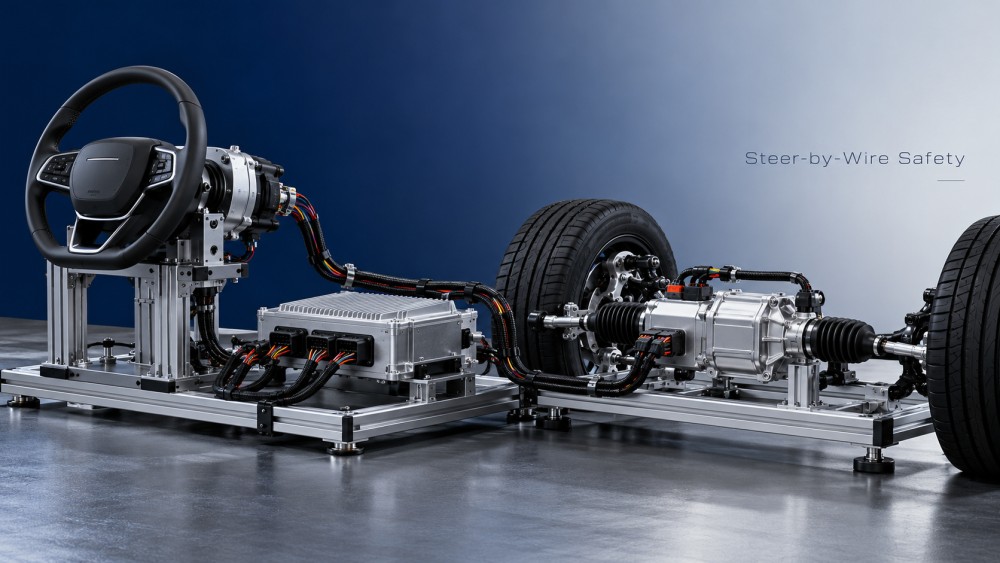
ISO 26262 guides steer-by-wire development by turning vehicle hazards into safety requirements, architectural decisions, and evidence that those requirements have been met. For a system without a continuous mechanical connection between the handwheel and road wheels, that process must address a difficult question: what steering capability remains available when an electrical or electronic fault occurs?
A credible safety argument therefore needs more than redundant sensors, two controllers, or an ASIL claim on a component datasheet. It must show how the complete steering function behaves after relevant faults, how quickly those faults are controlled, and whether the vehicle can remain controllable throughout the response. Quality and safety teams should assess ISO 26262 evidence against the intended vehicle application, operating conditions, and system boundaries.
The standard provides a functional safety lifecycle for safety-related electrical and electronic systems. It does not prescribe one steer-by-wire architecture or establish a universal rule that every steering fault must trigger shutdown. Its practical value lies in connecting hazard analysis, engineering decisions, verification, and release approval through traceable requirements.
Start with the vehicle hazard, then determine the required integrity
The first consequential decision is the item definition: what functions the steering system provides, where its boundaries lie, and which external systems it depends on. A steer-by-wire item may include handwheel sensing, steering feedback, road-wheel actuation, controllers, communications, and power interfaces. The exact boundary depends on the development arrangement, but responsibilities outside that boundary still need explicit treatment.
Interfaces can carry safety assumptions that are easy to overlook. A steering controller may depend on vehicle speed from another controller, electrical energy from a shared distribution system, or commands from an automated driving function. If those inputs become unavailable, incorrect, or delayed, the steering system needs a defined response. Calling an interface “external” does not resolve the associated vehicle hazard.
Hazard analysis and risk assessment, or HARA, examines hazardous events in operating situations and evaluates severity, exposure, and controllability. Relevant malfunctions can include unintended steering, loss of steering capability, excessive delay, or an incorrect relationship between handwheel input and road-wheel response. Their consequences depend on circumstances such as vehicle speed, road curvature, and the driver’s opportunity to intervene.
This is why “steer-by-wire is ASIL D” is an incomplete statement. ASILs are assigned to safety goals arising from hazardous events and carried into derived safety requirements. A severe steering hazard may lead to a high-integrity safety goal, but the allocation must follow the item-specific analysis. Different functions and requirements within the same system can have different classifications when the justification supports them.
For reviewers, the useful question is whether each safety goal follows convincingly from the identified hazard. A goal addressing unintended road-wheel movement, for example, needs requirements that control erroneous actuation. A goal addressing loss of steering needs requirements for preserving or recovering the necessary steering capability. Treating these as one generic “steering failure” can conceal different detection and mitigation needs.
Define what safe steering means after a fault
Steer-by-wire makes the definition of a safe state especially important. Removing electrical power may stop an unintended motor command, yet also remove the vehicle’s ability to change direction. A response that is acceptable when stationary may be unacceptable during a high-speed curve. Safety concepts must therefore describe behavior in relevant operating conditions, including transitions into degraded operation.
Where the hazard analysis demands continued steering capability, the architecture must support it for the required duration and conditions. This is often discussed as fail-operational behavior. The phrase needs a precise definition: which function remains available, with what performance, after which faults, and for how long? Continued operation could involve reduced assistance, restricted steering performance, or another justified degradation, depending on the vehicle concept.
Driver intervention also requires evidence. A warning cannot be credited as an effective mitigation simply because it is displayed. The safety analysis must consider whether the driver can recognize the condition, understand the required action, and maintain control within the available time. In vehicles with automated driving functions, the allocation of control during a steering fault introduces additional interface and transition requirements.
Timing connects these behavioral requirements to engineering limits. The fault tolerant time interval establishes how long a fault can exist before a hazardous event may occur without an effective safety mechanism. Detection, decision-making, communication, and actuation must fit within the relevant timing budget. A diagnostic that eventually identifies a failure can still be inadequate if hazardous wheel movement develops first.
Quality teams should look for timing evidence under demanding conditions: high processor load, degraded communications, power disturbances, and transitions between operating modes. Average response time alone provides weak support for a safety requirement with a strict maximum. The analysis and tests need to address the conditions that determine whether the safety response arrives in time.
Redundancy must survive shared causes and credible fault combinations
ISO 26262 helps structure the analysis of whether an architecture can achieve its safety goals. It does not make a duplicated architecture safe by definition. Two steering channels may share a power source, connector, clock, communication path, or software defect. A single shared dependency can undermine the intended benefit of duplication.
Consider two road-wheel control channels supplied through one vulnerable power connection. Their controllers may operate independently, but loss of that connection can disable both. Similarly, two angle sensors can agree while reporting an incorrect value if a common mechanical or electrical cause affects them together. Agreement between channels is useful evidence only within the assumptions of the diagnostic design.
Dependent failure analysis examines how common causes and cascading failures can defeat safety mechanisms or nominally independent elements. Freedom from interference matters where functions share computing, memory, communication, or other resources. A lower-integrity function must not be able to compromise a higher-integrity safety requirement through uncontrolled resource use or data corruption.
The same scrutiny applies to ASIL decomposition. Decomposition allows an initial safety requirement to be allocated to redundant requirements under defined conditions, including sufficient independence. It requires a justified architecture and supporting analysis. Purchasing two components with lower ASIL claims does not, by itself, establish that a higher-level safety requirement has been satisfied.
Hardware assessment also distinguishes random hardware failures from systematic faults. Architectural metrics, diagnostic coverage, and probabilistic analyses address particular aspects of random hardware failure risk. They do not demonstrate that control software is correct or that requirements capture every relevant hazardous behavior. Systematic failures require disciplined development, reviews, verification, configuration control, and change management across the lifecycle.
A useful design review follows individual faults through the complete response. If one steering-angle signal becomes stuck, how is it detected? Which information remains trustworthy? Can arbitration reject the failed source without producing a sudden command change? If a backup channel contains an undetected fault, when would that condition be discovered? These questions expose gaps that a block diagram alone cannot show.
Require evidence that follows the safety requirement across supplier boundaries
For steering systems functional safety, the decisive evidence is a connected chain from hazard to validated vehicle behavior. Each important safety requirement should link to its implementation, verification method, result, and unresolved limitations. Traceability makes it possible to assess whether a requirement is genuinely covered and whether a later change invalidates earlier evidence.
The functional safety concept describes how safety goals will be achieved at a functional level. The technical safety concept develops the technical requirements and allocation across the architecture. Hardware and software development then provide implementation evidence, while integration testing and vehicle-level safety validation establish whether the intended behavior has been achieved in the relevant context.
Verification and validation answer different questions. Verification checks whether a work product satisfies its specified requirements. Safety validation evaluates whether the safety goals are appropriate and achieved for the intended use. Passing controller tests cannot establish vehicle controllability if the assumed steering loads, vehicle dynamics, power behavior, or driver responses differ from those in the vehicle application.
Fault injection is particularly useful when tied to explicit safety requirements. Relevant campaigns may examine corrupted sensor values, communication loss or delay, controller resets, actuator faults, and power disturbances. The test set should follow the safety analyses and architecture. A large number of injected faults has limited meaning unless the results demonstrate detection, isolation, degraded operation, and timing against acceptance criteria.
Evidence should also cover recovery. Switching to a backup channel can create a transient command discontinuity, and restoring normal operation can introduce another. Repeated resets or intermittent faults may produce behavior that a single permanent-fault test misses. Whether recovery is allowed, inhibited, or conditional should be specified and verified.
Supplier responsibilities need equivalent precision. An OEM, steering system integrator, controller supplier, sensor supplier, and semiconductor supplier may each own part of the evidence. A development interface agreement should establish who performs the analyses, who verifies interface assumptions, what work products are exchanged, and who resolves safety-related changes and anomalies.
Components developed as safety elements out of context require particular care. Their safety documentation contains assumptions about the application, external diagnostics, operating conditions, and integration. The receiving team must establish that those assumptions hold in the steering system. A component’s safety manual is therefore an integration input, with obligations that need owners and verification.
Before accepting a release package, quality and safety managers can focus their review on a few consequential questions:
- Can each safety goal be traced to the relevant vehicle hazards, technical requirements, and validation results?
- Does the evidence demonstrate the specified steering behavior after faults, including response timing and degraded operating limits?
- Have shared dependencies, latent faults, and supplier assumptions been addressed at system level?
- Are outstanding anomalies assessed against safety requirements, with release decisions supported by documented reasoning?
- Do production controls and change procedures preserve the configuration and characteristics used in the safety argument?
ISO 26262 also extends attention beyond development completion. Production, operation, service, and decommissioning requirements matter where they affect functional safety. Manufacturing tests may need to verify safety-relevant assembly characteristics or diagnostic functions. Replacement parts, calibration changes, and software updates require impact analysis when they can affect assumptions or validated behavior.
A process assessment, product assessment, or certificate can support confidence within its stated scope. Its value depends on what was assessed, which configuration was covered, and what conditions apply. ISO 26262 conformity does not by itself establish compliance with every applicable vehicle approval requirement, nor does it cover every safety concern associated with steering. Cybersecurity and hazards from intended functionality need their own appropriate treatment and coordination.
The release decision ultimately rests on a vehicle-specific safety argument. For steer-by-wire, that argument should make the failure response understandable: the fault occurs, the system detects or tolerates it, steering remains within defined limits, and the vehicle reaches the justified operating condition within the available time. Any break in that chain identifies a concrete engineering or evidence gap to resolve before release.
Have questions about this sector analysis, or seeking best practices specific to your niche? Drop us a line below and let the senior consultants at GAC assist you.
“We respect your privacy. Your information is strictly confidential.”
Related News
- 00
0000-00
How to assess a smart cockpit electronics manufacturer's integration capability - 00
0000-00
How does a shielded HSD cable reduce interference in vehicles? - 00
0000-00
What drives demand for scroll compressors in the automotive market? - 00
0000-00
Does AEC-Q200 apply to flexible printed circuits? - 00
0000-00
How does production volume affect automotive flexible electronics costs?
Weekly Insights
Stay ahead with our curated technology reports delivered every Monday.
Recommended News
 How to assess a smart cockpit electronics manufacturer's integration capabilityAssess a smart cockpit electronics manufacturer's integration capability with practical checks for interfaces, testing, safety, cybersecurity and supplier support.Author:Time:Nov 18, 2026
 How does a shielded HSD cable reduce interference in vehicles?Discover how a shielded HSD cable reduces vehicle interference, and learn why connector design, routing, and testing matter for reliable high-speed data links.Author:Time:Nov 17, 2026
 What drives demand for scroll compressors in the automotive market?Explore the scroll compressor for automobile market and discover how EV adoption, heat pumps, efficiency, and supplier capabilities shape demand.Author:Time:Nov 16, 2026
 Does AEC-Q200 apply to flexible printed circuits?Flexible Printed Circuit AEC-Q200 requirements explained: discover which components qualify and how to assess automotive FPC reliability.Author:Time:Nov 15, 2026
 How does production volume affect automotive flexible electronics costs?Explore how production volume affects automotive flexible electronics cost, from tooling and yield to testing. Compare quotes and negotiate smarter.Author:Time:Nov 14, 2026
 How much does an in-vehicle infotainment system cost to replace?Explore in-vehicle infotainment cost, from affordable repairs to factory replacements. Compare options, installation fees, and compatibility before you buy.Author:Time:Nov 13, 2026
 How does condenser efficiency affect heat pump performance?Discover how condenser high efficiency can improve heat pump performance, reduce compressor power, and boost heating COP—plus the trade-offs to watch.Author:Time:Nov 12, 2026
 What does each FAKRA cable color code mean?FAKRA cable color code explained: Explore common connector colors, typical uses and key compatibility checks before choosing a replacement.Author:Time:Nov 11, 2026
 How to compare noise ratings for battery coolant pumpsCompare coolant pump low noise ratings with confidence. Learn how test conditions, hydraulic duty, tonal noise and installation affect your choice.Author:Time:Nov 10, 2026
 How bright should automotive display systems be in sunlight?Automotive Display Systems need more than brightness to stay readable in sunlight. Discover why 1,000 nits is a starting point and how to evaluate glare and heat.Author:Time:Nov 09, 2026
 How heat pumps improve the efficiency of EV thermal systemsEV Thermal Systems use heat pumps to reduce heating energy demand. Explore how they work, where they excel, and what limits efficiency in cold weather.Author:Time:Nov 08, 2026
 Can a smart cockpit platform support multiple displays?Can a smart cockpit platform support multiple displays? Explore key requirements for performance, safety, connectivity, and supplier evaluation.Author:Time:Nov 07, 2026
 How is automotive connector vibration resistance tested?Automotive connector vibration resistance testing reveals hidden contact failures. Explore test profiles, continuity monitoring and pass criteria.Author:Time:Nov 06, 2026
 How heat pumps save energy in automotive cabin climate systemsAutomotive Cabin Climate Systems energy saving starts with smarter heat pump design. Explore real-world efficiency, cold-weather trade-offs, and testing tips.Author:Time:Nov 05, 2026
 Is an EV heat pump worth it for winter driving range?Is a heat pump worth using in a cold-climate EV? Discover how it affects winter range, when it pays off, and what to check before buying.Author:Time:Nov 04, 2026
 When should you use 50-ohm coaxial cable instead of 75-ohm?Coaxial cable 50 ohm or 75 ohm? Learn when to use each, avoid impedance mismatches, and choose the right cable for reliable RF and video performance.Author:Time:Nov 03, 2026
 How to select a high temperature motor harness for an EVChoose the right high temperature motor harness for your EV. Compare thermal limits, current capacity, shielding, routing, and validation evidence.Author:Time:Nov 02, 2026
 How much does electric power steering replacement cost?Electric power steering price typically ranges from $1,000 to $3,000 for major replacements. Discover cost factors, repair options, and tips for comparing quotes.Author:Time:Nov 01, 2026
 How to size an EV A/C compressor for the required cooling capacitySize an EV A/C Compressor with confidence. Explore cooling loads, performance maps and power limits to select the right compressor for your vehicle.Author:Time:Oct 31, 2026
 How to choose the right pitch for an FPC board connectorFPC board connector pitch affects space, assembly and reliability. Learn how to compare options and select the best fit for your design.Author:Time:Oct 30, 2026
 How zonal design affects harness routing in high-voltage EV architecturesExplore high-voltage electrical architecture zonal design and its impact on EV harness routing. Discover key trade-offs in cable length, safety, thermal performance, and service access.Author:Time:Oct 29, 2026
 How tariffs affect costs in global automotive parts supply chainsNavigate tariffs in the global automotive parts trade supply chain. Learn to compare landed costs, manage duty exposure, and uncover smarter sourcing strategies to protect your margins.Author:Time:Oct 28, 2026
 How to assess vendor lock-in in a software-defined vehicle platformAssess Software-Defined Vehicle platform lock-in with practical tests for API portability, data access, update control, and exit costs. Learn how to choose a platform with a proven exit path.Author:Time:Oct 27, 2026
 How ISO 26262 guides functional safety in steer-by-wire systemsExplore steering systems functional safety through ISO 26262. Learn how hazard analysis, fault-tolerant design, and validation build a stronger steer-by-wire safety case.Author:Time:Oct 26, 2026
 How to evaluate a steering angle sensor manufacturer's accuracy claimsEvaluate steering angle sensor manufacturer accuracy claims with practical checks on calibration, latency, and test evidence. Compare suppliers confidently and avoid costly selection mistakes.Author:Time:Oct 25, 2026
 How to diagnose CAN bus faults in a hybrid vehicle control unitDiagnose Hybrid Vehicle Systems control unit CAN bus faults with step-by-step power, wiring, and waveform checks. Find the root cause and avoid unnecessary replacement.Author:Time:Oct 24, 2026
 How does battery cooling pipe diameter affect coolant pressure drop?Battery Cooling Pipe diameter affects coolant pressure drop and pump power. Explore sizing calculations and practical tips to optimize EV battery cooling and compare options with confidence.Author:Time:Oct 23, 2026
 How to assess PPAP readiness of automotive sensor system manufacturersAssess Automotive Sensor Systems manufacturers for PPAP readiness. Learn to verify production evidence, measurement capability, validation, and traceability to reduce sourcing risks.Author:Time:Oct 22, 2026
 What to ask an FPC connector manufacturer about reliability testingChoosing an FPC Connector manufacturer? Learn what to ask about reliability testing, failure limits, and traceable results to reduce design risks and select with confidence.Author:Time:Oct 21, 2026
 How to verify vehicle fitment for an aftermarket AC evaporatorNavigating the evaporator aftermarket? Verify vehicle fitment with VIN data, OE numbers, and physical interface checks. Use this guide to avoid costly mismatches and order confidently.Author:Time:Oct 20, 2026