
Is a Head-Up Display Hard to Integrate with Different Windshields?




A head-up display can be integrated with different windshields, but it is rarely a simple plug-and-play exercise. The difficulty is determined less by the HUD unit alone than by the optical relationship between the projector, the windshield construction, the driver’s eye position, and the vehicle package. A HUD that performs well behind one windshield may produce ghosting, distortion, image clipping, or poor brightness behind another, even when the dashboard opening and electrical interfaces appear similar.
For OEMs, cockpit suppliers, and engineering teams evaluating a HUD program, the practical answer is: integration is manageable when the windshield is treated as part of the display system early in the vehicle-development process. It becomes expensive and uncertain when the HUD is selected late, the glass specification is already frozen, or a common projector is expected to work unchanged across vehicle platforms with substantially different windshield geometry.
The windshield is an optical component, not just a projection surface
A conventional windshield is designed primarily for visibility, structural performance, occupant protection, acoustic comfort, solar control, and manufacturing consistency. A windshield used for HUD projection must satisfy those requirements while also reflecting a projected image back to the driver in a controlled way.
This is why two windshields that look nearly identical from outside the vehicle can behave differently with the same HUD. Their glass thicknesses, lamination construction, wedge angle, curvature, coatings, tint bands, and optical quality all influence the virtual image seen by the driver.
The most familiar problem is double imaging, often called ghosting. A laminated windshield has multiple reflecting surfaces. Light from the HUD projector can reflect from both the inner and outer glass interfaces, producing two slightly separated images. If the separation is noticeable, text may look blurred, navigation arrows may appear duplicated, and warning symbols may lose the clarity required for safe use.
HUD-compatible windshields commonly address this through a wedge-shaped interlayer or a carefully controlled glass construction. The small angle between the glass layers helps align the reflected images for the intended driver viewing zone. That solution is effective, but it links the windshield specification closely to the optical design of the HUD. A projector calibrated for one wedge condition may not deliver the same result when paired with different glass.
Curvature introduces another layer of complexity. Windshields are not optically flat mirrors. Their shape varies across the projection area, particularly on vehicles with steep windshield rake, wide cabins, low dashboards, or strongly styled A-pillars. Curvature can stretch, compress, rotate, or bend parts of the projected image. The driver may still see an image, but straight lines, text baselines, and augmented-reality graphics can become visibly distorted if the system has not been designed and calibrated for that glass geometry.
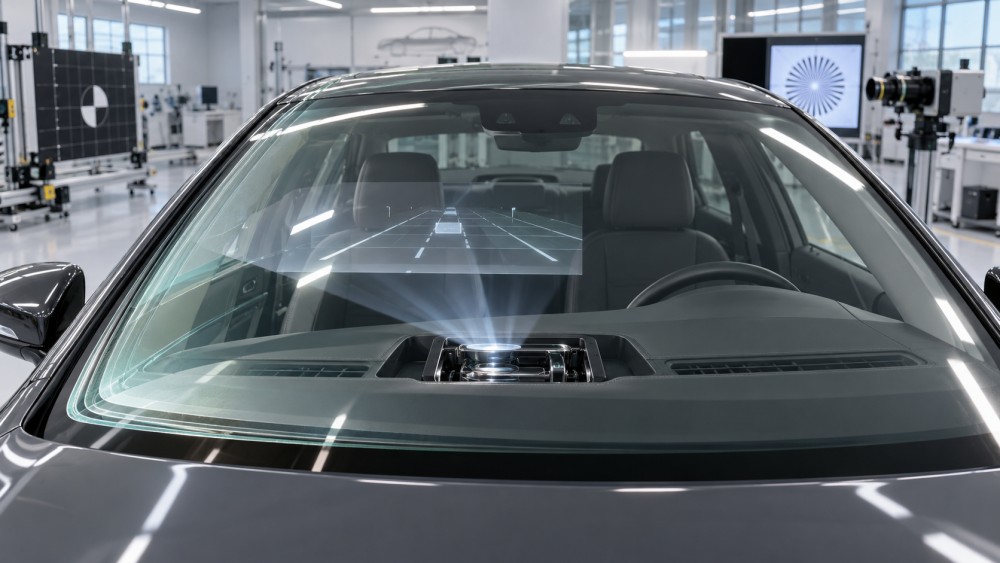
Why a windshield change can force HUD rework
It is tempting to assume that a HUD can be transferred between trims or derivative vehicles if the dashboard architecture remains similar. In practice, even modest windshield changes can affect optical performance. A revised roofline, different cowl height, altered windshield rake, acoustic glazing upgrade, or new solar-control coating may shift the conditions under which the image is reflected.
Several variables should be reviewed together rather than in isolation:
- Windshield angle and curvature: These determine where the projected light reflects and how the virtual image is shaped. A different rake angle can move the image vertically or change the required projector angle.
- Glass laminate and wedge design: These strongly affect ghosting performance. A windshield optimized for HUD may need a different interlayer construction from standard laminated glass.
- Projection-zone location: The relevant area is not the entire windshield. Optical quality must be controlled where the HUD image is reflected, including the likely viewing positions of different drivers.
- Coatings and tint: Infrared-reflective, solar-control, heated, acoustic, and other functional layers can alter reflectivity, transmission, color balance, or image brightness.
- Dashboard and instrument-panel position: The projector must fit below the windshield while maintaining its designed projection angle, thermal clearance, service access, and crash-related package requirements.
- Driver eye box: The HUD needs to remain visible across the expected range of driver heights and seating positions. A good image for one occupant position does not prove adequate coverage for the vehicle population.
These interactions explain why a late windshield substitution can create a disproportionate engineering burden. The issue may not be obvious in a static showroom check. It often appears during optical validation, temperature testing, drive evaluation, or when multiple driver positions are assessed. At that stage, correcting the result may involve reworking the projector angle, revising calibration, changing the windshield build, modifying the dashboard structure, or accepting a reduced image specification.
Different HUD types do not carry the same integration risk
Combiner HUDs use a separate transparent panel between the driver and windshield. They can reduce dependence on windshield optics because the combiner serves as the controlled reflective surface. The trade-off is visible hardware above the instrument panel, potential packaging concerns, and a styling result that some vehicle programs do not want. They may suit entry-level applications or fleets where cost and adaptability matter more than an integrated visual appearance.
Windshield HUDs project directly onto the glass. They create a cleaner cockpit and can place the virtual image farther ahead of the driver, but they require close coordination with the windshield. For a standard information HUD showing speed, warnings, and navigation prompts, the optical challenge is significant but usually bounded if the glass and display are engineered as a matched system.
Augmented-reality HUDs raise the bar further. Their graphics are intended to appear aligned with road features or driving paths at a longer virtual distance. Small errors in image position, distortion, windshield geometry, driver eye location, or vehicle attitude can make the overlay appear detached from the real scene. In this case, windshield variation is not merely a cosmetic issue. It can affect whether the information is understandable and whether the AR function delivers useful guidance.
For this reason, a vehicle program should not treat all HUDs as interchangeable electronic modules. The optical specification, virtual image distance, field of view, brightness target, and intended functions determine how tightly the glass, cockpit package, and software calibration must be controlled.
Manufacturing variation matters as much as nominal design
A CAD model may show the correct windshield shape and nominal angle, yet production glass always has tolerances. Variations in bending, laminate alignment, wedge angle, thickness distribution, optical distortion, and installation position can influence the final image. The goal is not to eliminate every variation; it is to ensure that the HUD remains acceptable across the specified production range.
This distinction is important for procurement and launch planning. A windshield supplier may be able to produce a HUD-compatible design, but the program also needs agreement on how the relevant optical zone will be controlled and verified. A qualification sample that looks excellent does not by itself establish that all production parts will deliver the same image quality.
Teams should define acceptance criteria in terms that connect to the driver’s experience. Typical considerations include ghost-image separation, image distortion, luminance uniformity, color shift, visible defects in the projection zone, image placement, and readability across the driver eye box. The exact targets depend on the HUD concept and vehicle requirements, but the criteria should be agreed before the glass and HUD suppliers finalize their production tooling.
Installation tolerance deserves similar attention. The windshield may meet its own specification and the HUD may meet its optical specification, while the assembled vehicle still produces an offset image because of stack-up between the dashboard, body-in-white, windshield bonding position, and projector mounting bracket. Integration teams need a vehicle-level tolerance analysis rather than separate component approvals.
Calibration can correct some errors, but not every error
Modern HUD systems use software calibration to compensate for predictable geometric differences. Image warping can correct certain distortions. Electronic adjustment can reposition the image. Brightness control can respond to ambient conditions, and some systems support alignment procedures during assembly or service.
These capabilities are valuable, but they should not be used to justify an unsuitable glass or package design. Calibration works best when the physical system is already within a defined optical range. It cannot fully remove a prominent ghost image created by incompatible lamination, recover brightness lost through an unfavorable coating, or correct severe local optical distortion without consequences elsewhere in the display.
There is also a cost and complexity question. A broad calibration range may require more sensors, longer end-of-line procedures, additional software validation, or tighter traceability between windshield variants and vehicle configurations. A multi-market vehicle with several glass suppliers, regional tint requirements, or optional windshields can become difficult to manage if the HUD configuration is not clearly linked to each approved glass part number.
For a platform strategy, the most robust approach is usually to define compatible windshield families early. This does not necessarily mean that every vehicle must use identical glass. It means that any approved variation has been assessed against the HUD optical envelope, rather than added as a commercial or regional change after the display system is frozen.
Questions to settle before selecting the HUD or windshield
Early program discussions often focus on display size, resolution, virtual image distance, and feature content. Those are visible attributes, but the following questions often determine whether the concept can be industrialized without late rework:
- Will the vehicle use a standard windshield, a HUD-specific windshield, or a combiner?
- What image quality is required for the planned use case: basic driving data, navigation guidance, or augmented-reality graphics?
- Which windshield variants are expected across regions, trim levels, and optional packages?
- Where is the HUD projection zone, and can the glass supplier control the required optical properties in that area?
- What are the permitted tolerances for windshield installation and HUD mounting in the assembled vehicle?
- How will ghosting, distortion, brightness, and image position be evaluated across driver positions and environmental conditions?
- Can service replacement glass be clearly identified as HUD-compatible, particularly where aftermarket replacement is common?
The last point is easy to overlook. A vehicle that leaves the factory with a HUD windshield can later receive replacement glass with a different optical construction. The vehicle may remain roadworthy, yet the HUD image could degrade substantially. Clear part identification and repair-channel guidance help prevent a display complaint from becoming a difficult diagnostic issue.
How to make the integration process more predictable
The practical solution is coordinated development among the vehicle body team, cockpit engineering team, HUD supplier, windshield supplier, and validation organization. This coordination should begin before exterior and instrument-panel geometry are fixed. It is much less effective when introduced after the windshield tooling, dashboard structure, or projector package has already been committed.
At concept stage, optical simulation can identify whether the intended windshield area, projector location, and driver eye box are feasible. Early physical samples then reveal effects that models may not capture perfectly, including local optical behavior and production-representative glass variation. Vehicle-level evaluation should include the range of seating positions, daytime and nighttime viewing conditions, expected temperature conditions, and relevant windshield variants.
For buyers sourcing a HUD system, the specification should ask more than whether the unit supports a stated image size or brightness level. It should define the reference windshield conditions used for that claim. For buyers sourcing glass, the requirement should specify the HUD zone and the optical performance expected in that zone, rather than relying only on general windshield standards. Each supplier can otherwise meet its individual deliverables while the combined system misses the vehicle requirement.
So, is a head-up display difficult to integrate with different windshields? It can be, particularly when a direct-to-windshield HUD is adapted across distinct vehicle geometries or glass constructions. The difficulty is controllable when the windshield is specified as part of the display architecture, compatible variants are managed deliberately, and calibration is treated as refinement rather than a cure for fundamental optical mismatch. That is the difference between a HUD that appears impressive in a single prototype and one that remains legible, stable, and manufacturable across the vehicle program.
Have questions about this sector analysis, or seeking best practices specific to your niche? Drop us a line below and let the senior consultants at GAC assist you.
“We respect your privacy. Your information is strictly confidential.”
Related News
- 00
0000-00
How does a shielded HSD cable reduce interference in vehicles? - 00
0000-00
What drives demand for scroll compressors in the automotive market? - 00
0000-00
Does AEC-Q200 apply to flexible printed circuits? - 00
0000-00
How does production volume affect automotive flexible electronics costs? - 00
0000-00
How much does an in-vehicle infotainment system cost to replace?
Weekly Insights
Stay ahead with our curated technology reports delivered every Monday.
Recommended News
 How does a shielded HSD cable reduce interference in vehicles?Discover how a shielded HSD cable reduces vehicle interference, and learn why connector design, routing, and testing matter for reliable high-speed data links.Author:Time:Nov 17, 2026
 What drives demand for scroll compressors in the automotive market?Explore the scroll compressor for automobile market and discover how EV adoption, heat pumps, efficiency, and supplier capabilities shape demand.Author:Time:Nov 16, 2026
 Does AEC-Q200 apply to flexible printed circuits?Flexible Printed Circuit AEC-Q200 requirements explained: discover which components qualify and how to assess automotive FPC reliability.Author:Time:Nov 15, 2026
 How does production volume affect automotive flexible electronics costs?Explore how production volume affects automotive flexible electronics cost, from tooling and yield to testing. Compare quotes and negotiate smarter.Author:Time:Nov 14, 2026
 How much does an in-vehicle infotainment system cost to replace?Explore in-vehicle infotainment cost, from affordable repairs to factory replacements. Compare options, installation fees, and compatibility before you buy.Author:Time:Nov 13, 2026
 How does condenser efficiency affect heat pump performance?Discover how condenser high efficiency can improve heat pump performance, reduce compressor power, and boost heating COP—plus the trade-offs to watch.Author:Time:Nov 12, 2026
 What does each FAKRA cable color code mean?FAKRA cable color code explained: Explore common connector colors, typical uses and key compatibility checks before choosing a replacement.Author:Time:Nov 11, 2026
 How to compare noise ratings for battery coolant pumpsCompare coolant pump low noise ratings with confidence. Learn how test conditions, hydraulic duty, tonal noise and installation affect your choice.Author:Time:Nov 10, 2026
 How bright should automotive display systems be in sunlight?Automotive Display Systems need more than brightness to stay readable in sunlight. Discover why 1,000 nits is a starting point and how to evaluate glare and heat.Author:Time:Nov 09, 2026
 How heat pumps improve the efficiency of EV thermal systemsEV Thermal Systems use heat pumps to reduce heating energy demand. Explore how they work, where they excel, and what limits efficiency in cold weather.Author:Time:Nov 08, 2026
 Can a smart cockpit platform support multiple displays?Can a smart cockpit platform support multiple displays? Explore key requirements for performance, safety, connectivity, and supplier evaluation.Author:Time:Nov 07, 2026
 How is automotive connector vibration resistance tested?Automotive connector vibration resistance testing reveals hidden contact failures. Explore test profiles, continuity monitoring and pass criteria.Author:Time:Nov 06, 2026
 How heat pumps save energy in automotive cabin climate systemsAutomotive Cabin Climate Systems energy saving starts with smarter heat pump design. Explore real-world efficiency, cold-weather trade-offs, and testing tips.Author:Time:Nov 05, 2026
 Is an EV heat pump worth it for winter driving range?Is a heat pump worth using in a cold-climate EV? Discover how it affects winter range, when it pays off, and what to check before buying.Author:Time:Nov 04, 2026
 When should you use 50-ohm coaxial cable instead of 75-ohm?Coaxial cable 50 ohm or 75 ohm? Learn when to use each, avoid impedance mismatches, and choose the right cable for reliable RF and video performance.Author:Time:Nov 03, 2026
 How to select a high temperature motor harness for an EVChoose the right high temperature motor harness for your EV. Compare thermal limits, current capacity, shielding, routing, and validation evidence.Author:Time:Nov 02, 2026
 How much does electric power steering replacement cost?Electric power steering price typically ranges from $1,000 to $3,000 for major replacements. Discover cost factors, repair options, and tips for comparing quotes.Author:Time:Nov 01, 2026
 How to size an EV A/C compressor for the required cooling capacitySize an EV A/C Compressor with confidence. Explore cooling loads, performance maps and power limits to select the right compressor for your vehicle.Author:Time:Oct 31, 2026
 How to choose the right pitch for an FPC board connectorFPC board connector pitch affects space, assembly and reliability. Learn how to compare options and select the best fit for your design.Author:Time:Oct 30, 2026
 How zonal design affects harness routing in high-voltage EV architecturesExplore high-voltage electrical architecture zonal design and its impact on EV harness routing. Discover key trade-offs in cable length, safety, thermal performance, and service access.Author:Time:Oct 29, 2026
 How tariffs affect costs in global automotive parts supply chainsNavigate tariffs in the global automotive parts trade supply chain. Learn to compare landed costs, manage duty exposure, and uncover smarter sourcing strategies to protect your margins.Author:Time:Oct 28, 2026
 How to assess vendor lock-in in a software-defined vehicle platformAssess Software-Defined Vehicle platform lock-in with practical tests for API portability, data access, update control, and exit costs. Learn how to choose a platform with a proven exit path.Author:Time:Oct 27, 2026
 How ISO 26262 guides functional safety in steer-by-wire systemsExplore steering systems functional safety through ISO 26262. Learn how hazard analysis, fault-tolerant design, and validation build a stronger steer-by-wire safety case.Author:Time:Oct 26, 2026
 How to evaluate a steering angle sensor manufacturer's accuracy claimsEvaluate steering angle sensor manufacturer accuracy claims with practical checks on calibration, latency, and test evidence. Compare suppliers confidently and avoid costly selection mistakes.Author:Time:Oct 25, 2026
 How to diagnose CAN bus faults in a hybrid vehicle control unitDiagnose Hybrid Vehicle Systems control unit CAN bus faults with step-by-step power, wiring, and waveform checks. Find the root cause and avoid unnecessary replacement.Author:Time:Oct 24, 2026
 How does battery cooling pipe diameter affect coolant pressure drop?Battery Cooling Pipe diameter affects coolant pressure drop and pump power. Explore sizing calculations and practical tips to optimize EV battery cooling and compare options with confidence.Author:Time:Oct 23, 2026
 How to assess PPAP readiness of automotive sensor system manufacturersAssess Automotive Sensor Systems manufacturers for PPAP readiness. Learn to verify production evidence, measurement capability, validation, and traceability to reduce sourcing risks.Author:Time:Oct 22, 2026
 What to ask an FPC connector manufacturer about reliability testingChoosing an FPC Connector manufacturer? Learn what to ask about reliability testing, failure limits, and traceable results to reduce design risks and select with confidence.Author:Time:Oct 21, 2026
 How to verify vehicle fitment for an aftermarket AC evaporatorNavigating the evaporator aftermarket? Verify vehicle fitment with VIN data, OE numbers, and physical interface checks. Use this guide to avoid costly mismatches and order confidently.Author:Time:Oct 20, 2026
 How electric compressor speed affects EV battery cooling capacityElectric compressor technology: battery cooling depends on more than RPM. Discover how speed, refrigerant flow, and system limits affect EV cooling capacity and energy efficiency.Author:Time:Oct 19, 2026





























