
How to verify a variable frequency compressor supplier’s efficiency claims




How to verify a variable frequency compressor supplier’s efficiency claims
A variable frequency compressor supplier may promise substantial energy savings, but do its efficiency figures reflect your actual operating conditions? For automotive A/C and new energy vehicle (NEV) thermal management applications, verification starts with comparable test boundaries—not headline percentages. Cooling capacity, electrical input power, inverter losses, and part-load performance all need to be assessed under clearly defined conditions.
The difficult part is rarely checking the arithmetic. It is discovering what the supplier measured, what it excluded, and whether the operating points resemble your vehicle. A technically valid result can still be a poor basis for selection if it represents only a favorable corner of the compressor map.
Start by asking: efficient compared with what?
Before requesting another performance chart, ask the supplier to define its baseline. Is the comparison against a fixed-speed compressor, an earlier electric compressor, a different displacement, or the same hardware with revised control software? These comparisons answer different questions.
For supplier selection, two comparisons are useful. Matched refrigerant conditions and speed help reveal differences in compressor behavior, although displacement must also be considered. Matched conditions and delivered cooling capacity are usually more relevant to the purchasing decision: how much electrical power does each candidate need to do the required job?
Do not assume that equal rotational speed means equal output. Different displacements, leakage characteristics, and volumetric efficiencies can produce different refrigerant mass flows. A lower-power compressor is not necessarily more efficient if it also delivers less cooling.
Also clarify what “variable frequency” means in the offer. In automotive applications, the relevant product is generally a speed-controlled electric compressor and its inverter. An industrial compressor brochure or a generic inverter efficiency statement does not establish automotive thermal performance.
Draw the measurement boundary before comparing COP
Cooling coefficient of performance is cooling capacity divided by input power. That definition is straightforward; the measurement boundary is where comparisons often break down.
For an electric compressor supplied with an integrated inverter, DC input at the assembly terminals is normally a useful procurement boundary. Motor-terminal power excludes inverter losses. Shaft power excludes both motor and inverter losses. None of these measurements is inherently wrong, but they are not interchangeable.
If capacity is calculated from refrigerant mass flow and enthalpy difference, request the locations and conditions used for those state points. Compressor inlet and outlet measurements alone do not directly define evaporator cooling capacity. The supplier should explain the calculation rather than provide only its final result.
Make the operating conditions genuinely comparable
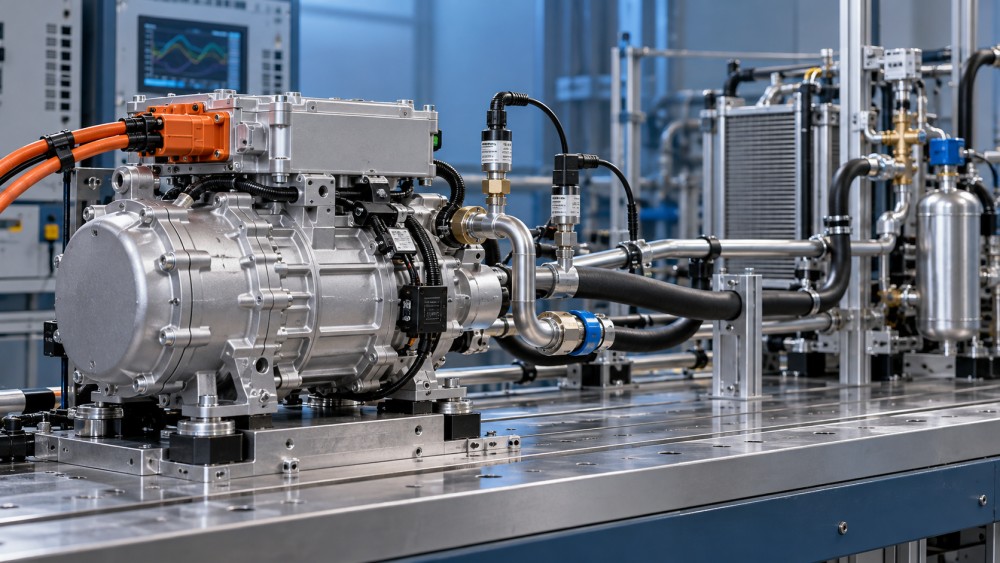
A chart labeled “standard conditions” is not enough. Request the refrigerant, lubricant specification, suction and discharge pressures, suction temperature or superheat, and liquid temperature or subcooling relevant to the capacity calculation. Include rotational speed, DC supply voltage, and the compressor’s thermal environment.
Where saturation temperatures replace pressures, confirm the refrigerant property convention and pressure reference. Gauge and absolute pressure must not be mixed. For refrigerants with temperature glide, the stated saturation convention also needs to be clear.
Sensor placement matters. Pressure at a remote heat exchanger is not necessarily pressure at the compressor port. Suction-line losses can shift the actual compression duty. Two benches may report similar evaporating conditions while imposing different inlet conditions on the compressor.
Voltage deserves particular attention in high-voltage vehicle architectures. Current, inverter operation, and thermal limits can change across the permitted supply range. A result at one nominal voltage does not demonstrate identical performance throughout that range.
Ask for the actual recorded conditions and permitted deviations, not just setpoints. When operating conditions drift, a small efficiency advantage may reflect the bench rather than the hardware.
Look beyond the best point on the map
The strongest selection evidence is a performance map covering your intended operating envelope. Request capacity and electrical input together across relevant speeds and suction/discharge conditions. COP-only maps conceal whether a favorable point delivers enough capacity.
For a vehicle combining cabin cooling and battery liquid cooling, the important points may include sustained battery cooling, combined cabin-and-battery demand, and low-load temperature maintenance. Hot-soak pull-down creates another requirement: adequate capacity without unacceptable electrical or thermal limiting. These duties should not receive equal weighting simply because they occupy equal space in a supplier’s presentation.
At low load, check minimum stable speed and minimum controllable capacity. If demand falls below that capacity, the system may cycle. Starts, pressure equalization, control delays, and temperature oscillation can reduce the benefit implied by steady-state part-load COP. Ask whether the reported result represents continuous operation or an average that includes cycling.
At high load, request continuous-operation limits and derating behavior. A briefly achievable operating point is not equivalent to sustained capacity after the motor and inverter reach thermal equilibrium.
For duty-cycle comparison, calculate total useful cooling divided by total electrical energy over the defined profile. Do not simply average COP values. Where the thermal load is fixed, comparing electrical energy required to satisfy that load is often the clearer decision metric.
Request evidence that can survive a technical review
A useful report lets another engineer understand how the result was produced. It should identify the tested assembly, inverter, control software, test method, instrumentation, stabilization criteria, and data-processing approach. A brochure curve without these details is screening information, not verification.
- Request numerical capacity and power data, including measured conditions for each point.
- Ask for calibration status, measurement uncertainty, and repeatability evidence at decision-critical points.
- Confirm sample quantity and whether the tested units represent the proposed production configuration.
- Request the applicable test standard and edition, together with deviations or project-specific procedures.
- Obtain operating limits, protection thresholds, and any restrictions affecting the published map.
Laboratory credentials can strengthen confidence, but scope matters. If ISO/IEC 17025 accreditation is cited, check whether the relevant testing falls within the laboratory’s accredited scope. Accreditation is not a blanket endorsement of every product claim. Likewise, a quality-management certificate does not validate a stated COP.
Treat narrow performance differences cautiously when they are comparable to measurement uncertainty. Repeated paired tests on the same bench can be more useful than comparing isolated reports from different facilities. For a close decision, agree the uncertainty treatment and acceptance rule before testing begins.
Separate compressor improvement from system improvement
An efficient compressor can still perform poorly in an unsuitable circuit. Expansion control, refrigerant charge, heat-exchanger sizing, line pressure losses, and thermal-valve routing influence the conditions it experiences. In an NEV heat-pump system, operating mode changes add another layer of interaction.
If a supplier claims vehicle-level energy savings, ask which other elements changed. Revised valve control, reduced pump consumption, or a different evaporating-temperature target may explain part of the result. Those improvements can be valuable, but they should not all be attributed to compressor hardware.
This is where the broader thermal-system perspective covered by GACT becomes useful: electric compressors, battery cooling circuits, integrated thermal valves, and heat pumps need to be evaluated together. Component data supports shortlisting; representative system testing establishes whether the advantage survives integration.
Turn the claim into an acceptance condition
Before nomination, agree a focused test matrix with the variable frequency compressor supplier. Select points from the actual duty profile, including the operating conditions that could disqualify the product. Define minimum delivered capacity and maximum electrical input together, alongside voltage, refrigerant conditions, stabilization requirements, and permissible deviations.
Tie the results to the proposed production hardware and software revisions. Agree how substitutions or control changes trigger review, and whether confirmation testing is required. A supplier’s best development sample is not automatically evidence for every production configuration.
If the headline saving disappears once capacity, electrical boundaries, and operating conditions are aligned, do not carry that percentage into the sourcing business case. Keep the candidate under consideration if it offers other advantages—but approve its efficiency claim only when the evidence supports the duty your vehicle actually needs.
Have questions about this sector analysis, or seeking best practices specific to your niche? Drop us a line below and let the senior consultants at GAC assist you.
“We respect your privacy. Your information is strictly confidential.”
Related News
- 00
0000-00
What does each FAKRA cable color code mean? - 00
0000-00
How to compare noise ratings for battery coolant pumps - 00
0000-00
How bright should automotive display systems be in sunlight? - 00
0000-00
How heat pumps improve the efficiency of EV thermal systems - 00
0000-00
Can a smart cockpit platform support multiple displays?
Weekly Insights
Stay ahead with our curated technology reports delivered every Monday.
Recommended News
 What does each FAKRA cable color code mean?FAKRA cable color code explained: Explore common connector colors, typical uses and key compatibility checks before choosing a replacement.Author:Time:Nov 11, 2026
 How to compare noise ratings for battery coolant pumpsCompare coolant pump low noise ratings with confidence. Learn how test conditions, hydraulic duty, tonal noise and installation affect your choice.Author:Time:Nov 10, 2026
 How bright should automotive display systems be in sunlight?Automotive Display Systems need more than brightness to stay readable in sunlight. Discover why 1,000 nits is a starting point and how to evaluate glare and heat.Author:Time:Nov 09, 2026
 How heat pumps improve the efficiency of EV thermal systemsEV Thermal Systems use heat pumps to reduce heating energy demand. Explore how they work, where they excel, and what limits efficiency in cold weather.Author:Time:Nov 08, 2026
 Can a smart cockpit platform support multiple displays?Can a smart cockpit platform support multiple displays? Explore key requirements for performance, safety, connectivity, and supplier evaluation.Author:Time:Nov 07, 2026
 How is automotive connector vibration resistance tested?Automotive connector vibration resistance testing reveals hidden contact failures. Explore test profiles, continuity monitoring and pass criteria.Author:Time:Nov 06, 2026
 How heat pumps save energy in automotive cabin climate systemsAutomotive Cabin Climate Systems energy saving starts with smarter heat pump design. Explore real-world efficiency, cold-weather trade-offs, and testing tips.Author:Time:Nov 05, 2026
 Is an EV heat pump worth it for winter driving range?Is a heat pump worth using in a cold-climate EV? Discover how it affects winter range, when it pays off, and what to check before buying.Author:Time:Nov 04, 2026
 When should you use 50-ohm coaxial cable instead of 75-ohm?Coaxial cable 50 ohm or 75 ohm? Learn when to use each, avoid impedance mismatches, and choose the right cable for reliable RF and video performance.Author:Time:Nov 03, 2026
 How to select a high temperature motor harness for an EVChoose the right high temperature motor harness for your EV. Compare thermal limits, current capacity, shielding, routing, and validation evidence.Author:Time:Nov 02, 2026
 How much does electric power steering replacement cost?Electric power steering price typically ranges from $1,000 to $3,000 for major replacements. Discover cost factors, repair options, and tips for comparing quotes.Author:Time:Nov 01, 2026
 How to size an EV A/C compressor for the required cooling capacitySize an EV A/C Compressor with confidence. Explore cooling loads, performance maps and power limits to select the right compressor for your vehicle.Author:Time:Oct 31, 2026
 How to choose the right pitch for an FPC board connectorFPC board connector pitch affects space, assembly and reliability. Learn how to compare options and select the best fit for your design.Author:Time:Oct 30, 2026
 How zonal design affects harness routing in high-voltage EV architecturesExplore high-voltage electrical architecture zonal design and its impact on EV harness routing. Discover key trade-offs in cable length, safety, thermal performance, and service access.Author:Time:Oct 29, 2026
 How tariffs affect costs in global automotive parts supply chainsNavigate tariffs in the global automotive parts trade supply chain. Learn to compare landed costs, manage duty exposure, and uncover smarter sourcing strategies to protect your margins.Author:Time:Oct 28, 2026
 How to assess vendor lock-in in a software-defined vehicle platformAssess Software-Defined Vehicle platform lock-in with practical tests for API portability, data access, update control, and exit costs. Learn how to choose a platform with a proven exit path.Author:Time:Oct 27, 2026
 How ISO 26262 guides functional safety in steer-by-wire systemsExplore steering systems functional safety through ISO 26262. Learn how hazard analysis, fault-tolerant design, and validation build a stronger steer-by-wire safety case.Author:Time:Oct 26, 2026
 How to evaluate a steering angle sensor manufacturer's accuracy claimsEvaluate steering angle sensor manufacturer accuracy claims with practical checks on calibration, latency, and test evidence. Compare suppliers confidently and avoid costly selection mistakes.Author:Time:Oct 25, 2026
 How to diagnose CAN bus faults in a hybrid vehicle control unitDiagnose Hybrid Vehicle Systems control unit CAN bus faults with step-by-step power, wiring, and waveform checks. Find the root cause and avoid unnecessary replacement.Author:Time:Oct 24, 2026
 How does battery cooling pipe diameter affect coolant pressure drop?Battery Cooling Pipe diameter affects coolant pressure drop and pump power. Explore sizing calculations and practical tips to optimize EV battery cooling and compare options with confidence.Author:Time:Oct 23, 2026
 How to assess PPAP readiness of automotive sensor system manufacturersAssess Automotive Sensor Systems manufacturers for PPAP readiness. Learn to verify production evidence, measurement capability, validation, and traceability to reduce sourcing risks.Author:Time:Oct 22, 2026
 What to ask an FPC connector manufacturer about reliability testingChoosing an FPC Connector manufacturer? Learn what to ask about reliability testing, failure limits, and traceable results to reduce design risks and select with confidence.Author:Time:Oct 21, 2026
 How to verify vehicle fitment for an aftermarket AC evaporatorNavigating the evaporator aftermarket? Verify vehicle fitment with VIN data, OE numbers, and physical interface checks. Use this guide to avoid costly mismatches and order confidently.Author:Time:Oct 20, 2026
 How electric compressor speed affects EV battery cooling capacityElectric compressor technology: battery cooling depends on more than RPM. Discover how speed, refrigerant flow, and system limits affect EV cooling capacity and energy efficiency.Author:Time:Oct 19, 2026
 How to verify a variable frequency compressor supplier’s efficiency claimsVerify a variable frequency compressor supplier’s efficiency claims using COP boundaries, matched test conditions, and duty-cycle data. Learn how to choose with confidence.Author:Time:Oct 18, 2026
 How bend radius affects FPC reliability in automotive camera modulesAutomotive FPC applications: camera module reliability starts with bend radius. Learn how stack-up, strain, and validation guide robust designs and help prevent costly failures.Author:Time:Oct 17, 2026
 How to diagnose intermittent loss of electric power steering assistMaster power steering system diagnostics to trace intermittent EPS assist loss. Learn proven checks for voltage, wiring, and fault codes to avoid costly guesswork.Author:Time:Oct 16, 2026
 How to size automotive power modules for electric compressorsSize automotive power modules for electric compressors with confidence. Learn how voltage, phase current, losses, and cooling shape reliable selection—and avoid costly oversizing.Author:Time:Oct 15, 2026
 Why automotive power electronics are shifting to silicon carbideAutomotive Power Electronics are shifting to silicon carbide. Discover how SiC can cut losses, boost EV power density, and reshape cooling, reliability, and system costs.Author:Time:Oct 14, 2026
 How EV adoption shapes the electrically driven compressor marketExplore how EV adoption shapes the electrically driven compressor market, from battery cooling and heat pumps to supplier margins. Discover the drivers of profitable growth.Author:Time:Oct 13, 2026





























