
Is Steer-by-Wire More Expensive Than an EPS Steering System?




Yes—at the vehicle level, a steer-by-wire (SbW) system is generally more expensive than a conventional electric power steering (EPS) system. The difference is not simply the price of an actuator or electronic control unit. SbW replaces the permanent mechanical steering path between the steering wheel and road wheels with electronically coordinated subsystems, so it adds redundant sensing, power supply capability, actuation, diagnostics, software, validation, and safety assurance.
That conclusion needs one qualification: comparing a basic column-assist EPS system with a high-function SbW architecture is not a like-for-like exercise. An EPS system can also become costly when it must support higher steering loads, advanced driver-assistance functions, dual-pinion or rack-mounted packaging, fail-operational capability, or a premium vehicle’s steering feel targets. Conversely, an SbW system can create value elsewhere in the vehicle by enabling packaging changes, adjustable steering ratios, automated-driving functions, and a more integrated chassis-control strategy. The relevant question is therefore not whether SbW costs more as a standalone system, but whether its added vehicle-level capability justifies the added program and lifecycle cost.
Why steer-by-wire carries a higher initial cost
A conventional EPS system retains a direct mechanical connection from the steering wheel, through the steering column and intermediate shaft, to the steering gear. The electric motor provides assist torque, but if electronic assistance is lost, the driver retains a physical steering path. Steering effort may become much higher, yet the basic mechanical relationship remains.
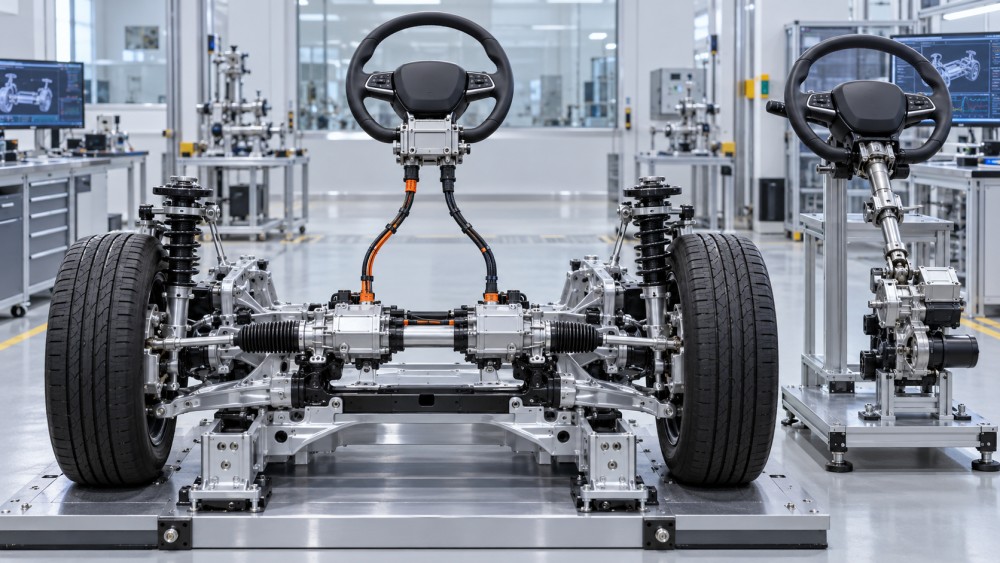
In a true SbW design, the steering wheel module measures driver input and generates an artificial steering feel. A separate road-wheel actuator turns the wheels. Commands pass through electronic control systems rather than a continuously connected mechanical shaft. Because a single electronic or electrical fault must not cause loss of steering control, the system architecture must address faults that a traditional EPS layout can tolerate differently.
The added cost commonly comes from several linked areas:
- Redundant sensing: Steering wheel angle, torque or handwheel input, road-wheel angle, motor position, and other relevant signals require robust plausibility checks. Critical inputs may need independent sensing paths.
- Redundant actuation and control: The road-wheel steering unit must preserve controlled steering capability under defined failures. This can require duplicated controllers, motor windings, power stages, or additional actuation paths, depending on the safety concept.
- Electrical power architecture: SbW cannot rely on a mechanical fallback connection. Low-voltage power loss, connector faults, voltage instability, and wiring failures therefore require a more resilient design than a conventional single-path steering assist system.
- Handwheel feedback actuator: A steering feel unit is needed to provide centering force, road feedback simulation, end-stop sensation, and warnings to the driver. This is an additional electromechanical subsystem not required by EPS.
- Software and calibration: Steering feel, response, rack motion, fault handling, and coordination with braking or stability functions are software-defined. Development extends beyond hardware design into calibration, functional safety engineering, cybersecurity, and validation.
- Testing and approval effort: Verification must cover normal operation, degraded modes, transient faults, communication failures, sensor disagreement, thermal conditions, electromagnetic compatibility, and driver interaction during faults.
These costs are particularly significant at the beginning of a program. The non-recurring engineering burden for a new SbW platform can be substantial because the OEM and supply chain must establish architecture, diagnostics, interface definitions, verification methods, and production-end testing. A mature EPS program benefits from deeply established component designs, manufacturing processes, supplier capacity, and service knowledge.
EPS is not one cost category
Calling EPS “the lower-cost option” is directionally correct, but it can conceal important differences. Column-assist EPS is often used where steering loads and vehicle mass allow it. Pinion-assist and rack-assist EPS arrangements are generally suited to greater steering forces and can support more demanding vehicle applications. The motor, reduction gear, rack, housing, ECU capability, sensors, and thermal requirements all affect cost.
An EPS system intended only to provide steering assist is a different product from one that also supports lane-centering functions, automated parking, hands-off monitoring strategies, over-the-air calibration management, and tightly controlled steering response. Some of these added functions may increase ECU performance requirements, sensing capability, software complexity, and validation scope without turning the system into SbW.
There is also a practical distinction between an EPS system with a mechanical steering fallback and an SbW system designed for fail-operational performance. The first can enter a degraded manual-steering condition after certain electrical failures. The second must maintain an acceptable controlled response without depending on the steering column’s mechanical connection. That difference drives much of the price gap.
The mechanical savings are real, but they rarely erase the gap immediately
SbW can remove or reduce the need for a conventional steering column shaft, intermediate shaft, universal joints, and some related mechanical packaging constraints. In some vehicle architectures, this may simplify front-compartment layout, improve flexibility for crash packaging, or provide more freedom in cabin design. The steering wheel may also be repositioned, retracted, or designed with a different geometry when the vehicle’s functional concept permits it.
Those savings should be evaluated carefully rather than treated as automatic. A steering wheel module still requires a physical structure, mounting, energy absorption considerations, switches, harnesses, and a feedback actuator. The front steering assembly still needs a robust mechanical rack, linkages, knuckles, and wheel-end components. SbW removes the continuous mechanical link, not the need for mechanical steering hardware at the wheels.
In addition, the deleted parts may be lower-cost, mature mechanical items, while the replacement electronics are safety-critical, highly validated components. Removing a shaft and joints does not directly offset the cost of a redundant actuator, independent electrical paths, sophisticated diagnostics, and the associated development effort.
The cost case becomes more credible where the entire vehicle benefits from the architectural change. A dedicated electric-vehicle platform, for example, may gain meaningful packaging freedom if steering, pedal systems, high-voltage routing, thermal components, crash structures, and cabin layout are designed around an electronic control architecture from the start. Retrofitting SbW into a platform originally engineered for conventional steering is less likely to capture those benefits.
Software is both the cost driver and the source of value
The hardware bill of materials is only part of the comparison. SbW shifts more steering behavior into software. Variable steering ratio, speed-dependent response, parking maneuver calibration, handwheel feedback, road-surface simulation, and coordination with other chassis systems can be adjusted without redesigning the mechanical ratio in the steering gear.
That flexibility has commercial and engineering value only when the vehicle program uses it. A vehicle requiring a conventional, familiar steering response across a limited set of variants may gain little from extensive software configurability. A platform intended to support different wheelbases, regional variants, shared vehicle architectures, advanced parking functions, or tightly integrated motion control has more opportunity to use an SbW system’s flexibility.
Software also changes the cost profile. Rather than paying only for hardware differentiation, the manufacturer must fund systems engineering, interface management, calibration, cybersecurity controls, software maintenance, and release governance. Features added after start of production may be possible, but they are not cost-free. Every software update affecting steering-related behavior requires disciplined assessment, validation, traceability, and configuration control.
This is why a low quoted unit price should not decide the comparison. A supplier quotation may include the handwheel unit and road-wheel actuator but exclude substantial OEM-side expenses: vehicle integration, safety analysis, cyber risk management, proving-ground work, simulation models, production diagnostics, homologation documentation, and service procedures.
Safety and regulatory compliance add cost in different ways
Steering is a safety-critical function. Development commonly involves functional safety work aligned with ISO 26262, including hazard analysis, safety goals, technical safety requirements, hardware and software verification, and confirmation measures appropriate to the system architecture. The standard does not prescribe one SbW hardware design, but a design without a mechanical fallback makes the safety argument more demanding.
Intended functionality must also be considered. ISO 21448, often referred to as SOTIF, is relevant where performance limitations, environmental conditions, sensing limitations, or system behavior could create hazards even when components have not failed. For SbW, this can include the quality and consistency of driver feedback, road-wheel response, and interaction with driver-assistance functions.
Vehicles sold in markets applying UNECE steering requirements must meet the applicable provisions of UN Regulation No. 79. Connected and software-updatable vehicle programs may also need to account for cybersecurity and software-update management requirements under UN Regulations No. 155 and No. 156 where applicable. Compliance responsibility is not solved by selecting a supplier with a technically capable actuator. The vehicle-level approval case depends on the combined behavior of steering hardware, electrical architecture, software, driver controls, and vehicle integration.
For conventional EPS, these obligations are also serious, but the permanent mechanical connection changes the fault-management problem. The driver can still transmit steering input to the rack when electrical assistance is unavailable. In SbW, maintaining a safe path from driver intent to road-wheel control is the central engineering obligation.
Where SbW can justify its premium
SbW makes the strongest economic sense when it enables functions or vehicle architecture that an EPS system cannot provide as effectively. The most relevant cases are not simply “premium vehicles,” but programs with a concrete need for electronic steering decoupling.
One example is integrated vehicle-motion control. Because SbW electronically controls the relationship between handwheel input and road-wheel angle, it can be coordinated more directly with rear-wheel steering, braking, torque vectoring, active suspension, and stability control. The benefit is not that all of these functions automatically become better, but that the system has an additional degree of design freedom.
Another is variable steering behavior without mechanically changing the steering gear ratio. Low-speed maneuvering can use a different handwheel-to-road-wheel relationship from highway driving, while the feedback actuator can be calibrated to preserve a coherent driver experience. This may support maneuverability and packaging objectives, but the calibration burden remains significant: inconsistent or artificial steering feel can undermine perceived quality even if the system meets functional requirements.
SbW can also support cabin concepts in which steering controls have a different placement or stowage requirement. Such concepts require careful treatment of occupant protection, human-machine interaction, failure warnings, and legal requirements; they should not be assumed to be a low-cost by-product of deleting a steering shaft.
When EPS remains the economically sound choice
EPS remains more rational where a vehicle needs reliable electric assist, standard driver-assistance steering support, proven serviceability, and a conventional steering layout without the need for electronic decoupling. It is especially compelling when program volumes, architecture maturity, and manufacturing simplicity are more important than advanced steering configurability.
For many vehicle programs, the mechanical fallback is not a limitation but a valuable risk-control feature. It reduces dependence on redundant electrical architecture and can simplify the transition to a degraded operating state. The supply base is broad, component interfaces are established, and workshop procedures are more familiar. These advantages affect not only purchase cost but also launch risk, warranty planning, spare-parts strategy, and repair training.
An EPS system can still support meaningful driver-assistance capability. It should not be treated as technologically obsolete merely because SbW offers a more flexible electronic architecture. The decision turns on required functions and system-level value, not on which technology appears more advanced.
How to compare the two systems without distorting the business case
A useful comparison starts with a defined vehicle function set. The baseline should specify steering loads, target steering feel, driver-assistance requirements, electrical architecture, automated-driving assumptions, diagnostic expectations, regional approval needs, and planned vehicle variants. Comparing SbW against a minimally equipped EPS while assigning advanced functions only to SbW will inevitably produce a misleading result.
The cost model should separate recurring and non-recurring items. Recurring costs include the steering modules, actuators, ECUs, sensors, harnesses, connectors, brackets, end-of-line tests, and expected service parts. Non-recurring costs include architecture design, safety engineering, software development, validation, tooling, manufacturing test development, homologation support, and supplier integration. A program with limited production volume may struggle to absorb the latter even if the hardware premium appears manageable.
It is equally important to identify avoided costs and enabled value. These may include deleted mechanical parts, reduced packaging constraints, common software across vehicle derivatives, improved low-speed maneuverability, or functions that would otherwise require separate systems. Only benefits that are tied to a defined program requirement should be counted. Broad claims about future software revenue or unspecified autonomous-driving value are not a reliable basis for a steering-system investment decision.
Supply-chain resilience deserves the same scrutiny as technical performance. SbW increases reliance on safety-capable semiconductor content, software toolchains, specialized validation capability, and suppliers able to support long-term configuration management. Procurement review should examine not only unit pricing but also sourcing strategy for critical electronic components, change-notification controls, software ownership and access rights, diagnostic-tool availability, repair policy, and the availability of validated replacement parts over the vehicle lifecycle.
The practical answer
Steer-by-wire is more expensive than EPS in most current program comparisons because it substitutes a mechanically backed steering path with a safety-critical electronic system that must be redundant, diagnosable, powered through faults, and extensively validated. The premium is not limited to the steering hardware; it extends into electrical architecture, software, integration, compliance, manufacturing, and aftersales support.
That premium can be justified when SbW unlocks specific vehicle-level benefits—electronic chassis integration, packaging freedom, differentiated steering behavior, or a defined advanced-mobility concept—that a conventional EPS system cannot deliver adequately. If the requirement is dependable power assist with conventional steering behavior and established driver-assistance functions, EPS will usually provide the stronger cost-to-value position. The correct comparison is therefore not “new technology versus old technology,” but “required vehicle capability versus the full cost and risk of delivering it.”
Have questions about this sector analysis, or seeking best practices specific to your niche? Drop us a line below and let the senior consultants at GAC assist you.
“We respect your privacy. Your information is strictly confidential.”
Related News
- 00
0000-00
What does each FAKRA cable color code mean? - 00
0000-00
How to compare noise ratings for battery coolant pumps - 00
0000-00
How bright should automotive display systems be in sunlight? - 00
0000-00
How heat pumps improve the efficiency of EV thermal systems - 00
0000-00
Can a smart cockpit platform support multiple displays?
Weekly Insights
Stay ahead with our curated technology reports delivered every Monday.
Recommended News
 What does each FAKRA cable color code mean?FAKRA cable color code explained: Explore common connector colors, typical uses and key compatibility checks before choosing a replacement.Author:Time:Nov 11, 2026
 How to compare noise ratings for battery coolant pumpsCompare coolant pump low noise ratings with confidence. Learn how test conditions, hydraulic duty, tonal noise and installation affect your choice.Author:Time:Nov 10, 2026
 How bright should automotive display systems be in sunlight?Automotive Display Systems need more than brightness to stay readable in sunlight. Discover why 1,000 nits is a starting point and how to evaluate glare and heat.Author:Time:Nov 09, 2026
 How heat pumps improve the efficiency of EV thermal systemsEV Thermal Systems use heat pumps to reduce heating energy demand. Explore how they work, where they excel, and what limits efficiency in cold weather.Author:Time:Nov 08, 2026
 Can a smart cockpit platform support multiple displays?Can a smart cockpit platform support multiple displays? Explore key requirements for performance, safety, connectivity, and supplier evaluation.Author:Time:Nov 07, 2026
 How is automotive connector vibration resistance tested?Automotive connector vibration resistance testing reveals hidden contact failures. Explore test profiles, continuity monitoring and pass criteria.Author:Time:Nov 06, 2026
 How heat pumps save energy in automotive cabin climate systemsAutomotive Cabin Climate Systems energy saving starts with smarter heat pump design. Explore real-world efficiency, cold-weather trade-offs, and testing tips.Author:Time:Nov 05, 2026
 Is an EV heat pump worth it for winter driving range?Is a heat pump worth using in a cold-climate EV? Discover how it affects winter range, when it pays off, and what to check before buying.Author:Time:Nov 04, 2026
 When should you use 50-ohm coaxial cable instead of 75-ohm?Coaxial cable 50 ohm or 75 ohm? Learn when to use each, avoid impedance mismatches, and choose the right cable for reliable RF and video performance.Author:Time:Nov 03, 2026
 How to select a high temperature motor harness for an EVChoose the right high temperature motor harness for your EV. Compare thermal limits, current capacity, shielding, routing, and validation evidence.Author:Time:Nov 02, 2026
 How much does electric power steering replacement cost?Electric power steering price typically ranges from $1,000 to $3,000 for major replacements. Discover cost factors, repair options, and tips for comparing quotes.Author:Time:Nov 01, 2026
 How to size an EV A/C compressor for the required cooling capacitySize an EV A/C Compressor with confidence. Explore cooling loads, performance maps and power limits to select the right compressor for your vehicle.Author:Time:Oct 31, 2026
 How to choose the right pitch for an FPC board connectorFPC board connector pitch affects space, assembly and reliability. Learn how to compare options and select the best fit for your design.Author:Time:Oct 30, 2026
 How zonal design affects harness routing in high-voltage EV architecturesExplore high-voltage electrical architecture zonal design and its impact on EV harness routing. Discover key trade-offs in cable length, safety, thermal performance, and service access.Author:Time:Oct 29, 2026
 How tariffs affect costs in global automotive parts supply chainsNavigate tariffs in the global automotive parts trade supply chain. Learn to compare landed costs, manage duty exposure, and uncover smarter sourcing strategies to protect your margins.Author:Time:Oct 28, 2026
 How to assess vendor lock-in in a software-defined vehicle platformAssess Software-Defined Vehicle platform lock-in with practical tests for API portability, data access, update control, and exit costs. Learn how to choose a platform with a proven exit path.Author:Time:Oct 27, 2026
 How ISO 26262 guides functional safety in steer-by-wire systemsExplore steering systems functional safety through ISO 26262. Learn how hazard analysis, fault-tolerant design, and validation build a stronger steer-by-wire safety case.Author:Time:Oct 26, 2026
 How to evaluate a steering angle sensor manufacturer's accuracy claimsEvaluate steering angle sensor manufacturer accuracy claims with practical checks on calibration, latency, and test evidence. Compare suppliers confidently and avoid costly selection mistakes.Author:Time:Oct 25, 2026
 How to diagnose CAN bus faults in a hybrid vehicle control unitDiagnose Hybrid Vehicle Systems control unit CAN bus faults with step-by-step power, wiring, and waveform checks. Find the root cause and avoid unnecessary replacement.Author:Time:Oct 24, 2026
 How does battery cooling pipe diameter affect coolant pressure drop?Battery Cooling Pipe diameter affects coolant pressure drop and pump power. Explore sizing calculations and practical tips to optimize EV battery cooling and compare options with confidence.Author:Time:Oct 23, 2026
 How to assess PPAP readiness of automotive sensor system manufacturersAssess Automotive Sensor Systems manufacturers for PPAP readiness. Learn to verify production evidence, measurement capability, validation, and traceability to reduce sourcing risks.Author:Time:Oct 22, 2026
 What to ask an FPC connector manufacturer about reliability testingChoosing an FPC Connector manufacturer? Learn what to ask about reliability testing, failure limits, and traceable results to reduce design risks and select with confidence.Author:Time:Oct 21, 2026
 How to verify vehicle fitment for an aftermarket AC evaporatorNavigating the evaporator aftermarket? Verify vehicle fitment with VIN data, OE numbers, and physical interface checks. Use this guide to avoid costly mismatches and order confidently.Author:Time:Oct 20, 2026
 How electric compressor speed affects EV battery cooling capacityElectric compressor technology: battery cooling depends on more than RPM. Discover how speed, refrigerant flow, and system limits affect EV cooling capacity and energy efficiency.Author:Time:Oct 19, 2026
 How to verify a variable frequency compressor supplier’s efficiency claimsVerify a variable frequency compressor supplier’s efficiency claims using COP boundaries, matched test conditions, and duty-cycle data. Learn how to choose with confidence.Author:Time:Oct 18, 2026
 How bend radius affects FPC reliability in automotive camera modulesAutomotive FPC applications: camera module reliability starts with bend radius. Learn how stack-up, strain, and validation guide robust designs and help prevent costly failures.Author:Time:Oct 17, 2026
 How to diagnose intermittent loss of electric power steering assistMaster power steering system diagnostics to trace intermittent EPS assist loss. Learn proven checks for voltage, wiring, and fault codes to avoid costly guesswork.Author:Time:Oct 16, 2026
 How to size automotive power modules for electric compressorsSize automotive power modules for electric compressors with confidence. Learn how voltage, phase current, losses, and cooling shape reliable selection—and avoid costly oversizing.Author:Time:Oct 15, 2026
 Why automotive power electronics are shifting to silicon carbideAutomotive Power Electronics are shifting to silicon carbide. Discover how SiC can cut losses, boost EV power density, and reshape cooling, reliability, and system costs.Author:Time:Oct 14, 2026
 How EV adoption shapes the electrically driven compressor marketExplore how EV adoption shapes the electrically driven compressor market, from battery cooling and heat pumps to supplier margins. Discover the drivers of profitable growth.Author:Time:Oct 13, 2026





























