How to verify a waterproof connector supplier's IP ratings




Choosing a waterproof connector supplier involves more than checking an IP rating on a product datasheet. For automotive procurement teams, an unverified claim can lead to premature failures, costly replacements, and supply chain disruption. This guide explains how to assess IP test reports, confirm that certification applies to the exact connector configuration, and compare protection claims against real-world operating conditions. Use these checks to make better-informed sourcing decisions and reduce purchasing risk.
What an IP rating does—and does not—tell you
An ingress protection, or IP, rating describes how an enclosure performed against defined exposure to solid objects or dust and water. IEC 60529 is the standard commonly associated with IP codes. The first numeral addresses solid ingress; the second addresses water. For example, an IP67 claim indicates dust-tight protection and protection against the specified temporary immersion test conditions.
That does not mean a connector is waterproof under every condition. A rating is tied to a test method, a sample and its setup. It does not, by itself, establish resistance to coolant, road salt, vibration, thermal cycling or repeated mating. Nor does it automatically prove that electrical performance remains acceptable after years on a vehicle.
Higher-looking numbers also need interpretation. IP67 covers temporary immersion; IP68 concerns continuous immersion under conditions agreed between the manufacturer and user, subject to the standard’s requirements. Ask what depth, duration and acceptance criteria were actually used. A vague “IP68 certified” statement without those conditions is not enough to compare suppliers.
High-pressure water jet protection is a different question from immersion. An IP69 claim should be checked against its cited standard and edition, including the applicable test conditions. Do not assume an immersion-rated connector has also passed a high-pressure jet test, or vice versa, unless both claims are supported.
Start with the report, not the badge
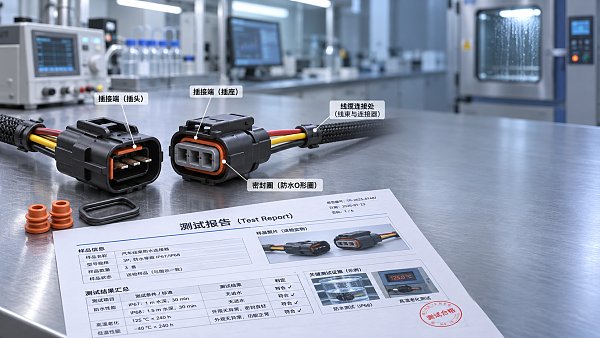
A catalogue icon is useful for screening, but the test report is the working document. Request the complete report, or a controlled copy with enough detail to assess the result. If commercial confidentiality limits disclosure, agree on a review route rather than accepting an unsupported summary.
Check that the document identifies the laboratory, report number, issue date, applicable standard and edition, test dates, sample description, procedures, conditions, observations and results. It should be clear which tests were performed and whether any deviations or exclusions applied. A report that lists a standard without identifying the relevant test or result leaves too much room for interpretation.
Distinguish testing from certification. A laboratory test report records what happened to submitted samples; it is not automatically an independent product certification or evidence of ongoing production surveillance. If a supplier claims certification, request the certificate, its scope, validity and the identity of the issuing body. Verify the claim through the issuer where a verification service is available.
Also check the laboratory’s accreditation and scope. Accreditation to ISO/IEC 17025 can support confidence in a laboratory’s competence, but it does not mean every test it performs is accredited. Confirm whether the relevant test method was within scope at the time of testing. A non-accredited test is not necessarily invalid; it simply calls for a closer assessment of the equipment, method and oversight.
Match the tested sample to the part you will buy
This is where many apparently convincing claims become less useful. A report for a connector family may cover one cavity count, one cable size and one assembly arrangement. The quotation may be for a different variant. Ask the supplier to map the tested sample to the full ordering code and identify every difference.
Pay particular attention to the mating half, seals, terminals, wire insulation diameter, cavity plugs and backshell or cable exit. An approved seal may be designed for a defined range of wire outside diameters; selecting it by conductor size alone can be misleading. Unused cavities must be closed with the specified components, not improvised plugs.
The assembly process matters as much as the bill of materials. Confirm the insertion method, seal position, crimp tooling and inspection requirements. If a harness manufacturer assembles the connector, establish who controls those instructions and who verifies that the delivered harness follows them. A correctly tested connector can become a weak point when a seal is damaged or a cable is pulled sideways during installation.
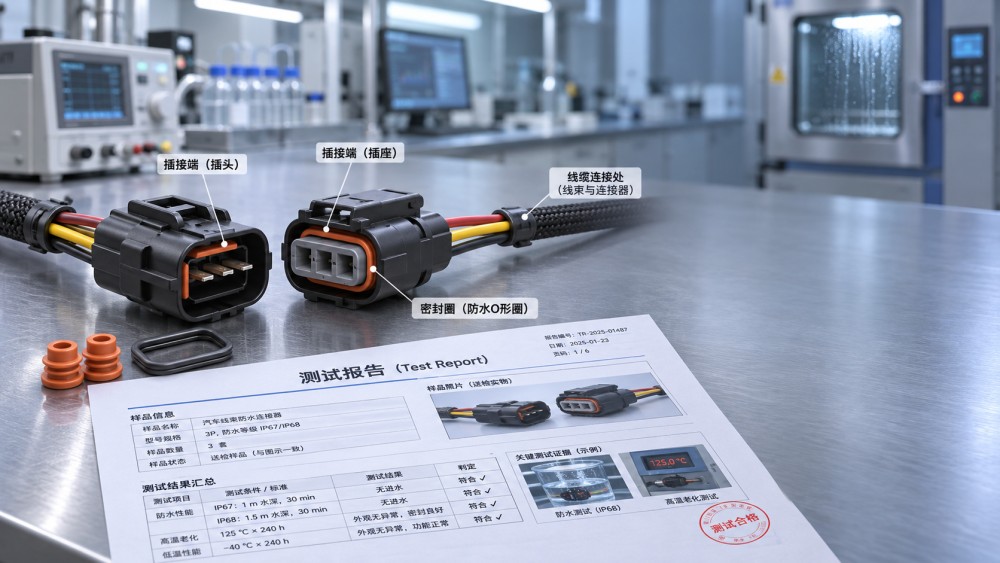
Ask whether the rated condition is mated, unmated, capped or mounted through a panel. Some interfaces rely on a mating seal or protective cap; the exposed half may not have the same protection during transport, storage or service. If the application requires protection while disconnected, that requirement belongs in the specification and the test plan.
Translate the rating into a vehicle exposure profile
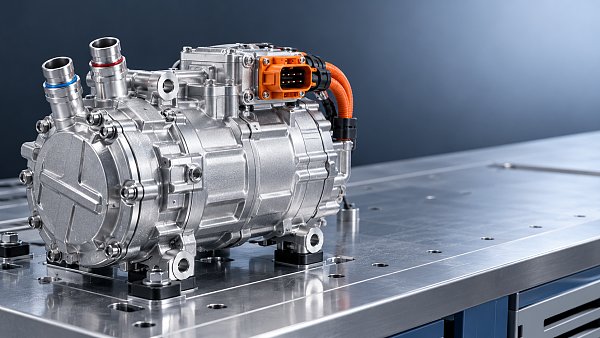
Before comparing quotations, document where the connector will sit and what it is likely to encounter. A protected cockpit connection, an underbody harness and a connector near an electric compressor may need very different evidence, even when each is described as waterproof.
- Water exposure: Is the concern splash, standing water, pressure washing, condensation or a combination? Record expected orientation and drainage paths.
- Temperature and pressure changes: Can heating and cooling create pressure differences that draw moisture past a seal? Consider the installed assembly, not just the connector on a bench.
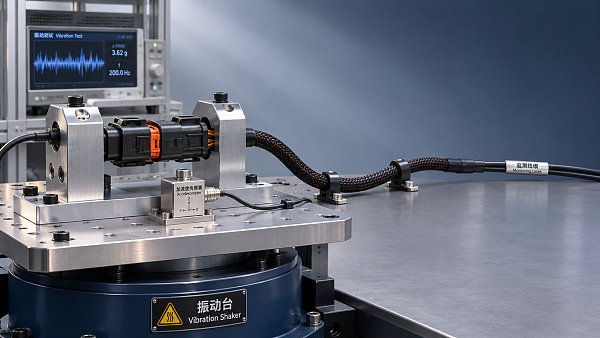
- Mechanical loading: Identify cable movement, vibration, bend radius and strain relief. Seal performance may change when the harness is under load.
- Fluids and contamination: Specify relevant coolant, oil, road salt or cleaning chemicals. Water-only IP testing does not establish chemical compatibility.
- Service conditions: Define mating cycles, access constraints and whether technicians may disconnect the interface in wet or dirty conditions.
For automotive projects, IEC 60529 may be only part of the qualification framework. ISO 20653 addresses degrees of protection for electrical equipment in road vehicles, while OEM specifications can add application-specific environmental and electrical requirements. Confirm the required standard, edition and contractual test plan with engineering; similar labels do not make all test programmes interchangeable.
A useful question is whether ingress protection was checked before or after relevant conditioning. A new sample that passes an immersion test may not answer the same question as a sample exposed to thermal cycling, vibration or fluids before immersion. The sequence and acceptance criteria should be agreed for the project rather than inferred from the IP code.
Make the acceptance criteria visible
“Pass” can conceal important differences. Review how the report assessed water entry and whether the tested equipment’s intended operation was considered. For an automotive electrical interface, the project may also require insulation resistance, dielectric withstand, contact resistance or functional checks. These are separate requirements: do not assume that an IP result includes them.
Confirm sample quantity, preparation and orientation, as well as whether the test covered the complete cable-to-connector assembly. Small sample tests provide useful evidence, but they do not establish a production defect rate. If a report records water inside a housing, review the observations and acceptance basis with engineering rather than interpreting the photograph or pass label in isolation.
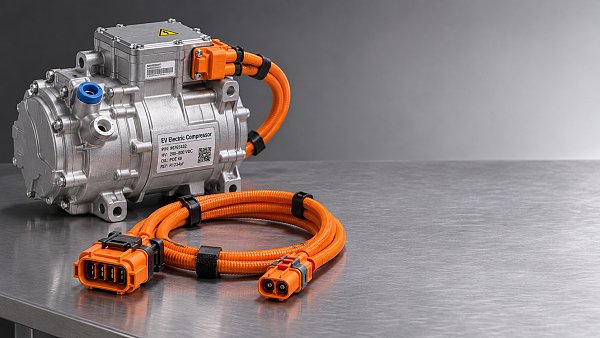
For high-voltage harnesses, protection against water is only one part of the decision. Electrical safety, shielding, mechanical retention and the applicable vehicle-level requirements need their own review. Procurement should resist treating a strong IP claim as a substitute for the wider qualification package.
Compare suppliers on evidence and change control
Two suppliers may quote the same IP rating but offer very different levels of traceability. One may provide a report that matches the exact assembly and identifies test conditions; another may provide only a family-level datasheet. Record that difference in the sourcing comparison rather than treating both claims as equivalent.
The evidence should remain relevant after nomination. Ask how the supplier controls changes to seal material, moulding tooling, manufacturing location, sub-suppliers and assembly instructions. Agree which changes require advance notification, engineering review or requalification. A supplier does not need to repeat every test for every administrative change, but the buyer should be able to assess whether a change affects the qualified configuration.
Check practical delivery questions too: whether seals and cavity plugs are included in the quoted part, how lot traceability works, what inspection records are available, and whether the required variant has a stable supply path. If production uses an alternate cable or second source, determine whether the existing evidence covers it before it appears on the line.
Where a documentation gap remains, make it explicit. The parties can agree on additional testing, a controlled engineering assessment or a conditional sourcing decision with clear owners and deadlines. Avoid turning an open technical question into an assumption hidden in a purchase order.
Build a defensible sourcing record
The strongest decision trail connects four items: the application requirements, the exact ordered configuration, the supporting test evidence and the production controls that keep that configuration consistent. Store the relevant report revision and drawing alongside the approval record, and document any differences that engineering has accepted.
GACT’s coverage of automotive wiring harnesses, thermal systems and supply chain developments can provide useful context when defining where an interface sits in a vehicle system. The final purchasing decision, however, still depends on project-specific evidence. Before releasing the order, confirm the test scope, assembly responsibilities, qualification gaps and change-notification requirements with both the supplier and the engineering team.
Have questions about this sector analysis, or seeking best practices specific to your niche? Drop us a line below and let the senior consultants at GAC assist you.
“We respect your privacy. Your information is strictly confidential.”
Related News
- 00
0000-00
What does AEC-Q100 qualification mean for automotive camera systems? - 00
0000-00
How to verify a waterproof connector supplier's IP ratings - 00
0000-00
How do air pockets affect automotive coolant systems? - 00
0000-00
How to identify automotive component export opportunities in new markets - 00
0000-00
How to assess a smart cockpit electronics manufacturer's integration capability
Weekly Insights
Stay ahead with our curated technology reports delivered every Monday.
Recommended News
 What does AEC-Q100 qualification mean for automotive camera systems?Automotive Camera Systems AEC-Q100 qualification: Discover what it means for IC reliability, temperature grades and camera validation before approving a design.Author:Time:Nov 22, 2026
 How to verify a waterproof connector supplier's IP ratingsWaterproof connector supplier IP ratings: learn how to verify test reports, match configurations and reduce automotive sourcing risks before you buy.Author:Time:Nov 21, 2026
 How do air pockets affect automotive coolant systems?Automotive Coolant Systems can overheat when air pockets disrupt coolant flow. Discover the warning signs, safe bleeding methods, and when to seek further diagnosis.Author:Time:Nov 20, 2026
 How to identify automotive component export opportunities in new marketsDiscover Automotive Component Export opportunities in new markets by assessing buyer access, technical fit, trade requirements, and landed costs.Author:Time:Nov 19, 2026
 How to assess a smart cockpit electronics manufacturer's integration capabilityAssess a smart cockpit electronics manufacturer's integration capability with practical checks for interfaces, testing, safety, cybersecurity and supplier support.Author:Time:Nov 18, 2026
 How does a shielded HSD cable reduce interference in vehicles?Discover how a shielded HSD cable reduces vehicle interference, and learn why connector design, routing, and testing matter for reliable high-speed data links.Author:Time:Nov 17, 2026
 What drives demand for scroll compressors in the automotive market?Explore the scroll compressor for automobile market and discover how EV adoption, heat pumps, efficiency, and supplier capabilities shape demand.Author:Time:Nov 16, 2026
 Does AEC-Q200 apply to flexible printed circuits?Flexible Printed Circuit AEC-Q200 requirements explained: discover which components qualify and how to assess automotive FPC reliability.Author:Time:Nov 15, 2026
 How does production volume affect automotive flexible electronics costs?Explore how production volume affects automotive flexible electronics cost, from tooling and yield to testing. Compare quotes and negotiate smarter.Author:Time:Nov 14, 2026
 How much does an in-vehicle infotainment system cost to replace?Explore in-vehicle infotainment cost, from affordable repairs to factory replacements. Compare options, installation fees, and compatibility before you buy.Author:Time:Nov 13, 2026
 How does condenser efficiency affect heat pump performance?Discover how condenser high efficiency can improve heat pump performance, reduce compressor power, and boost heating COP—plus the trade-offs to watch.Author:Time:Nov 12, 2026
 What does each FAKRA cable color code mean?FAKRA cable color code explained: Explore common connector colors, typical uses and key compatibility checks before choosing a replacement.Author:Time:Nov 11, 2026
 How to compare noise ratings for battery coolant pumpsCompare coolant pump low noise ratings with confidence. Learn how test conditions, hydraulic duty, tonal noise and installation affect your choice.Author:Time:Nov 10, 2026
 How bright should automotive display systems be in sunlight?Automotive Display Systems need more than brightness to stay readable in sunlight. Discover why 1,000 nits is a starting point and how to evaluate glare and heat.Author:Time:Nov 09, 2026
 How heat pumps improve the efficiency of EV thermal systemsEV Thermal Systems use heat pumps to reduce heating energy demand. Explore how they work, where they excel, and what limits efficiency in cold weather.Author:Time:Nov 08, 2026
 Can a smart cockpit platform support multiple displays?Can a smart cockpit platform support multiple displays? Explore key requirements for performance, safety, connectivity, and supplier evaluation.Author:Time:Nov 07, 2026
 How is automotive connector vibration resistance tested?Automotive connector vibration resistance testing reveals hidden contact failures. Explore test profiles, continuity monitoring and pass criteria.Author:Time:Nov 06, 2026
 How heat pumps save energy in automotive cabin climate systemsAutomotive Cabin Climate Systems energy saving starts with smarter heat pump design. Explore real-world efficiency, cold-weather trade-offs, and testing tips.Author:Time:Nov 05, 2026
 Is an EV heat pump worth it for winter driving range?Is a heat pump worth using in a cold-climate EV? Discover how it affects winter range, when it pays off, and what to check before buying.Author:Time:Nov 04, 2026
 When should you use 50-ohm coaxial cable instead of 75-ohm?Coaxial cable 50 ohm or 75 ohm? Learn when to use each, avoid impedance mismatches, and choose the right cable for reliable RF and video performance.Author:Time:Nov 03, 2026
 How to select a high temperature motor harness for an EVChoose the right high temperature motor harness for your EV. Compare thermal limits, current capacity, shielding, routing, and validation evidence.Author:Time:Nov 02, 2026
 How much does electric power steering replacement cost?Electric power steering price typically ranges from $1,000 to $3,000 for major replacements. Discover cost factors, repair options, and tips for comparing quotes.Author:Time:Nov 01, 2026
 How to size an EV A/C compressor for the required cooling capacitySize an EV A/C Compressor with confidence. Explore cooling loads, performance maps and power limits to select the right compressor for your vehicle.Author:Time:Oct 31, 2026
 How to choose the right pitch for an FPC board connectorFPC board connector pitch affects space, assembly and reliability. Learn how to compare options and select the best fit for your design.Author:Time:Oct 30, 2026
 How zonal design affects harness routing in high-voltage EV architecturesExplore high-voltage electrical architecture zonal design and its impact on EV harness routing. Discover key trade-offs in cable length, safety, thermal performance, and service access.Author:Time:Oct 29, 2026
 How tariffs affect costs in global automotive parts supply chainsNavigate tariffs in the global automotive parts trade supply chain. Learn to compare landed costs, manage duty exposure, and uncover smarter sourcing strategies to protect your margins.Author:Time:Oct 28, 2026
 How to assess vendor lock-in in a software-defined vehicle platformAssess Software-Defined Vehicle platform lock-in with practical tests for API portability, data access, update control, and exit costs. Learn how to choose a platform with a proven exit path.Author:Time:Oct 27, 2026
 How ISO 26262 guides functional safety in steer-by-wire systemsExplore steering systems functional safety through ISO 26262. Learn how hazard analysis, fault-tolerant design, and validation build a stronger steer-by-wire safety case.Author:Time:Oct 26, 2026
 How to evaluate a steering angle sensor manufacturer's accuracy claimsEvaluate steering angle sensor manufacturer accuracy claims with practical checks on calibration, latency, and test evidence. Compare suppliers confidently and avoid costly selection mistakes.Author:Time:Oct 25, 2026
 How to diagnose CAN bus faults in a hybrid vehicle control unitDiagnose Hybrid Vehicle Systems control unit CAN bus faults with step-by-step power, wiring, and waveform checks. Find the root cause and avoid unnecessary replacement.Author:Time:Oct 24, 2026