How heat pumps save energy in automotive cabin climate systems




For technical evaluators, Automotive Cabin Climate Systems energy saving is a critical consideration as electric vehicles balance passenger comfort with driving range.
Unlike resistance heaters, automotive heat pumps transfer heat from sources such as ambient air, power electronics, and the battery to warm the cabin.
Their efficiency depends on factors including operating temperature, system architecture, refrigerant selection, and component integration. These variables shape performance across real-world driving conditions.
The central question is not whether a heat pump can outperform resistance heating, but how much energy the complete vehicle saves under representative conditions.
How Does a Heat Pump Reduce Cabin Heating Energy?
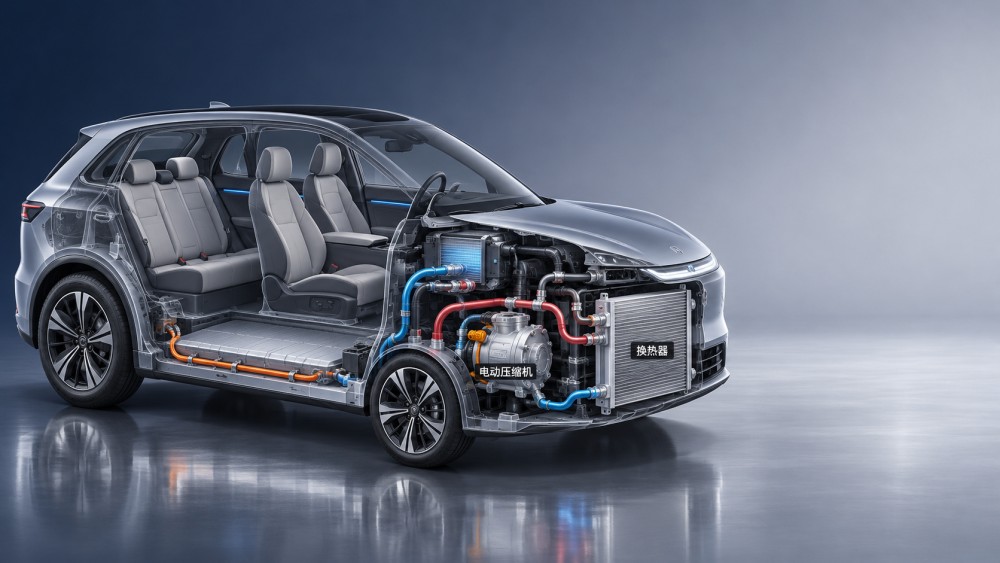
A heat pump uses a refrigerant circuit to move thermal energy into the cabin. An electrically driven compressor supplies the work needed for that transfer.
In heating mode, the refrigerant absorbs heat at a lower temperature, passes through the compressor, and releases useful heat at a higher temperature.
The source can be outside air, coolant carrying waste heat, or another available thermal reservoir. Valves and heat exchangers determine which paths are active.
A positive temperature coefficient, or PTC, resistance heater produces heat directly from electricity. A heat pump can deliver more heat than its electrical input.
That advantage is expressed as the coefficient of performance, or COP: useful heating output divided by electrical energy consumed over the same period.
For example, a system delivering 3 kW of cabin heat while consuming 1 kW of electricity has a heating COP of 3.
Under the same boundary conditions, a resistance heater would need approximately 3 kW of electrical input to deliver 3 kW of heat.
This comparison is illustrative, not a guaranteed vehicle result. Real COP changes with temperatures, compressor speed, airflow, refrigerant conditions, and auxiliary loads.
Evaluators should also distinguish compressor-only COP from system COP, which may include fans, pumps, controls, and supplemental electric heating.
How Much Energy and Driving Range Can Be Saved?
The value depends on heating demand and the baseline vehicle. A heat pump generally offers its greatest benefit when cabin heat is needed frequently.
Consider a 30-minute trip with an average cabin heating requirement of 3 kW. Resistance heating would consume approximately 1.5 kWh in this simplified example.
If a heat pump maintained a system COP of 2.5 over that period, it would consume about 0.6 kWh and save 0.9 kWh.
At a vehicle energy consumption of 20 kWh per 100 km, that saved energy corresponds to roughly 4.5 km of theoretical driving range.
This is an energy-equivalence calculation, not a measured range improvement. Actual results depend on battery conditions, route, speed, weather, and vehicle control strategies.
The calculation also assumes equal delivered cabin heat, equal comfort, and a system COP that includes relevant auxiliaries. Those assumptions require test verification.
For annual estimates, weight energy savings by local weather, trip length, parking conditions, occupancy, and charging behavior rather than applying one constant percentage.
Short trips deserve particular attention because warming a cold interior can dominate the energy balance before the system reaches a more efficient steady state.
When the cabin requires cooling, compare complete cooling-system performance as well. A reversible heat pump is not automatically more efficient than every conventional air-conditioning configuration.
What Happens in Cold Weather?
As outdoor temperature falls, an air-source heat pump has less favorable conditions for extracting heat and must generally lift it to a higher delivery temperature.
The compressor may consume more power for each unit of cabin heat. Available heating capacity can also decline just as occupant heating demand rises.
Humidity introduces another challenge. Frost can accumulate on an outdoor heat exchanger, restricting airflow and heat transfer until a defrost cycle removes it.
Defrost operation consumes energy and can temporarily reduce heat available to the cabin. Its frequency depends on temperature, humidity, airflow, and control strategy.
Many systems use PTC assistance or another supplemental heat source during demanding conditions. This preserves comfort but reduces the combined heating system COP.
Cold-weather evaluations should therefore report total electrical consumption, delivered comfort, defrost events, and supplemental heater use rather than relying on steady-state compressor data alone.
Test several conditions around freezing as well as colder temperatures. Frost formation and defrost behavior can make moderately cold, humid weather especially consequential.
At very low temperatures, the efficiency advantage may narrow substantially. The crossover point is vehicle-specific and should be established through controlled testing.
Which Heat Sources and Components Matter Most?
Ambient air is widely available, but its temperature varies. Waste heat from electric drive components or power electronics can provide a useful alternative source.
Waste heat is not free in a system-design sense: its availability depends on operating conditions, and extracting it requires suitable plumbing, controls, and heat exchangers.
Battery coolant may also participate in thermal integration, but battery temperature limits, charging needs, and component durability constrain when heat can be extracted.
Using battery heat for occupants can create a competing demand. Evaluators should check whether the control strategy protects battery performance and subsequent charging requirements.
The electric compressor affects efficiency across operating points. Assess its speed range, part-load performance, electrical losses, acoustic behavior, and compatibility with the refrigerant.
Integrated thermal valves route refrigerant or coolant among operating modes. Their pressure losses, leakage, switching reliability, and control accuracy influence overall system performance.
Heat exchanger sizing affects both heat transfer and packaging. Larger components may improve performance while adding mass, cost, airflow resistance, and installation constraints.
Coolant pumps and cabin blowers also matter because their power draw can erode compressor-level gains. Request efficiency data for the complete operating envelope.
Integrated architectures can share components between cabin and battery thermal management, but additional modes increase calibration effort, diagnostic complexity, and potential failure interactions.
How Should Refrigerant and Safety Trade-Offs Be Assessed?
Refrigerant selection affects operating pressure, heat-transfer characteristics, environmental impact, component design, and service procedures. No single property determines the best vehicle-level solution.
R134a, R1234yf, and R744 are examples used in automotive applications. Their suitability depends on system architecture, applicable regulations, safety requirements, and market strategy.
R1234yf has a lower global warming potential than R134a but is mildly flammable. Risk management depends on the complete system and applicable standards.
R744, or carbon dioxide, has low global warming potential but operates at substantially higher pressures, affecting component design, packaging, and service equipment.
For each target market, verify current refrigerant rules and applicable vehicle safety standards. Requirements and compliance dates can differ by jurisdiction and application.
Compare direct refrigerant emissions from leakage with indirect emissions from electricity consumption. The relative importance depends on leakage rates, vehicle use, and electricity generation.
How Can Evaluators Compare Competing Systems Fairly?
Start by defining the baseline: vehicle configuration, resistance heating capacity, cooling system, battery conditioning strategy, and any shared components must be clearly identified.
Set consistent test boundaries. Record high-voltage power to the compressor, PTC heater, pumps, fans, and other loads included in the stated performance metric.
Measure delivered heating as well as electrical input. Comparing power consumption without equivalent cabin temperature, airflow, and warm-up performance can produce misleading conclusions.
Use a test matrix covering ambient temperature, humidity, solar load, vehicle speed, battery state, initial cabin temperature, occupancy, and relevant driving cycles.
Include cold-soak starts and sustained operation. Report time to reach comfort targets, window defogging performance, peak power, total energy, and temperature stability.
For defrost, record initiation conditions, duration, frequency, occupant impact, and energy consumption. Compare systems over complete cycles rather than excluding unfavorable intervals.
Where possible, use both controlled chamber testing and road validation. Chamber tests improve repeatability; road tests expose transient conditions and integration effects.
Ask suppliers for measurement uncertainty, sensor locations, software versions, and control settings. These details help explain discrepancies between component, bench, and vehicle results.
Report seasonal energy consumption using representative weather and trip distributions. A weighted result is more useful for deployment decisions than one favorable COP point.
What Should Be Included in a Procurement Decision?
Beyond energy efficiency, assess incremental component cost, mass, packaging, manufacturing complexity, software calibration, and service requirements against the vehicle program's expected benefits.
Estimate ownership value using expected energy savings, local electricity prices, vehicle lifetime, and maintenance assumptions. State whether the analysis includes residual value or incentives.
For fleet applications, segment vehicles by climate and duty cycle. Frequent cold-weather use may justify an option that delivers limited value in mild regions.
Review compressor durability, valve cycling, refrigerant leakage, corrosion resistance, and repair access. Request reliability evidence relevant to the intended operating environment.
Also check supply continuity and regional service capability. Specialized refrigerant handling, high-pressure components, or proprietary controls can affect repair costs and downtime.
Finally, confirm how the system behaves after a fault. Cabin comfort, windshield visibility, battery protection, and safe high-voltage operation remain essential evaluation criteria.
Conclusion
Heat pumps can reduce cabin heating electricity by transferring heat instead of generating it entirely through resistance, but their advantage changes with operating conditions.
The strongest evaluation compares complete vehicle energy use at equivalent comfort, including cold starts, defrost, auxiliary loads, and interactions with battery thermal management.
For technical teams, the right choice is the architecture that delivers verified seasonal savings and dependable comfort within the program's cost, safety, and packaging constraints.
Have questions about this sector analysis, or seeking best practices specific to your niche? Drop us a line below and let the senior consultants at GAC assist you.
“We respect your privacy. Your information is strictly confidential.”
Related News
- 00
0000-00
How to assess a smart cockpit electronics manufacturer's integration capability - 00
0000-00
How does a shielded HSD cable reduce interference in vehicles? - 00
0000-00
What drives demand for scroll compressors in the automotive market? - 00
0000-00
Does AEC-Q200 apply to flexible printed circuits? - 00
0000-00
How does production volume affect automotive flexible electronics costs?
Weekly Insights
Stay ahead with our curated technology reports delivered every Monday.
Recommended News
 How to assess a smart cockpit electronics manufacturer's integration capabilityAssess a smart cockpit electronics manufacturer's integration capability with practical checks for interfaces, testing, safety, cybersecurity and supplier support.Author:Time:Nov 18, 2026
 How does a shielded HSD cable reduce interference in vehicles?Discover how a shielded HSD cable reduces vehicle interference, and learn why connector design, routing, and testing matter for reliable high-speed data links.Author:Time:Nov 17, 2026
 What drives demand for scroll compressors in the automotive market?Explore the scroll compressor for automobile market and discover how EV adoption, heat pumps, efficiency, and supplier capabilities shape demand.Author:Time:Nov 16, 2026
 Does AEC-Q200 apply to flexible printed circuits?Flexible Printed Circuit AEC-Q200 requirements explained: discover which components qualify and how to assess automotive FPC reliability.Author:Time:Nov 15, 2026
 How does production volume affect automotive flexible electronics costs?Explore how production volume affects automotive flexible electronics cost, from tooling and yield to testing. Compare quotes and negotiate smarter.Author:Time:Nov 14, 2026
 How much does an in-vehicle infotainment system cost to replace?Explore in-vehicle infotainment cost, from affordable repairs to factory replacements. Compare options, installation fees, and compatibility before you buy.Author:Time:Nov 13, 2026
 How does condenser efficiency affect heat pump performance?Discover how condenser high efficiency can improve heat pump performance, reduce compressor power, and boost heating COP—plus the trade-offs to watch.Author:Time:Nov 12, 2026
 What does each FAKRA cable color code mean?FAKRA cable color code explained: Explore common connector colors, typical uses and key compatibility checks before choosing a replacement.Author:Time:Nov 11, 2026
 How to compare noise ratings for battery coolant pumpsCompare coolant pump low noise ratings with confidence. Learn how test conditions, hydraulic duty, tonal noise and installation affect your choice.Author:Time:Nov 10, 2026
 How bright should automotive display systems be in sunlight?Automotive Display Systems need more than brightness to stay readable in sunlight. Discover why 1,000 nits is a starting point and how to evaluate glare and heat.Author:Time:Nov 09, 2026
 How heat pumps improve the efficiency of EV thermal systemsEV Thermal Systems use heat pumps to reduce heating energy demand. Explore how they work, where they excel, and what limits efficiency in cold weather.Author:Time:Nov 08, 2026
 Can a smart cockpit platform support multiple displays?Can a smart cockpit platform support multiple displays? Explore key requirements for performance, safety, connectivity, and supplier evaluation.Author:Time:Nov 07, 2026
 How is automotive connector vibration resistance tested?Automotive connector vibration resistance testing reveals hidden contact failures. Explore test profiles, continuity monitoring and pass criteria.Author:Time:Nov 06, 2026
 How heat pumps save energy in automotive cabin climate systemsAutomotive Cabin Climate Systems energy saving starts with smarter heat pump design. Explore real-world efficiency, cold-weather trade-offs, and testing tips.Author:Time:Nov 05, 2026
 Is an EV heat pump worth it for winter driving range?Is a heat pump worth using in a cold-climate EV? Discover how it affects winter range, when it pays off, and what to check before buying.Author:Time:Nov 04, 2026
 When should you use 50-ohm coaxial cable instead of 75-ohm?Coaxial cable 50 ohm or 75 ohm? Learn when to use each, avoid impedance mismatches, and choose the right cable for reliable RF and video performance.Author:Time:Nov 03, 2026
 How to select a high temperature motor harness for an EVChoose the right high temperature motor harness for your EV. Compare thermal limits, current capacity, shielding, routing, and validation evidence.Author:Time:Nov 02, 2026
 How much does electric power steering replacement cost?Electric power steering price typically ranges from $1,000 to $3,000 for major replacements. Discover cost factors, repair options, and tips for comparing quotes.Author:Time:Nov 01, 2026
 How to size an EV A/C compressor for the required cooling capacitySize an EV A/C Compressor with confidence. Explore cooling loads, performance maps and power limits to select the right compressor for your vehicle.Author:Time:Oct 31, 2026
 How to choose the right pitch for an FPC board connectorFPC board connector pitch affects space, assembly and reliability. Learn how to compare options and select the best fit for your design.Author:Time:Oct 30, 2026
 How zonal design affects harness routing in high-voltage EV architecturesExplore high-voltage electrical architecture zonal design and its impact on EV harness routing. Discover key trade-offs in cable length, safety, thermal performance, and service access.Author:Time:Oct 29, 2026
 How tariffs affect costs in global automotive parts supply chainsNavigate tariffs in the global automotive parts trade supply chain. Learn to compare landed costs, manage duty exposure, and uncover smarter sourcing strategies to protect your margins.Author:Time:Oct 28, 2026
 How to assess vendor lock-in in a software-defined vehicle platformAssess Software-Defined Vehicle platform lock-in with practical tests for API portability, data access, update control, and exit costs. Learn how to choose a platform with a proven exit path.Author:Time:Oct 27, 2026
 How ISO 26262 guides functional safety in steer-by-wire systemsExplore steering systems functional safety through ISO 26262. Learn how hazard analysis, fault-tolerant design, and validation build a stronger steer-by-wire safety case.Author:Time:Oct 26, 2026
 How to evaluate a steering angle sensor manufacturer's accuracy claimsEvaluate steering angle sensor manufacturer accuracy claims with practical checks on calibration, latency, and test evidence. Compare suppliers confidently and avoid costly selection mistakes.Author:Time:Oct 25, 2026
 How to diagnose CAN bus faults in a hybrid vehicle control unitDiagnose Hybrid Vehicle Systems control unit CAN bus faults with step-by-step power, wiring, and waveform checks. Find the root cause and avoid unnecessary replacement.Author:Time:Oct 24, 2026
 How does battery cooling pipe diameter affect coolant pressure drop?Battery Cooling Pipe diameter affects coolant pressure drop and pump power. Explore sizing calculations and practical tips to optimize EV battery cooling and compare options with confidence.Author:Time:Oct 23, 2026
 How to assess PPAP readiness of automotive sensor system manufacturersAssess Automotive Sensor Systems manufacturers for PPAP readiness. Learn to verify production evidence, measurement capability, validation, and traceability to reduce sourcing risks.Author:Time:Oct 22, 2026
 What to ask an FPC connector manufacturer about reliability testingChoosing an FPC Connector manufacturer? Learn what to ask about reliability testing, failure limits, and traceable results to reduce design risks and select with confidence.Author:Time:Oct 21, 2026
 How to verify vehicle fitment for an aftermarket AC evaporatorNavigating the evaporator aftermarket? Verify vehicle fitment with VIN data, OE numbers, and physical interface checks. Use this guide to avoid costly mismatches and order confidently.Author:Time:Oct 20, 2026