EPS Steering Failures: Early Signs and Service Checks




EPS steering failures often begin with subtle warning signs—intermittent stiffness, unusual noises, steering pull, or dashboard alerts—that aftermarket technicians should never overlook. For service professionals, early diagnosis and precise inspection are essential to prevent safety risks, reduce repeat repairs, and protect system reliability. This article outlines the most common early symptoms and the key service checks needed to identify faults efficiently and support accurate maintenance decisions.
For aftermarket workshops, EPS steering complaints are rarely just comfort issues. A light steering fluctuation during low-speed maneuvering, a momentary assist drop after engine start, or a steering angle mismatch after front-end work can quickly become a comeback case, a calibration issue, or a safety concern.
As vehicles become more dependent on electromechanical controls, technicians need a service logic that connects electrical supply, communication signals, steering mechanics, and software adaptation. That is especially relevant in today’s supply chain environment, where steering columns, torque sensors, harnesses, and control modules are increasingly integrated.
Recognizing Early EPS Steering Failure Symptoms
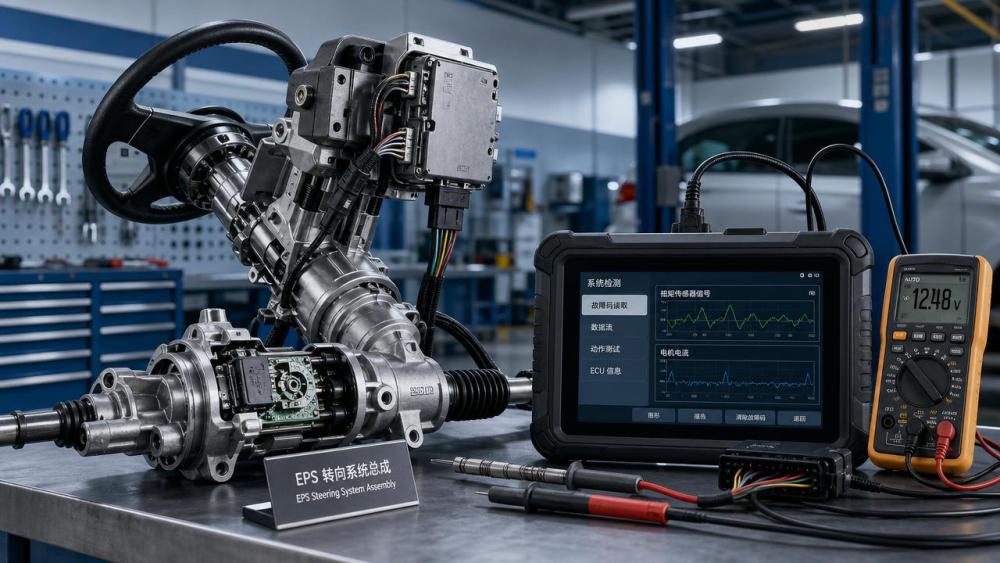
Early EPS steering faults usually appear in patterns rather than complete failure. In many workshop cases, the first stage lasts 1–4 weeks and shows up only at cold start, full-lock turns, rough roads, or parking speeds below 15 km/h.
Typical Driver Complaints Technicians Should Decode
Customers often describe EPS steering issues with non-technical language. “Heavy steering,” “wandering,” “clicking,” or “steering not returning normally” may point to very different root causes. The technician’s first task is to convert symptoms into electrical, mechanical, or communication-related fault paths.
- Intermittent heavy assist during parking or low-speed turns
- Steering wheel pull or off-center feel after suspension alignment
- Grinding, clicking, or motor-like humming from the column or rack area
- Warning lamp illumination after battery replacement or jump-start events
- Assist loss triggered by potholes, vibration, or high-current electrical loads
If two or more of these symptoms occur together, the probability of a system-level EPS steering issue rises significantly. For example, assist fluctuation plus charging voltage instability often indicates the need to inspect both the power supply side and module fault memory before replacing parts.
Why Subtle Symptoms Matter in Modern Steering Systems
Unlike hydraulic systems, EPS steering depends on sensor input, module logic, motor output, and stable voltage. A deviation as small as 0.2–0.5 V in supply under load, or a brief communication interruption, can change assist behavior without producing a hard failure immediately.
This is why “no obvious fault found” is a weak conclusion in EPS service. A vehicle may pass a static bay check but still fail during dynamic steering angle changes, thermal loading, or after 20–30 minutes of operation when motor temperature rises and internal resistance changes.
Symptoms by likely subsystem
The table below helps aftermarket technicians classify EPS steering symptoms by likely fault area. It is not a substitute for OEM procedures, but it is useful for reducing unnecessary part replacement and improving diagnostic speed.
The key takeaway is that EPS steering symptoms should be grouped by operating condition, not just by noise or warning lamp status. A symptom that appears only under 12 V stress, only after alignment, or only when warm provides stronger diagnostic direction than a generic complaint alone.
Common Misdiagnosis Patterns in the Aftermarket
One frequent mistake is replacing the steering assembly before checking system voltage and grounds. EPS steering motors can draw substantial current during parking maneuvers, and weak battery condition, oxidized ground points, or connector resistance above normal can mimic internal steering faults.
Another common error is skipping calibration after suspension, tire, or steering component work. On many vehicles, steering angle offset, torque sensor zero point, and ADAS-related references must be checked within the same service event. A mechanically correct repair may still feel wrong if software adaptation is incomplete.
Essential Service Checks for Accurate EPS Diagnosis
A practical EPS steering workflow should move from basic electrical and mechanical checks to data-based confirmation. In most workshops, a disciplined 5-step process can reduce repeat repairs and improve first-time fix rates, especially when fault symptoms are intermittent.
Step 1: Verify Power Supply and Ground Integrity
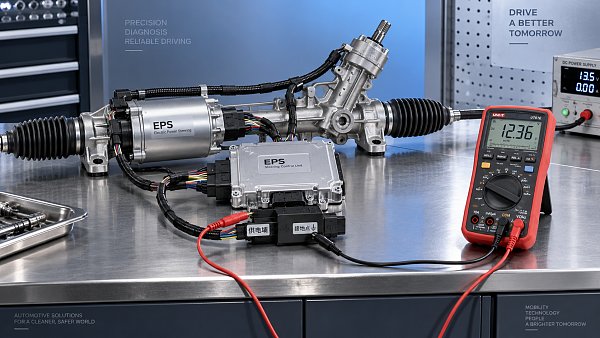
Begin with battery state, charging voltage, fuse condition, and ground path resistance. During steering load, low system voltage may momentarily disable assist or set undervoltage-related DTCs. A normal static reading is not enough; voltage should also be observed during steering input at idle and with accessories on.
Technicians should pay special attention to high-load conditions such as headlamps, rear defrost, blower on high, and repeated lock-to-lock steering. In these conditions, any unstable drop pattern becomes more visible and helps separate EPS steering failure from vehicle-wide electrical weakness.
Recommended baseline checks
- Confirm battery voltage and cranking behavior
- Inspect EPS fuse, relay path, and primary grounds
- Measure charging output under idle and loaded conditions
- Check connector fit, terminal tension, and signs of heat discoloration
- Compare live data before and during steering effort
Step 2: Scan Fault Codes and Read Live Data Correctly
DTC reading is necessary, but fault codes alone do not complete the diagnosis. EPS steering service becomes far more accurate when technicians compare torque sensor values, steering angle, motor current, assist command, and vehicle speed data in real time.
Look for data irregularities such as an unstable zero point, left/right asymmetry, signal dropout, or steering angle not returning consistently to center. Even a small offset can create steering feel complaints and trigger intervention from stability control systems.
The following table summarizes a service-oriented EPS steering inspection sequence that many aftermarket teams can adapt to different vehicle platforms.
This process matters because EPS steering faults are often layered. A vehicle can have a mild mechanical bind and an angle sensor issue at the same time. Without structured checks, one fault may hide the other and lead to unnecessary module replacement.
Step 3: Inspect Mechanical Resistance Before Condemning Electronics
EPS steering systems amplify driver input, but they cannot compensate for excessive mechanical drag. Binding tie rod ends, damaged top mounts, collision-related subframe shift, or rack contamination can all raise steering effort and distort electronic diagnosis.
A useful method is to isolate steering effort with the front wheels unloaded where appropriate, then compare steering feel and scan data. If motor current is high but steering movement is still uneven, the technician should investigate friction or alignment geometry before replacing electronic parts.
Step 4: Confirm Calibration, Coding, and Post-Repair Procedures
After replacing a column, rack, sensor-related part, battery, or even performing wheel alignment, many vehicles require steering angle calibration or initialization. Some systems also need basic settings, coding confirmation, or a short road test cycle of 5–15 minutes to complete learning.
Skipping this step can create steering pull, warning lamps, limited assist, or ESC/ADAS interaction complaints. For aftermarket technicians, this is one of the most preventable causes of repeat work in EPS steering service.
Workshop Risk Control, Parts Decisions, and Service Value
Beyond diagnosis, EPS steering work also affects workshop profitability and customer trust. The difference between a one-time repair and a comeback often lies in documentation, parts judgment, and whether the technician explains the difference between symptom relief and root-cause correction.
How to Decide Between Repair, Reconditioning, and Replacement
Not every EPS steering complaint requires full assembly replacement. In some cases, the correct solution may be connector repair, harness correction, ground restoration, calibration, or mechanical adjustment. In others, replacing a high-failure internal component without a validated test result creates additional liability.
- Choose repair first when the fault is clearly external, such as wiring, grounds, or mount looseness
- Consider reconditioning only when testing standards and part traceability are controlled
- Replace the assembly when sensor integrity, motor function, or internal gear condition cannot be reliably restored
For B2B service environments, documentation should include at least 4 items: initial complaint, scan result, measured electrical condition, and post-repair verification. This improves internal quality control and helps justify parts decisions to fleet clients, insurers, or parts distributors.
High-Value Checks That Reduce Comebacks
Several low-cost checks consistently improve EPS steering repair quality. These include confirming battery condition before diagnosis, checking connector pin fit, verifying steering center after alignment, and completing a structured road test with left/right low-speed turns and straight-line recovery.
A road test of 8–12 minutes is often enough to validate whether assist is stable across parking speed, urban speed, and return-to-center conditions. Recording these observations gives the workshop a stronger close-out process and helps identify faults that do not appear in a static service bay.
Frequently overlooked workshop details
The following points are frequently missed in aftermarket EPS steering work, even in otherwise competent repairs.
- Using alignment results without confirming steering wheel center
- Clearing fault codes before recording freeze-frame data
- Ignoring low battery history after start-stop complaints
- Replacing steering parts before checking harness stress or water ingress
- Failing to complete calibration after related chassis service
Why EPS Steering Intelligence Matters to the Supply Chain
For organizations following automotive electromechanical controls, EPS steering is more than a repair topic. It reflects how steering columns, torque sensors, motors, control modules, and wiring harnesses are becoming more integrated with chassis redundancy, software logic, and broader smart vehicle architecture.
That is why service teams, parts buyers, and technical managers benefit from intelligence that links component design, field failure patterns, and maintenance practice. In the current market, understanding how electrical signal quality, connector reliability, and steering control behavior interact is becoming a core capability rather than a specialized niche.
Effective EPS steering service starts with recognizing minor symptoms before they become major failures. Intermittent assist loss, steering pull, unusual noises, unstable sensor data, and calibration omissions all deserve structured inspection rather than quick assumptions.
For aftermarket technicians and B2B service decision-makers, the best results come from combining 3 priorities: stable electrical supply checks, disciplined mechanical inspection, and correct scan-tool-based calibration procedures. This approach reduces repeat repairs, protects steering reliability, and supports better parts decisions.
If you need deeper insight into EPS steering components, automotive electromechanical controls, or broader supply-chain and service trends, contact GACT to get tailored intelligence, discuss component-level issues, or explore more practical solutions for steering system maintenance and decision support.
Related News
- 00
0000-00
How electric compressor speed affects EV battery cooling capacity - 00
0000-00
How to verify a variable frequency compressor supplier’s efficiency claims - 00
0000-00
How bend radius affects FPC reliability in automotive camera modules - 00
0000-00
How to diagnose intermittent loss of electric power steering assist - 00
0000-00
How to size automotive power modules for electric compressors
Weekly Insights
Stay ahead with our curated technology reports delivered every Monday.
Recommended News
 How electric compressor speed affects EV battery cooling capacityElectric compressor technology: battery cooling depends on more than RPM. Discover how speed, refrigerant flow, and system limits affect EV cooling capacity and energy efficiency.Author:Time:Oct 19, 2026
 How to verify a variable frequency compressor supplier’s efficiency claimsVerify a variable frequency compressor supplier’s efficiency claims using COP boundaries, matched test conditions, and duty-cycle data. Learn how to choose with confidence.Author:Time:Oct 18, 2026
 How bend radius affects FPC reliability in automotive camera modulesAutomotive FPC applications: camera module reliability starts with bend radius. Learn how stack-up, strain, and validation guide robust designs and help prevent costly failures.Author:Time:Oct 17, 2026
 How to diagnose intermittent loss of electric power steering assistMaster power steering system diagnostics to trace intermittent EPS assist loss. Learn proven checks for voltage, wiring, and fault codes to avoid costly guesswork.Author:Time:Oct 16, 2026
 How to size automotive power modules for electric compressorsSize automotive power modules for electric compressors with confidence. Learn how voltage, phase current, losses, and cooling shape reliable selection—and avoid costly oversizing.Author:Time:Oct 15, 2026
 Why automotive power electronics are shifting to silicon carbideAutomotive Power Electronics are shifting to silicon carbide. Discover how SiC can cut losses, boost EV power density, and reshape cooling, reliability, and system costs.Author:Time:Oct 14, 2026
 How EV adoption shapes the electrically driven compressor marketExplore how EV adoption shapes the electrically driven compressor market, from battery cooling and heat pumps to supplier margins. Discover the drivers of profitable growth.Author:Time:Oct 13, 2026
 How to size a PTC heater for reliable EV cabin heatingPTC Heater sizing for EV cabins: learn how to balance defrost performance, heat-pump integration, airflow, voltage range, and battery power for reliable winter comfort.Author:Time:Oct 12, 2026
 What determines the cooling output of electric automotive AC compressors?Automotive air conditioning compressors electric systems: explore how speed, voltage, refrigerant, controls, and heat exchangers shape EV cooling capacity and efficiency.Author:Time:Oct 11, 2026
 What makes a touchscreen media head unit responsive enough for daily use?Touchscreen media head unit performance explained: discover what delivers fast starts, smooth maps, reliable phone pairing, and responsive daily driving.Author:Time:Oct 10, 2026
 Can a Domain Controller Share a Cooling Loop with Other Electronics?Can a domain controller share a cooling loop with other electronics? Explore thermal zoning, flow control, safety priorities, and reliable vehicle electronics cooling strategies.Author:Time:Oct 19, 2026
 What Causes Domain Controller Overheating During Summer Testing?What causes domain controller overheating in summer testing? Explore heat load, airflow, installation, software factors, and practical fixes.Author:Time:Oct 18, 2026
 Is a Head-Up Display Hard to Integrate with Different Windshields?Is a head-up display difficult to integrate with different windshields? Discover how glass geometry, coatings, and calibration affect HUD clarity, cost, and production readiness.Author:Time:Oct 17, 2026
 What Should Be Checked Before Selecting an Automotive Head Unit?What should be checked before selecting an automotive head unit? Explore compatibility, performance, cybersecurity, compliance, and supplier support.Author:Time:Oct 16, 2026
 Is Steer-by-Wire More Expensive Than an EPS Steering System?Is steer-by-wire more expensive than an EPS steering system? Explore the true costs, safety demands, software value, and when SbW justifies its premium.Author:Time:Oct 15, 2026
 Which Automotive Electronics Need Validation for 800V Platforms?What automotive electronics should be validated for 800V platforms? Explore critical checks for harnesses, power electronics, thermal systems, safety, and EMC.Author:Time:Oct 14, 2026
 How Do Automotive Compressor Export Requirements Vary by Market?How do automotive compressor export requirements vary by market? Explore key compliance rules for refrigerants, EV safety, OEM approvals, labeling, and customs.Author:Time:Oct 13, 2026
 What Documents Are Needed to Export Automotive Thermal Components?What documents are needed to export automotive thermal components? Explore customs, compliance, technical records, and shipping tips to prevent costly delays.Author:Time:Oct 12, 2026
 How Often Should an EV Air Conditioning Compressor Be Inspected?How often should an EV air conditioning compressor be inspected? Discover recommended service intervals, warning signs, and expert care tips to protect cooling performance and EV reliability.Author:Time:Oct 11, 2026
 How to size power solutions for automotive head-up display systemsHeads-up display systems power solutions: learn how to size automotive HUD power architectures for startup, brightness, thermal limits, EMC, protection, and reliable vehicle operation.Author:Time:Oct 19, 2026
 How does a head-up display work in a high-performance car?Hoe werkt een head-up display in een high-performance auto en welke informatie toont het? Discover the tech, safety alerts, and performance data that sharpen every drive.Author:Time:Oct 18, 2026
 Which trends will shape zonal EV architectures in the next decade?Future trends in zonal EV architectures: explore smarter power distribution, 48V systems, thermal integration, software, and resilient networks shaping next-gen vehicles.Author:Time:Oct 17, 2026
 When does a zonal EV architecture outperform a centralized design?Explore the trade-offs between zonal and centralized EV architectures to identify the best path for harness efficiency, software scalability, safety, and faster EV launches.Author:Time:Oct 16, 2026
 How to compare vendors for zonal EV power architecturesComparing vendors for zonal EV power architectures: assess electrical capability, interface ownership, lifecycle support, and integration risk for smarter sourcing.Author:Time:Oct 15, 2026
 How zonal architectures can improve EV reliability at the system levelHow zonal architectures affect EV reliability: explore fault containment, diagnostics, power resilience, and software strategies for more dependable electric vehicles.Author:Time:Oct 14, 2026
 What is driving growth in the automotive E/E architecture market?Explore what drives the automotive electric electronic systems architecture market, from EV power systems and zonal computing to ADAS, cybersecurity, and software-defined vehicles.Author:Time:Oct 13, 2026
 How to evaluate top-rated vehicle electrical components for reliabilityDiscover how to evaluate top-rated vehicle electrical components for reliability, from connector integrity and thermal margins to validation data and manufacturing control.Author:Time:Oct 12, 2026
 What makes vehicle electrical components reliable over a long service life?Top-rated vehicle electrical components for reliability depend on thermal control, sealing, vibration resistance, and validated manufacturing. Discover how to choose durable parts.Author:Time:Oct 11, 2026
 How battery thermal management solutions prevent fast-charge overheatingBattery thermal management solutions prevent fast-charge overheating with intelligent cooling, valve control, predictive preconditioning, and reliable heat rejection.Author:Time:Oct 09, 2026
 What an automotive market report can reveal about EV demand shiftsAutomotive market report insights reveal EV demand shifts, component opportunities, regional risks, and smarter investment strategies for growth.Author:Time:Oct 08, 2026