
What to verify before choosing an intelligent steering manufacturer




Choosing an intelligent steering manufacturer is not a catalog comparison exercise. For a conventional steering program, a familiar column, gear, or electric power steering (EPS) unit may be evaluated largely through performance targets, packaging, cost, and manufacturing maturity. For an intelligent steering program—especially one involving steer-by-wire, rear-wheel steering coordination, automated driving functions, or centralized vehicle control—the decision reaches much further.
The steering supplier may influence vehicle safety architecture, electrical architecture, software release timing, diagnostic strategy, cybersecurity exposure, homologation evidence, and the ownership of field issues years after SOP. A product can look capable in a demonstration vehicle while still being difficult to integrate, insufficiently validated, or dependent on engineering support that is not scalable.
Technical evaluators therefore need to verify evidence, not just claims. The following review points help procurement, vehicle engineering, functional safety, and quality teams assess whether an intelligent steering manufacturer can support a real production program rather than only a prototype opportunity.
Begin with the vehicle-level steering use case
Before reviewing suppliers, define what “intelligent steering” means for the vehicle architecture. The term is used broadly across the market. It may describe a conventional EPS system with advanced control features, a variable steering ratio system, an active front steering solution, a rear-wheel steering actuator, or a full steer-by-wire (SbW) architecture without a permanent mechanical connection between the steering wheel and road wheels.
These are not interchangeable technical scopes. A supplier that is credible in column-mounted EPS may not have the system engineering capability required for a fail-operational steer-by-wire platform. Equally, a manufacturer with advanced SbW demonstrations may not be the right fit for a cost-sensitive high-volume EPS program.
Build a short system definition before the request for quotation or technical workshop. It should clarify:
- Vehicle segment, axle loads, tire sizes, steering rack loads, and intended markets.
- Target functions, such as lane centering support, automated parking, hands-off driving, variable ratio, road feel tuning, or rear-steering coordination.
- Electrical architecture, including 12 V, 48 V, or high-voltage interfaces and network protocols.
- Required availability during a fault, limp-home expectations, and driver takeover assumptions.
- Mechanical packaging constraints at the column, rack, front axle, and cockpit interface.
- Program timing, expected annual volume, localization needs, and service parts strategy.
This baseline prevents a common error: assessing suppliers against an attractive feature list instead of the actual safety and integration burden of the intended vehicle.
Separate product capability from system responsibility
One of the most important questions is where the intelligent steering manufacturer’s responsibility begins and ends. Some suppliers provide a motor, ECU, torque sensor, and mechanical assembly, while the OEM or a separate software integrator owns higher-level controls. Others offer a complete steering domain solution, including vehicle motion interfaces, software calibration tools, diagnostics, and functional safety work products.
Neither model is automatically better. The risk appears when responsibilities are assumed rather than documented. If the vehicle dynamics controller requests a steering angle that conflicts with rack limits, who arbitrates? If automated parking fails due to a timing issue across CAN or Automotive Ethernet, who owns root-cause analysis? If the driver-feel model changes late in development, can the supplier update the controller without destabilizing safety functions?
Ask for a responsibility matrix covering hardware, embedded software, application software, calibration, cybersecurity, safety analysis, vehicle integration, validation, and post-SOP engineering. The matrix should identify deliverables, interfaces, approval gates, and escalation paths. A capable supplier will usually be comfortable discussing these boundaries in practical detail.
For steer-by-wire, inspect redundancy as an architecture—not a slogan
Steer-by-wire is often presented through simple language such as “dual redundancy” or “fail-safe design.” Those phrases are not enough for a technical assessment. Redundancy must be examined across sensing, computing, power supply, communication, actuation, and mechanical behavior.
For example, duplicated microcontrollers do not ensure steering availability if both depend on a shared power path, shared clock source, shared connector region, or common software defect. Two steering angle sensors offer limited protection if their mounting arrangement permits the same mechanical failure mode. A backup power source has little value if the system cannot detect degradation early enough to transition safely.
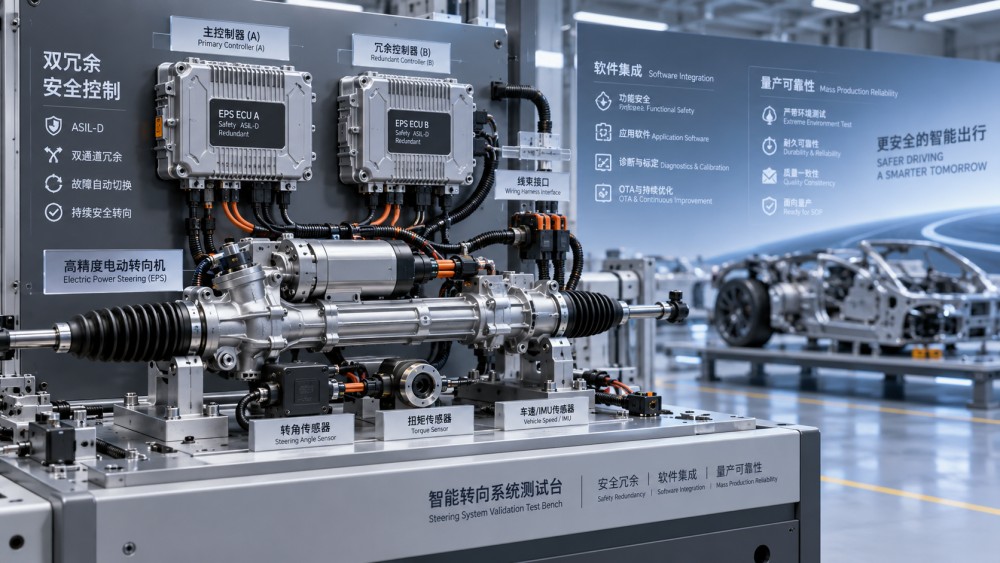
During an architecture review, request a fault containment explanation rather than only a block diagram. The supplier should be able to explain what happens when there is a loss of primary power, a sensor plausibility error, a motor inverter fault, a communication timeout, an ECU reset, an actuator jam, or an internal memory corruption event. Look for clear answers to three questions:
- How is the fault detected and diagnosed?
- What steering capability remains available to the driver or automated system?
- What independent path prevents the same failure from disabling the backup function?
For SbW systems, review the relationship between the handwheel actuator and road-wheel actuator as well. The driver must receive stable, understandable feedback under normal driving and abnormal conditions. A supplier should demonstrate how it manages loss of road-wheel feedback, abrupt friction changes, degraded actuator performance, and transitions between control modes. The quality of this explanation often reveals more than a polished demonstration drive.
Verify functional safety evidence early, not at nomination
Functional safety should be treated as a design input from the beginning of supplier selection. Intelligent steering is typically among the most safety-critical vehicle systems, and late discovery of a safety gap can create expensive architecture changes.
Technical evaluators do not need to demand every confidential work product during an early assessment. They should, however, establish whether the supplier has a disciplined safety development process and whether its evidence matches the product being proposed. Ask to review the approach to hazard analysis and risk assessment, functional safety concept development, technical safety requirements, safety mechanisms, fault reaction time, confirmation measures, and safety case structure.
A useful distinction is between a supplier that says it “works to ISO 26262” and one that can trace safety goals through system requirements, hardware and software design, verification, and production controls. The latter should be able to discuss assumptions of use, dependencies on vehicle-level functions, and residual risks that require OEM decisions.
Also examine change management. If a new semiconductor, software library, sensor variant, or manufacturing location is introduced after design validation, how is safety impact assessed? Intelligent steering programs rarely remain static. A strong manufacturer has a defined process for managing changes without losing traceability or weakening the original safety argument.
Evaluate software as a long-term engineering capability
In intelligent steering, mechanical precision remains essential, but software increasingly determines the driver experience and system behavior. Control algorithms govern assist curves, damping, returnability, pull compensation, friction compensation, overlay torque, end-stop behavior, diagnostics, and interaction with automated driving functions. The supplier’s software organization therefore deserves the same level of scrutiny as its machining and assembly operations.
Ask how software is partitioned between platform code and vehicle-specific application code. Find out whether the proposed ECU supports secure boot, secure diagnostics, authenticated updates, and rollback logic appropriate to the vehicle’s update strategy. If over-the-air software updates are planned, verify how the supplier supports release packaging, compatibility management, field monitoring, and rollback after an unsuccessful update.
Calibration is another practical differentiator. A steering system that meets torque and response specifications may still feel artificial, inconsistent, or tiring in daily driving. Review the available calibration parameters, toolchain, data logging capability, and process for tuning across tire variants, vehicle masses, driving modes, and temperature conditions. The supplier should be able to explain how it avoids turning every vehicle change into a bespoke software project.
Cybersecurity cannot be left to a generic corporate statement. The steering controller sits on a connected vehicle network and may receive requests from ADAS, vehicle motion, gateway, diagnostic, and cloud-related update paths. Confirm how the manufacturer handles threat analysis, access control, secure communication assumptions, vulnerability handling, and incident response. The goal is not to extract sensitive details in a sourcing meeting; it is to determine whether cybersecurity engineering is embedded in product development and supplier governance.
Do not overlook steering feel, durability, and real-world edge cases
Specifications tend to focus on peak assist torque, response time, steering angle accuracy, current draw, and packaging. Those metrics matter, yet they do not fully capture road behavior. An intelligent steering manufacturer should have a credible approach to subjective and objective evaluation.
During technical reviews, ask how the supplier assesses on-center feel, return-to-center behavior, steering kickback, crosswind response, road disturbance filtering, torque ripple, noise, and behavior on low-friction surfaces. For electric vehicles, added vehicle mass, different front axle loading, regenerative braking interactions, and quiet cabin conditions can make steering tuning more visible to drivers.
Environmental validation also needs to reflect the target market. Heat, cold starts, humidity, salt exposure, vibration, water ingress, electromagnetic compatibility, and connector durability can each affect steering performance. A manufacturer should map its validation plan to the program’s operating environment rather than offer a generic test list. For global vehicles, it is worth checking whether the supplier has experience interpreting different regulatory and customer test expectations across China, Europe, North America, Japan, South Korea, India, and other destination markets.
Audit the production system behind the prototype
A working prototype proves possibility; it does not prove repeatability. Intelligent steering assemblies combine precision mechanics, magnets, sensors, electronics, software flashing, torque measurement, and safety-critical traceability. The production process must control all of them.
When assessing a potential manufacturer, review process flow from incoming parts to end-of-line testing. Pay attention to traceability for safety-relevant components, supplier quality controls for semiconductors and sensors, torque and fastening verification, ECU programming controls, calibration data management, end-of-line functional tests, and quarantine procedures for nonconforming product.
Ask what data are retained per unit and for how long. In a field investigation, can the supplier connect a serial number to production batch information, software version, key component lot, test results, and rework history? This level of traceability is particularly valuable when a defect may involve both hardware and software.
Capacity planning deserves a similarly direct conversation. Instead of accepting a broad statement about production capability, ask about bottleneck operations, dual sourcing of critical electronic parts, geographic manufacturing options, tooling ownership, ramp-up plans, and business continuity measures. The steering system may be a single sourced module, but it should not become a single point of failure for the vehicle launch.
Test integration discipline through the supplier’s questions
In early meetings, evaluators often focus on asking questions. It is equally revealing to observe the questions coming back. A mature intelligent steering manufacturer will ask about suspension kinematics, tire characteristics, rack loads, wheel alignment, brake intervention strategy, ADAS control authority, vehicle network topology, diagnostic protocols, power quality, crash requirements, and driver interface philosophy.
If the supplier quickly offers a “standard solution” without probing these areas, the team may be underestimating integration complexity. Steering interacts with chassis, braking, ADAS, cockpit electronics, wiring harness design, and power management. In next-generation vehicles, this interaction is intensified by centralized computing and high-speed communication architectures.
Request an interface control document or equivalent preliminary interface package. It should define signals, message timing, ownership of steering commands, fault reporting, power states, diagnostics, and software version compatibility. This document does not need to be complete during sourcing, but the supplier’s ability to develop it is a useful measure of engineering maturity.
Use a weighted decision model, but leave room for technical judgment
A structured scorecard helps cross-functional teams avoid decisions driven solely by unit price or a compelling prototype drive. Typical categories include system architecture, safety evidence, software capability, validation coverage, manufacturing quality, supply chain resilience, integration support, commercial terms, and lifecycle service.
Weighting should reflect program risk. A mass-market 12 V EPS program may place greater weight on cost, proven production scale, and quality performance. A premium or automated vehicle platform using steer-by-wire should place more weight on fail-operational architecture, software support, safety assurance, and vehicle-level integration capacity.
Still, avoid treating the scorecard as a substitute for engineering judgment. A supplier can achieve acceptable scores across many boxes while carrying one unresolved architectural risk that threatens the entire program. Record such issues separately as “must-close” gates, with an owner, required evidence, and a date for resolution.
What a confident final verification should look like
Before selecting an intelligent steering manufacturer, technical evaluators should be able to answer a concise set of questions with evidence: Does the proposed architecture match the intended vehicle and automation functions? Are failure modes understood, isolated, and safely managed? Can the supplier support the required software, cybersecurity, calibration, and update lifecycle? Is validation relevant to real vehicle conditions? Can production deliver traceable, repeatable quality at launch volume? And does the supplier understand the interfaces that connect steering to the wider vehicle?
The strongest partner is not necessarily the one with the longest feature list. It is the one that can turn complex steering requirements into a transparent engineering plan, identify trade-offs early, and remain accountable from concept freeze through field support. For teams navigating the shift from conventional EPS to software-defined and steer-by-wire systems, that depth of verification is what turns supplier selection into a defensible technical decision.
Have questions about this sector analysis, or seeking best practices specific to your niche? Drop us a line below and let the senior consultants at GAC assist you.
“We respect your privacy. Your information is strictly confidential.”
Related News
- 00
0000-00
What does each FAKRA cable color code mean? - 00
0000-00
How to compare noise ratings for battery coolant pumps - 00
0000-00
How bright should automotive display systems be in sunlight? - 00
0000-00
How heat pumps improve the efficiency of EV thermal systems - 00
0000-00
Can a smart cockpit platform support multiple displays?
Weekly Insights
Stay ahead with our curated technology reports delivered every Monday.
Recommended News
 What does each FAKRA cable color code mean?FAKRA cable color code explained: Explore common connector colors, typical uses and key compatibility checks before choosing a replacement.Author:Time:Nov 11, 2026
 How to compare noise ratings for battery coolant pumpsCompare coolant pump low noise ratings with confidence. Learn how test conditions, hydraulic duty, tonal noise and installation affect your choice.Author:Time:Nov 10, 2026
 How bright should automotive display systems be in sunlight?Automotive Display Systems need more than brightness to stay readable in sunlight. Discover why 1,000 nits is a starting point and how to evaluate glare and heat.Author:Time:Nov 09, 2026
 How heat pumps improve the efficiency of EV thermal systemsEV Thermal Systems use heat pumps to reduce heating energy demand. Explore how they work, where they excel, and what limits efficiency in cold weather.Author:Time:Nov 08, 2026
 Can a smart cockpit platform support multiple displays?Can a smart cockpit platform support multiple displays? Explore key requirements for performance, safety, connectivity, and supplier evaluation.Author:Time:Nov 07, 2026
 How is automotive connector vibration resistance tested?Automotive connector vibration resistance testing reveals hidden contact failures. Explore test profiles, continuity monitoring and pass criteria.Author:Time:Nov 06, 2026
 How heat pumps save energy in automotive cabin climate systemsAutomotive Cabin Climate Systems energy saving starts with smarter heat pump design. Explore real-world efficiency, cold-weather trade-offs, and testing tips.Author:Time:Nov 05, 2026
 Is an EV heat pump worth it for winter driving range?Is a heat pump worth using in a cold-climate EV? Discover how it affects winter range, when it pays off, and what to check before buying.Author:Time:Nov 04, 2026
 When should you use 50-ohm coaxial cable instead of 75-ohm?Coaxial cable 50 ohm or 75 ohm? Learn when to use each, avoid impedance mismatches, and choose the right cable for reliable RF and video performance.Author:Time:Nov 03, 2026
 How to select a high temperature motor harness for an EVChoose the right high temperature motor harness for your EV. Compare thermal limits, current capacity, shielding, routing, and validation evidence.Author:Time:Nov 02, 2026
 How much does electric power steering replacement cost?Electric power steering price typically ranges from $1,000 to $3,000 for major replacements. Discover cost factors, repair options, and tips for comparing quotes.Author:Time:Nov 01, 2026
 How to size an EV A/C compressor for the required cooling capacitySize an EV A/C Compressor with confidence. Explore cooling loads, performance maps and power limits to select the right compressor for your vehicle.Author:Time:Oct 31, 2026
 How to choose the right pitch for an FPC board connectorFPC board connector pitch affects space, assembly and reliability. Learn how to compare options and select the best fit for your design.Author:Time:Oct 30, 2026
 How zonal design affects harness routing in high-voltage EV architecturesExplore high-voltage electrical architecture zonal design and its impact on EV harness routing. Discover key trade-offs in cable length, safety, thermal performance, and service access.Author:Time:Oct 29, 2026
 How tariffs affect costs in global automotive parts supply chainsNavigate tariffs in the global automotive parts trade supply chain. Learn to compare landed costs, manage duty exposure, and uncover smarter sourcing strategies to protect your margins.Author:Time:Oct 28, 2026
 How to assess vendor lock-in in a software-defined vehicle platformAssess Software-Defined Vehicle platform lock-in with practical tests for API portability, data access, update control, and exit costs. Learn how to choose a platform with a proven exit path.Author:Time:Oct 27, 2026
 How ISO 26262 guides functional safety in steer-by-wire systemsExplore steering systems functional safety through ISO 26262. Learn how hazard analysis, fault-tolerant design, and validation build a stronger steer-by-wire safety case.Author:Time:Oct 26, 2026
 How to evaluate a steering angle sensor manufacturer's accuracy claimsEvaluate steering angle sensor manufacturer accuracy claims with practical checks on calibration, latency, and test evidence. Compare suppliers confidently and avoid costly selection mistakes.Author:Time:Oct 25, 2026
 How to diagnose CAN bus faults in a hybrid vehicle control unitDiagnose Hybrid Vehicle Systems control unit CAN bus faults with step-by-step power, wiring, and waveform checks. Find the root cause and avoid unnecessary replacement.Author:Time:Oct 24, 2026
 How does battery cooling pipe diameter affect coolant pressure drop?Battery Cooling Pipe diameter affects coolant pressure drop and pump power. Explore sizing calculations and practical tips to optimize EV battery cooling and compare options with confidence.Author:Time:Oct 23, 2026
 How to assess PPAP readiness of automotive sensor system manufacturersAssess Automotive Sensor Systems manufacturers for PPAP readiness. Learn to verify production evidence, measurement capability, validation, and traceability to reduce sourcing risks.Author:Time:Oct 22, 2026
 What to ask an FPC connector manufacturer about reliability testingChoosing an FPC Connector manufacturer? Learn what to ask about reliability testing, failure limits, and traceable results to reduce design risks and select with confidence.Author:Time:Oct 21, 2026
 How to verify vehicle fitment for an aftermarket AC evaporatorNavigating the evaporator aftermarket? Verify vehicle fitment with VIN data, OE numbers, and physical interface checks. Use this guide to avoid costly mismatches and order confidently.Author:Time:Oct 20, 2026
 How electric compressor speed affects EV battery cooling capacityElectric compressor technology: battery cooling depends on more than RPM. Discover how speed, refrigerant flow, and system limits affect EV cooling capacity and energy efficiency.Author:Time:Oct 19, 2026
 How to verify a variable frequency compressor supplier’s efficiency claimsVerify a variable frequency compressor supplier’s efficiency claims using COP boundaries, matched test conditions, and duty-cycle data. Learn how to choose with confidence.Author:Time:Oct 18, 2026
 How bend radius affects FPC reliability in automotive camera modulesAutomotive FPC applications: camera module reliability starts with bend radius. Learn how stack-up, strain, and validation guide robust designs and help prevent costly failures.Author:Time:Oct 17, 2026
 How to diagnose intermittent loss of electric power steering assistMaster power steering system diagnostics to trace intermittent EPS assist loss. Learn proven checks for voltage, wiring, and fault codes to avoid costly guesswork.Author:Time:Oct 16, 2026
 How to size automotive power modules for electric compressorsSize automotive power modules for electric compressors with confidence. Learn how voltage, phase current, losses, and cooling shape reliable selection—and avoid costly oversizing.Author:Time:Oct 15, 2026
 Why automotive power electronics are shifting to silicon carbideAutomotive Power Electronics are shifting to silicon carbide. Discover how SiC can cut losses, boost EV power density, and reshape cooling, reliability, and system costs.Author:Time:Oct 14, 2026
 How EV adoption shapes the electrically driven compressor marketExplore how EV adoption shapes the electrically driven compressor market, from battery cooling and heat pumps to supplier margins. Discover the drivers of profitable growth.Author:Time:Oct 13, 2026





























