
How grille shutter actuators affect vehicle cooling control




A vehicle can show normal coolant temperatures during steady driving yet struggle during low-speed climbing, hot-soak restart, towing, battery fast charging, or high HVAC demand. In many of these situations, the cooling hardware is not the only variable. The grille shutter position—and the actuator’s ability to reach and hold that position—can determine whether the heat exchangers receive the airflow requested by the thermal control strategy.
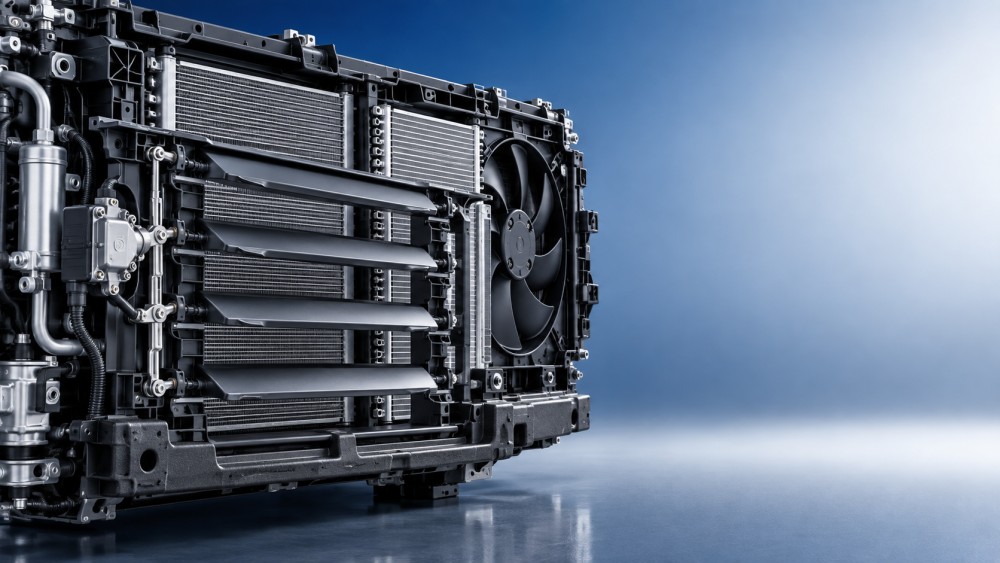
The core point is simple: an Automotive Actuators grille shutter system does not merely open and close an exterior panel. It is an airflow control device within the vehicle’s thermal architecture. When its actuator responds accurately, the controller can trade aerodynamic drag against cooling capacity. When the actuator is slow, mispositioned, obstructed, or poorly coordinated with thermal requests, the vehicle may compensate with higher fan speed, compressor load, coolant pump activity, or protective derating.
The actuator changes the usable cooling window
Cooling systems are often evaluated by radiator size, condenser capacity, fan performance, coolant flow, and refrigerant circuit design. Those elements remain fundamental, but their available performance depends heavily on air mass flow through the front-end module. Active grille shutters regulate that flow before it reaches the condenser, radiator, charge-air cooler, battery chiller, heat-pump heat exchanger, or other stacked components.
With shutters closed or partially closed, the vehicle reduces air entering the grille opening. This can lower aerodynamic drag and may help the powertrain or battery warm up under cold conditions. With shutters open, the front-end module gains a more direct flow path, especially at road speeds where ram air is more effective than fan-driven airflow. The actuator is the mechanical interface that converts a control request into a real airflow state.
That distinction matters during technical assessment. A command indicating “open” in a controller does not prove that the blades are fully open, synchronized, free of ice or debris, or stable under aerodynamic load. The actual blade angle, travel time, and retained position determine the cooling effect.
Cooling control is not a single-temperature decision
Older assumptions often treat grille shutters as an engine-cooling device. In a modern vehicle, the decision to open or close may involve several competing thermal demands. The controller may receive input from engine coolant temperature, transmission oil temperature, charge-air temperature, A/C high-side pressure, inverter temperature, battery coolant temperature, ambient temperature, vehicle speed, cabin heating demand, and drive mode. Not every vehicle uses every signal, but the principle is consistent: shutter control is usually part of a coordinated thermal decision rather than an isolated response to radiator temperature.
In an internal-combustion vehicle, a closed shutter can support faster warm-up and reduce drag when cooling demand is low. Under sustained load, the same shutter must open early enough to prevent a delayed rise in coolant or charge-air temperature. The challenge is not simply opening at a defined threshold. Thermal systems have time lag. By the time a sensor reaches its limit, heat may already be stored in the engine, coolant, underhood air, and heat exchangers.
In battery-electric and hybrid vehicles, the logic can be more complex. The front-end airflow may affect battery cooling, power-electronics cooling, cabin heat-pump operation, and refrigerant-side heat rejection. A partially closed grille can improve range at cruise, but it must not restrict heat rejection during rapid charging, repeated acceleration, steep grades, or high ambient conditions. A shutter command therefore needs to consider both current measurements and the likelihood that thermal load will continue to rise.
What the actuator must do beyond opening and closing
A grille shutter actuator is usually expected to perform several jobs reliably over the vehicle’s operating life:
- Position the blades: Move to fully open, fully closed, or one or more intermediate positions when the control strategy supports modulation.
- Report status: Provide position feedback directly or allow the controller to infer movement from motor current, timing, switch states, or learned end stops.
- Hold against load: Maintain the commanded position despite vibration, pressure pulses, road-induced shock, and aerodynamic force.
- Protect itself: Detect excessive current, stalled movement, blocked blades, or travel outside an expected range.
- Recover predictably: After a power interruption, diagnostic event, or recalibration process, return to a known and safe operating state.
These requirements explain why actuator quality cannot be judged only by nominal motor torque. Gear reduction, backlash, housing stiffness, linkage geometry, blade friction, sealing loads, connector integrity, and control software all influence the resulting shutter position. A strong motor coupled to a mechanism with high variation in friction may still produce inconsistent movement. Likewise, an accurate position sensor cannot prevent a thermal issue if the linkage permits one blade bank to lag behind another.
Response time has different meanings at different vehicle speeds
At highway speed, opening the shutter can quickly expose the heat exchangers to high airflow, although the thermal benefit still depends on pressure drop across the cooling stack. At idle or in stop-and-go traffic, opening the shutter alone may provide limited cooling because vehicle speed is low. The electric fan must then pull air through the grille, shutters, and heat exchangers. A partially obstructed shutter may become more significant in this condition because the fan operates against a higher system resistance.
This is why a complaint such as “temperature increases in traffic but not on the highway” should not automatically be assigned to the grille shutter actuator. Fan operation, fan shroud sealing, condenser contamination, coolant circulation, refrigerant pressure control, and underbody air exit paths also require review. Still, shutter position should be verified early because a closed or partially closed grille can amplify any weakness in low-speed cooling capacity.
The opposite pattern also occurs. A vehicle may cool adequately in urban operation but develop rising temperatures during sustained high-load driving. Here, the shutter may open, but not fully; it may oscillate between positions; or the airflow path may not deliver the expected pressure recovery at speed. Evaluators should compare requested position, reported position, actual blade condition, vehicle speed, fan command, and the relevant thermal temperatures over the same event rather than reviewing each signal in isolation.
Control logic should avoid chasing short-term noise
A poorly calibrated control strategy may command frequent shutter movement around a narrow temperature threshold. That behavior can increase actuator duty cycles without materially improving cooling control. More importantly, it can create repeated transitions between aerodynamic and thermal states while the underlying temperatures are still responding to previous commands.
Robust logic typically uses hysteresis, filtered signals, operating-mode priorities, and plausibility checks. For example, a controller may require a sustained cooling request before opening fully, while allowing an immediate protective opening if a critical temperature, pressure, or fault condition appears. It may hold the shutters open after a high-load event rather than closing them the moment one sensor falls below a threshold. The exact calibration is vehicle-specific, but the assessment principle is clear: actuator behavior should be understandable in the context of thermal lag and safety margins.
Fail-safe behavior is equally important. A system needs a defined response when position feedback is implausible, travel is blocked, communication is lost, or the actuator cannot complete its learned range. In many architectures, the safer thermal state is open, because unrestricted grille airflow preserves cooling potential. That does not guarantee the vehicle will be free of a fault; it defines how the system limits thermal risk while diagnostic information is stored.
Where cooling problems can be mistaken for actuator faults
Because the shutters are visible, they can become an easy suspect. A proper assessment separates a genuine actuation problem from a cooling-system issue that happens to trigger more frequent shutter opening.
A thermal complaint can also originate downstream of the grille. Condenser fin blockage, damaged radiator seals, coolant air pockets, incorrect fan rotation, refrigerant overcharge, or a weak pump can reduce heat rejection even when the shutters are fully open. The actuator should therefore be evaluated as part of the airflow and thermal chain, not as a standalone electrical component.
A practical evaluation sequence
When assessing an active grille shutter system, begin with the requested function rather than with parts replacement. The following sequence helps avoid confusing a commanded state with a mechanical failure.
- Establish the operating condition. Identify ambient temperature, vehicle speed, drive load, HVAC mode, charging state where applicable, and the temperature or pressure that caused concern.
- Read commands and feedback together. Compare controller target position with reported actuator position. A mismatch points toward actuator, wiring, feedback, or mechanical travel issues. Matching signals do not yet prove that the blades moved correctly.
- Inspect actual motion. Use an approved actuator test or observe the shutter during a controlled operating event. Look for incomplete travel, delayed start, clicking, asymmetric blade movement, binding, and reopening after a commanded close.
- Check the mechanical environment. Examine for stone damage, accumulated debris, distorted shutters, ice exposure, foreign objects, damaged louvers, loose pivots, and misaligned surrounding trim.
- Correlate with cooling performance. Evaluate fan command, coolant temperatures, refrigerant pressure where relevant, pump behavior, and heat-exchanger condition. The aim is to confirm whether shutter position is limiting air-side heat transfer.
- Confirm learned positions after service. If the system design requires initialization, calibration, or end-stop learning, complete that process using the specified service method. Incorrect learned travel can create a functional fault even after sound mechanical repair.
Electrical testing should include more than supply voltage. A connector may show normal voltage with no load but suffer excessive voltage drop when the motor starts. Intermittent ground quality, corrosion at terminals, damaged insulation near moving components, and water paths into the connector can create faults that appear only under vibration or high actuator load. Current behavior during travel can be informative, but it should be interpreted against the actuator design and service information rather than treated as a universal pass/fail value.
Durability factors that affect long-term cooling control
Shutter actuators operate in a harsh location. They face temperature cycling, splash water, salt, dust, gravel impact, airflow vibration, and repeated movement. The front of the vehicle can also experience localized thermal gradients: the actuator housing may be exposed to cold external air while adjacent components receive heat from the cooling stack or powertrain compartment.
For technical evaluation, durability review should include sealing strategy, pressure equalization, connector retention, wire routing, gear material behavior across temperature, corrosion resistance of shafts and fasteners, and the way the system handles frozen or obstructed blades. The force needed to move a shutter is not constant. Deposits, aging pivots, distorted louvers, and ice can raise resistance substantially. A design that works with low friction when new may become vulnerable if torque reserve and stall detection are poorly matched.
Mechanical end stops also deserve attention. Repeated impacts at open or closed limits can produce noise, gear wear, lost calibration, or blade misalignment. Software-based soft landing can reduce stress, but only if position sensing and motor control remain reliable. In a system with inferred position rather than continuous feedback, changes in friction can gradually reduce positional accuracy unless relearning logic accounts for them.
Integration decisions that influence the result
The actuator cannot compensate for an unfavorable grille shutter module layout. Blade overlap, hinge location, linkage ratio, effective open area, and the distance to the heat exchanger all affect airflow. A shutter assembly that appears open from the front may still create significant restriction if the blade orientation, support structure, or downstream duct geometry disrupts the flow path.
Control integration matters just as much. Thermal management software should know whether the shutter is available, moving, at target, blocked, or in a fail-safe position. A simple binary “open/closed” assumption can be inadequate for systems that use intermediate positions or have multiple independently controlled shutter zones. In electrified vehicles, coordination with the refrigerant loop and coolant valves is especially important because opening the grille may increase heat rejection capability while other components determine where the heat is being routed.
The best technical question is therefore not “Does the shutter open?” It is “Under the relevant thermal load, does the commanded shutter state produce the expected airflow condition, and does the system detect when it does not?” That question connects actuator performance to the real purpose of the system: controlled cooling capacity without unnecessary aerodynamic loss.
Questions that often arise during evaluation
Can a failed grille shutter cause overheating by itself?
It can contribute directly when the shutters remain closed or restricted during a period that requires airflow. The effect depends on vehicle speed, fan capacity, heat-exchanger condition, ambient temperature, and thermal load. A fully closed shutter is more consequential during high cooling demand, but it should not be assumed to be the only cause without checking the rest of the system.
Is fully open always the correct fail-safe position?
From a cooling perspective, open is often the conservative state because it minimizes grille restriction. However, the intended fault behavior depends on the vehicle architecture, diagnostic strategy, packaging, and operating conditions. The correct requirement should be verified against the system specification rather than inferred from appearance alone.
Do partially open shutters provide meaningful control?
Yes, provided the module geometry, position accuracy, and calibration support repeatable intermediate airflow states. Partial opening can help balance drag reduction with modest cooling demand. Its value falls if blade position varies significantly, the pressure drop remains high across much of the travel range, or the control logic cannot distinguish between requested and achieved position.
Have questions about this sector analysis, or seeking best practices specific to your niche? Drop us a line below and let the senior consultants at GAC assist you.
“We respect your privacy. Your information is strictly confidential.”
Related News
- 00
0000-00
How does a shielded HSD cable reduce interference in vehicles? - 00
0000-00
What drives demand for scroll compressors in the automotive market? - 00
0000-00
Does AEC-Q200 apply to flexible printed circuits? - 00
0000-00
How does production volume affect automotive flexible electronics costs? - 00
0000-00
How much does an in-vehicle infotainment system cost to replace?
Weekly Insights
Stay ahead with our curated technology reports delivered every Monday.
Recommended News
 How does a shielded HSD cable reduce interference in vehicles?Discover how a shielded HSD cable reduces vehicle interference, and learn why connector design, routing, and testing matter for reliable high-speed data links.Author:Time:Nov 17, 2026
 What drives demand for scroll compressors in the automotive market?Explore the scroll compressor for automobile market and discover how EV adoption, heat pumps, efficiency, and supplier capabilities shape demand.Author:Time:Nov 16, 2026
 Does AEC-Q200 apply to flexible printed circuits?Flexible Printed Circuit AEC-Q200 requirements explained: discover which components qualify and how to assess automotive FPC reliability.Author:Time:Nov 15, 2026
 How does production volume affect automotive flexible electronics costs?Explore how production volume affects automotive flexible electronics cost, from tooling and yield to testing. Compare quotes and negotiate smarter.Author:Time:Nov 14, 2026
 How much does an in-vehicle infotainment system cost to replace?Explore in-vehicle infotainment cost, from affordable repairs to factory replacements. Compare options, installation fees, and compatibility before you buy.Author:Time:Nov 13, 2026
 How does condenser efficiency affect heat pump performance?Discover how condenser high efficiency can improve heat pump performance, reduce compressor power, and boost heating COP—plus the trade-offs to watch.Author:Time:Nov 12, 2026
 What does each FAKRA cable color code mean?FAKRA cable color code explained: Explore common connector colors, typical uses and key compatibility checks before choosing a replacement.Author:Time:Nov 11, 2026
 How to compare noise ratings for battery coolant pumpsCompare coolant pump low noise ratings with confidence. Learn how test conditions, hydraulic duty, tonal noise and installation affect your choice.Author:Time:Nov 10, 2026
 How bright should automotive display systems be in sunlight?Automotive Display Systems need more than brightness to stay readable in sunlight. Discover why 1,000 nits is a starting point and how to evaluate glare and heat.Author:Time:Nov 09, 2026
 How heat pumps improve the efficiency of EV thermal systemsEV Thermal Systems use heat pumps to reduce heating energy demand. Explore how they work, where they excel, and what limits efficiency in cold weather.Author:Time:Nov 08, 2026
 Can a smart cockpit platform support multiple displays?Can a smart cockpit platform support multiple displays? Explore key requirements for performance, safety, connectivity, and supplier evaluation.Author:Time:Nov 07, 2026
 How is automotive connector vibration resistance tested?Automotive connector vibration resistance testing reveals hidden contact failures. Explore test profiles, continuity monitoring and pass criteria.Author:Time:Nov 06, 2026
 How heat pumps save energy in automotive cabin climate systemsAutomotive Cabin Climate Systems energy saving starts with smarter heat pump design. Explore real-world efficiency, cold-weather trade-offs, and testing tips.Author:Time:Nov 05, 2026
 Is an EV heat pump worth it for winter driving range?Is a heat pump worth using in a cold-climate EV? Discover how it affects winter range, when it pays off, and what to check before buying.Author:Time:Nov 04, 2026
 When should you use 50-ohm coaxial cable instead of 75-ohm?Coaxial cable 50 ohm or 75 ohm? Learn when to use each, avoid impedance mismatches, and choose the right cable for reliable RF and video performance.Author:Time:Nov 03, 2026
 How to select a high temperature motor harness for an EVChoose the right high temperature motor harness for your EV. Compare thermal limits, current capacity, shielding, routing, and validation evidence.Author:Time:Nov 02, 2026
 How much does electric power steering replacement cost?Electric power steering price typically ranges from $1,000 to $3,000 for major replacements. Discover cost factors, repair options, and tips for comparing quotes.Author:Time:Nov 01, 2026
 How to size an EV A/C compressor for the required cooling capacitySize an EV A/C Compressor with confidence. Explore cooling loads, performance maps and power limits to select the right compressor for your vehicle.Author:Time:Oct 31, 2026
 How to choose the right pitch for an FPC board connectorFPC board connector pitch affects space, assembly and reliability. Learn how to compare options and select the best fit for your design.Author:Time:Oct 30, 2026
 How zonal design affects harness routing in high-voltage EV architecturesExplore high-voltage electrical architecture zonal design and its impact on EV harness routing. Discover key trade-offs in cable length, safety, thermal performance, and service access.Author:Time:Oct 29, 2026
 How tariffs affect costs in global automotive parts supply chainsNavigate tariffs in the global automotive parts trade supply chain. Learn to compare landed costs, manage duty exposure, and uncover smarter sourcing strategies to protect your margins.Author:Time:Oct 28, 2026
 How to assess vendor lock-in in a software-defined vehicle platformAssess Software-Defined Vehicle platform lock-in with practical tests for API portability, data access, update control, and exit costs. Learn how to choose a platform with a proven exit path.Author:Time:Oct 27, 2026
 How ISO 26262 guides functional safety in steer-by-wire systemsExplore steering systems functional safety through ISO 26262. Learn how hazard analysis, fault-tolerant design, and validation build a stronger steer-by-wire safety case.Author:Time:Oct 26, 2026
 How to evaluate a steering angle sensor manufacturer's accuracy claimsEvaluate steering angle sensor manufacturer accuracy claims with practical checks on calibration, latency, and test evidence. Compare suppliers confidently and avoid costly selection mistakes.Author:Time:Oct 25, 2026
 How to diagnose CAN bus faults in a hybrid vehicle control unitDiagnose Hybrid Vehicle Systems control unit CAN bus faults with step-by-step power, wiring, and waveform checks. Find the root cause and avoid unnecessary replacement.Author:Time:Oct 24, 2026
 How does battery cooling pipe diameter affect coolant pressure drop?Battery Cooling Pipe diameter affects coolant pressure drop and pump power. Explore sizing calculations and practical tips to optimize EV battery cooling and compare options with confidence.Author:Time:Oct 23, 2026
 How to assess PPAP readiness of automotive sensor system manufacturersAssess Automotive Sensor Systems manufacturers for PPAP readiness. Learn to verify production evidence, measurement capability, validation, and traceability to reduce sourcing risks.Author:Time:Oct 22, 2026
 What to ask an FPC connector manufacturer about reliability testingChoosing an FPC Connector manufacturer? Learn what to ask about reliability testing, failure limits, and traceable results to reduce design risks and select with confidence.Author:Time:Oct 21, 2026
 How to verify vehicle fitment for an aftermarket AC evaporatorNavigating the evaporator aftermarket? Verify vehicle fitment with VIN data, OE numbers, and physical interface checks. Use this guide to avoid costly mismatches and order confidently.Author:Time:Oct 20, 2026
 How electric compressor speed affects EV battery cooling capacityElectric compressor technology: battery cooling depends on more than RPM. Discover how speed, refrigerant flow, and system limits affect EV cooling capacity and energy efficiency.Author:Time:Oct 19, 2026





























