When does a heat pump for battery preheating improve cold-weather range?




On a winter morning, an EV may have enough energy stored in its pack to complete a familiar commute, yet feel noticeably less capable than it did a few months earlier. Regenerative braking is limited, acceleration may be softened, DC fast charging starts slowly, and the predicted range drops sooner than expected. The battery is not necessarily degraded; it may simply be cold.
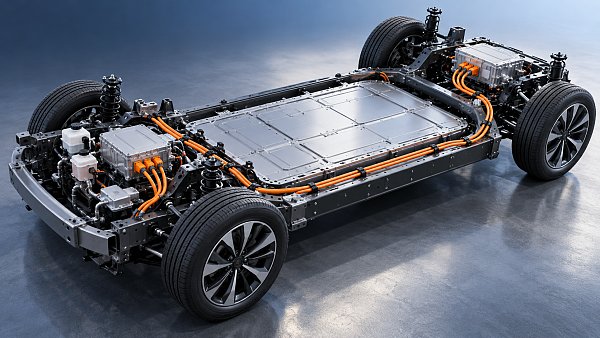
A heat pump for battery preheating improves cold-weather range when the energy used to bring the battery into an effective operating window is lower than the energy savings created by better battery efficiency, stronger regenerative braking, reduced cabin-heating demand, and improved power availability. That condition sounds straightforward, but it depends on ambient temperature, parking duration, driving cycle, pack chemistry, thermal hardware, and control strategy.
For technical evaluators, the important question is not whether a heat pump can heat a battery. It can. The question is where, when, and how often the system should do so—and whether the vehicle-level energy balance remains positive in the climate and duty cycle being assessed.
The range penalty begins inside the cold battery
At low cell temperature, electrochemical reactions slow and internal resistance rises. During discharge, higher resistance creates greater voltage sag and resistive loss. The battery management system may then reduce available power to protect cells from excessive current or low-voltage conditions. During charging, especially at higher rates, the allowable charge current can be restricted until cell temperature reaches a safer and more receptive range.
That behavior affects range in more than one way. A cold pack loses usable energy because more of its stored energy is dissipated as heat during current flow. It may also be unable to accept as much regenerative braking energy. Meanwhile, the traction motor and cabin climate system draw energy from a pack already operating under less favorable conditions.
Battery preheating addresses the first part of this chain: it moves cell temperature toward the calibration target before or during driving. In many systems, that target is not a single fixed value. It can vary by cell chemistry, state of charge, requested power, charge mode, pack age, and thermal uniformity. A vehicle preparing for DC charging may need a different battery temperature strategy from one leaving home for a short urban trip.
Why a heat pump changes the energy equation
Traditional battery heating can rely on high-voltage PTC heaters or resistive coolant heaters. These are direct and predictable: one unit of electrical energy becomes roughly one unit of heat at the heater. A heat pump transfers heat from a source to the battery coolant loop, potentially delivering more thermal energy than the compressor and auxiliary devices consume.
Its practical value is expressed through heating coefficient of performance (COP):
COP = heat delivered to the thermal loop / electrical power consumed by the heating system.
When the heat pump operates at a COP above 1, it can provide the same battery-heating duty using less battery energy than a purely resistive heater. Under favorable conditions, the saved energy can remain available for traction. The system may also use recovered heat from the e-drive, inverter, power electronics, or refrigerant-side thermal loops, reducing reliance on ambient air as the sole heat source.
However, a heat pump does not create energy. Its COP declines as the temperature lift grows—the difference between a cold heat source and the desired coolant or battery temperature. At very low ambient temperatures, frost formation, defrost events, compressor operating limits, and reduced available source heat can weaken or even erase the advantage over resistance heating.
This is why claims about “heat-pump range improvement” need a defined test condition. A useful result at 5°C cannot automatically be extended to −20°C, nor can a benefit measured on a one-hour highway trip be assumed for a ten-minute urban journey.
When battery preheating delivers a genuine range benefit
The strongest case usually appears when several operating conditions align rather than when any one condition is present alone.
1. The battery begins well below its efficient operating zone
Preheating has more value when the pack has been parked long enough to approach ambient temperature. An overnight soak outdoors is more consequential than a brief stop after a warm drive. The colder the cells become, the greater the potential gain in discharge efficiency, power capability, and regenerative acceptance—although the heating energy required also rises.
2. The vehicle has enough time to precondition intelligently
Grid-connected preconditioning is often the clearest use case. If the vehicle warms the battery while connected to AC charging or a DC charger, the energy cost does not come entirely from the usable driving energy stored in the pack. The driver leaves with a conditioned battery, and the heat pump’s efficiency advantage can be meaningful even before the wheels turn.
In contrast, an unplanned departure from a cold-soaked vehicle forces the system to heat while driving. The vehicle must decide whether to prioritize immediate traction energy, cabin comfort, battery temperature, or a blended target. For a short journey, the energy spent warming the entire pack may not be recovered before arrival.
3. The planned drive is long enough to repay the thermal investment
Preheating consumes energy upfront. It pays back gradually through lower battery losses, improved recuperation, and—in integrated systems—more efficient cabin heating. A 150-kilometer winter highway route offers more opportunity to recover that investment than a 5-kilometer school run.
Trip duration alone is not sufficient. High-power operation increases battery current and makes internal resistance more important, so sustained highway driving, hill climbing, towing, or repeated acceleration may justify earlier thermal conditioning. Low-load city driving may see a smaller traction-efficiency gain, although regenerative braking availability can still matter.
4. The system can harvest useful heat from the vehicle
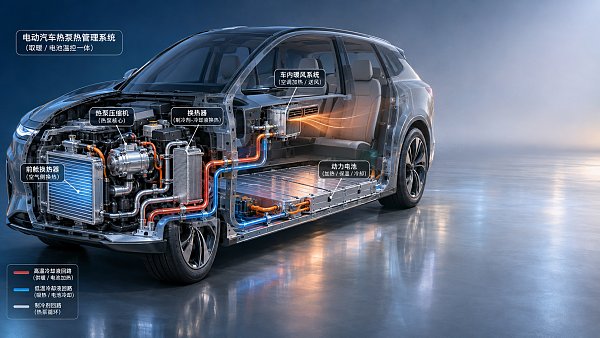
A well-integrated EV thermal architecture can draw from multiple heat sources: ambient air, e-motor and inverter waste heat, refrigerant-side heat exchange, and sometimes residual heat in coolant circuits. The heat pump becomes more attractive when it can select or blend sources according to their temperature and availability.
During steady driving, powertrain losses may be recoverable. During an early-morning preconditioning event before driving, those losses are not yet available, so the heat pump depends more heavily on ambient heat or external electricity. These are different operating points and should be evaluated separately.
The thermal architecture determines whether the concept works in practice
The phrase “heat pump battery preheating” can describe very different system layouts. A technical assessment should look beyond the presence of a compressor and identify the actual heat paths.
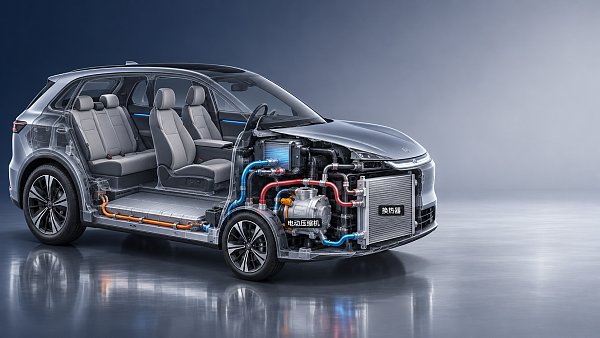
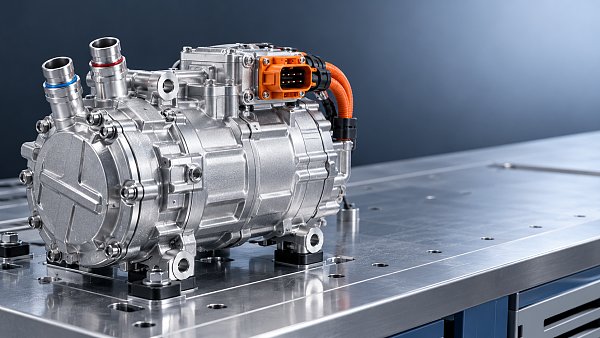
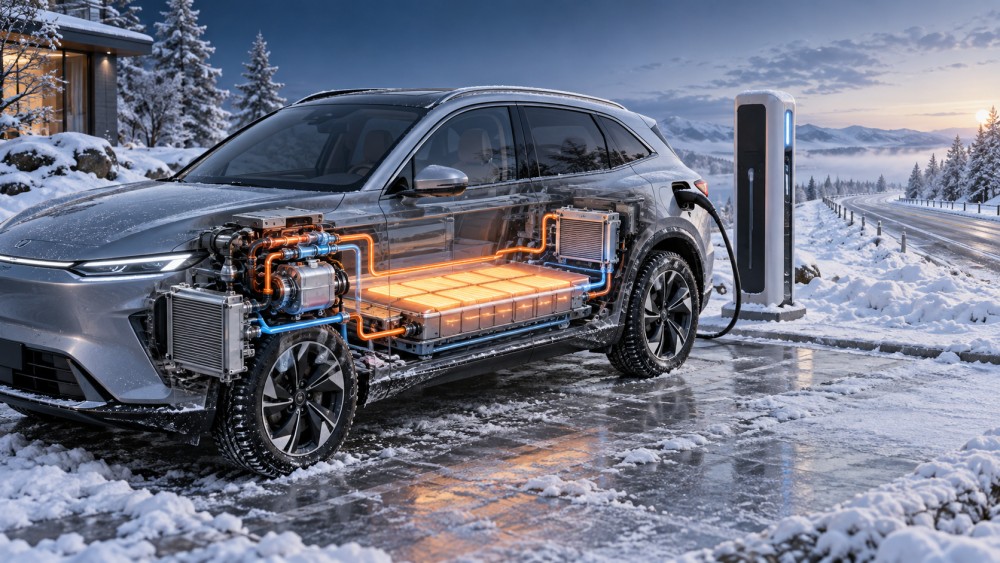
In a typical integrated architecture, the refrigerant circuit includes an electric compressor, condenser or refrigerant-to-coolant heat exchanger, expansion device, evaporator, and a network of valves. The coolant circuit may connect the battery plate, cabin heater core, e-drive loop, chiller, radiator, and expansion tank. An integrated thermal valve or multi-port coolant valve controls which loops are coupled, bypassed, or isolated.
The control challenge is substantial. The system may need to heat the battery while maintaining cabin comfort, cool the e-drive while extracting useful heat, protect the compressor from unfavorable pressure ratios, and prevent local cell temperature gradients. A design with high peak COP but weak mode transitions can perform poorly in daily use.
Battery temperature uniformity deserves particular attention. Heating only the coolant inlet rapidly is not the same as bringing the complete cell population to a usable condition. Large pack-level gradients can cause uneven charge acceptance, inconsistent power limits, and control uncertainty. Coolant flow distribution, cold plate design, sensor placement, and estimator quality are therefore as relevant as compressor capacity.
Cold temperature is not one operating condition
It is tempting to treat “winter” as a single use case. For thermal-system development, that shortcut conceals the most important trade-offs.
A hybrid approach is common for good reason. The heat pump can handle efficient bulk heating where conditions allow, while a PTC element supports rapid warm-up, low-temperature operation, defrost, or peak thermal demand. Evaluators should not regard the presence of a resistive heater as a design failure. It may be essential to maintaining predictable vehicle behavior across extreme conditions.
Battery chemistry and pack design change the threshold
There is no universal preheat setpoint or break-even temperature. Cell chemistry influences low-temperature impedance, charge acceptance, allowable current, and aging sensitivity. Pack construction adds further variation through cell format, module insulation, thermal interface materials, coolant plate geometry, total thermal mass, and sensor coverage.
A large pack has greater thermal mass and can require considerable energy to warm from a deep soak. Yet it may also support a longer trip in which the heating investment can be recovered. A compact battery may warm faster but has less stored energy available to absorb thermal-system consumption. Pack insulation introduces another trade-off: it can preserve useful heat after driving, but may also slow passive cooling in hot conditions.
For vehicles using route-based charging preparation, the target should be tied to expected charging power, charger arrival time, ambient conditions, and current battery temperature. Heating the pack earlier than necessary wastes energy; waiting too long can result in a cold arrival and a disappointing fast-charge session. The same optimization logic applies to range, not only charging speed.
Validation should measure net vehicle benefit, not component efficiency alone
A compressor-map result or bench COP value cannot establish range improvement by itself. The correct measurement is the net energy outcome at vehicle level. This calls for testing that compares equivalent trips with and without battery preconditioning, while controlling initial state of charge, battery soak temperature, cabin setpoint, payload, tire condition, road load, and driving profile.
Key evaluation metrics include:
- Energy consumed for battery warm-up, separated from cabin heating and other auxiliaries;
- Battery inlet, outlet, average, and maximum cell temperature gradients over time;
- Available discharge power and regenerative braking capability during the first part of the trip;
- Traction energy consumption per distance over the full route, not only after warm-up;
- Heat-pump electrical consumption, delivered thermal power, and COP across operating modes;
- Charge acceptance and DC charging duration when preconditioning is linked to navigation;
- Defrost behavior, noise, transient comfort effects, and fallback heater activation.
Standards and regulatory requirements do not usually provide one simple pass/fail test for “range benefit from battery preheating.” Instead, the assessment sits across environmental durability, electrical safety, functional safety, EMC, refrigerant-system requirements, and vehicle energy-consumption test procedures. Relevant teams should align their program with applicable vehicle and battery requirements in target markets, then add internal scenarios that reflect actual winter customer use.
Laboratory climatic-chamber testing remains essential, but road testing should include stop-and-go traffic, motorway cruising, elevation change, repeated parking events, and charger arrival behavior. A strategy that looks excellent in a steady-state chamber cycle may behave differently when the driver changes destination, switches cabin modes, or encounters a queue at a charging station.
A practical decision rule for technical evaluators
A heat pump for battery preheating is most likely to improve cold-weather range when the vehicle can precondition before departure or ahead of a long, energy-intensive drive; when the ambient and source-side temperatures allow useful COP; when battery warming restores meaningful efficiency or recuperation; and when the thermal system can share heat across battery, cabin, and e-drive loops without creating excessive complexity or control losses.
It is less likely to provide a net benefit on very short cold trips, in severe ambient conditions with limited source heat, or where the control strategy heats the battery indiscriminately instead of responding to route, state of charge, and expected load. In those conditions, a carefully managed hybrid heat-pump/PTC strategy may be more credible than a heat-pump-only concept.
The best system is not the one that reaches the highest advertised heating COP. It is the one that makes the right thermal decision before the driver notices a limitation: preserving range when it matters, protecting the cells, supporting charging performance, and avoiding unnecessary energy consumption when the trip simply does not justify preheating.
Have questions about this sector analysis, or seeking best practices specific to your niche? Drop us a line below and let the senior consultants at GAC assist you.
“We respect your privacy. Your information is strictly confidential.”
Related News
- 00
0000-00
How to assess a smart cockpit electronics manufacturer's integration capability - 00
0000-00
How does a shielded HSD cable reduce interference in vehicles? - 00
0000-00
What drives demand for scroll compressors in the automotive market? - 00
0000-00
Does AEC-Q200 apply to flexible printed circuits? - 00
0000-00
How does production volume affect automotive flexible electronics costs?
Weekly Insights
Stay ahead with our curated technology reports delivered every Monday.
Recommended News
 How to assess a smart cockpit electronics manufacturer's integration capabilityAssess a smart cockpit electronics manufacturer's integration capability with practical checks for interfaces, testing, safety, cybersecurity and supplier support.Author:Time:Nov 18, 2026
 How does a shielded HSD cable reduce interference in vehicles?Discover how a shielded HSD cable reduces vehicle interference, and learn why connector design, routing, and testing matter for reliable high-speed data links.Author:Time:Nov 17, 2026
 What drives demand for scroll compressors in the automotive market?Explore the scroll compressor for automobile market and discover how EV adoption, heat pumps, efficiency, and supplier capabilities shape demand.Author:Time:Nov 16, 2026
 Does AEC-Q200 apply to flexible printed circuits?Flexible Printed Circuit AEC-Q200 requirements explained: discover which components qualify and how to assess automotive FPC reliability.Author:Time:Nov 15, 2026
 How does production volume affect automotive flexible electronics costs?Explore how production volume affects automotive flexible electronics cost, from tooling and yield to testing. Compare quotes and negotiate smarter.Author:Time:Nov 14, 2026
 How much does an in-vehicle infotainment system cost to replace?Explore in-vehicle infotainment cost, from affordable repairs to factory replacements. Compare options, installation fees, and compatibility before you buy.Author:Time:Nov 13, 2026
 How does condenser efficiency affect heat pump performance?Discover how condenser high efficiency can improve heat pump performance, reduce compressor power, and boost heating COP—plus the trade-offs to watch.Author:Time:Nov 12, 2026
 What does each FAKRA cable color code mean?FAKRA cable color code explained: Explore common connector colors, typical uses and key compatibility checks before choosing a replacement.Author:Time:Nov 11, 2026
 How to compare noise ratings for battery coolant pumpsCompare coolant pump low noise ratings with confidence. Learn how test conditions, hydraulic duty, tonal noise and installation affect your choice.Author:Time:Nov 10, 2026
 How bright should automotive display systems be in sunlight?Automotive Display Systems need more than brightness to stay readable in sunlight. Discover why 1,000 nits is a starting point and how to evaluate glare and heat.Author:Time:Nov 09, 2026
 How heat pumps improve the efficiency of EV thermal systemsEV Thermal Systems use heat pumps to reduce heating energy demand. Explore how they work, where they excel, and what limits efficiency in cold weather.Author:Time:Nov 08, 2026
 Can a smart cockpit platform support multiple displays?Can a smart cockpit platform support multiple displays? Explore key requirements for performance, safety, connectivity, and supplier evaluation.Author:Time:Nov 07, 2026
 How is automotive connector vibration resistance tested?Automotive connector vibration resistance testing reveals hidden contact failures. Explore test profiles, continuity monitoring and pass criteria.Author:Time:Nov 06, 2026
 How heat pumps save energy in automotive cabin climate systemsAutomotive Cabin Climate Systems energy saving starts with smarter heat pump design. Explore real-world efficiency, cold-weather trade-offs, and testing tips.Author:Time:Nov 05, 2026
 Is an EV heat pump worth it for winter driving range?Is a heat pump worth using in a cold-climate EV? Discover how it affects winter range, when it pays off, and what to check before buying.Author:Time:Nov 04, 2026
 When should you use 50-ohm coaxial cable instead of 75-ohm?Coaxial cable 50 ohm or 75 ohm? Learn when to use each, avoid impedance mismatches, and choose the right cable for reliable RF and video performance.Author:Time:Nov 03, 2026
 How to select a high temperature motor harness for an EVChoose the right high temperature motor harness for your EV. Compare thermal limits, current capacity, shielding, routing, and validation evidence.Author:Time:Nov 02, 2026
 How much does electric power steering replacement cost?Electric power steering price typically ranges from $1,000 to $3,000 for major replacements. Discover cost factors, repair options, and tips for comparing quotes.Author:Time:Nov 01, 2026
 How to size an EV A/C compressor for the required cooling capacitySize an EV A/C Compressor with confidence. Explore cooling loads, performance maps and power limits to select the right compressor for your vehicle.Author:Time:Oct 31, 2026
 How to choose the right pitch for an FPC board connectorFPC board connector pitch affects space, assembly and reliability. Learn how to compare options and select the best fit for your design.Author:Time:Oct 30, 2026
 How zonal design affects harness routing in high-voltage EV architecturesExplore high-voltage electrical architecture zonal design and its impact on EV harness routing. Discover key trade-offs in cable length, safety, thermal performance, and service access.Author:Time:Oct 29, 2026
 How tariffs affect costs in global automotive parts supply chainsNavigate tariffs in the global automotive parts trade supply chain. Learn to compare landed costs, manage duty exposure, and uncover smarter sourcing strategies to protect your margins.Author:Time:Oct 28, 2026
 How to assess vendor lock-in in a software-defined vehicle platformAssess Software-Defined Vehicle platform lock-in with practical tests for API portability, data access, update control, and exit costs. Learn how to choose a platform with a proven exit path.Author:Time:Oct 27, 2026
 How ISO 26262 guides functional safety in steer-by-wire systemsExplore steering systems functional safety through ISO 26262. Learn how hazard analysis, fault-tolerant design, and validation build a stronger steer-by-wire safety case.Author:Time:Oct 26, 2026
 How to evaluate a steering angle sensor manufacturer's accuracy claimsEvaluate steering angle sensor manufacturer accuracy claims with practical checks on calibration, latency, and test evidence. Compare suppliers confidently and avoid costly selection mistakes.Author:Time:Oct 25, 2026
 How to diagnose CAN bus faults in a hybrid vehicle control unitDiagnose Hybrid Vehicle Systems control unit CAN bus faults with step-by-step power, wiring, and waveform checks. Find the root cause and avoid unnecessary replacement.Author:Time:Oct 24, 2026
 How does battery cooling pipe diameter affect coolant pressure drop?Battery Cooling Pipe diameter affects coolant pressure drop and pump power. Explore sizing calculations and practical tips to optimize EV battery cooling and compare options with confidence.Author:Time:Oct 23, 2026
 How to assess PPAP readiness of automotive sensor system manufacturersAssess Automotive Sensor Systems manufacturers for PPAP readiness. Learn to verify production evidence, measurement capability, validation, and traceability to reduce sourcing risks.Author:Time:Oct 22, 2026
 What to ask an FPC connector manufacturer about reliability testingChoosing an FPC Connector manufacturer? Learn what to ask about reliability testing, failure limits, and traceable results to reduce design risks and select with confidence.Author:Time:Oct 21, 2026
 How to verify vehicle fitment for an aftermarket AC evaporatorNavigating the evaporator aftermarket? Verify vehicle fitment with VIN data, OE numbers, and physical interface checks. Use this guide to avoid costly mismatches and order confidently.Author:Time:Oct 20, 2026