When Defrosting Algorithms Improve Heat Pump Range




As EV heat pumps move from auxiliary components to core efficiency drivers, defrosting algorithms are becoming critical to winter range, cabin comfort, and system stability. For technical evaluators, understanding how these control strategies balance frost removal, compressor load, and energy consumption is essential when assessing next-generation thermal management performance and supplier competitiveness.
In battery electric vehicles and plug-in hybrids, a heat pump can improve low-temperature efficiency, but only when frosting on the outdoor heat exchanger is managed with precision. Once ambient temperature drops into the -10°C to 5°C band and humidity rises, coil frosting can cut airflow, reduce heat transfer, and trigger sharp efficiency loss within 15 to 30 minutes of operation.
That is why defrosting algorithms are no longer a minor software feature. They are now a cross-domain control capability connecting compressor behavior, expansion valve response, blower scheduling, refrigerant routing, and battery energy strategy. For technical evaluators working across the automotive supply chain, this topic directly affects thermal module selection, supplier benchmarking, and winter performance validation.
Why Defrosting Algorithms Now Matter More Than Hardware Alone
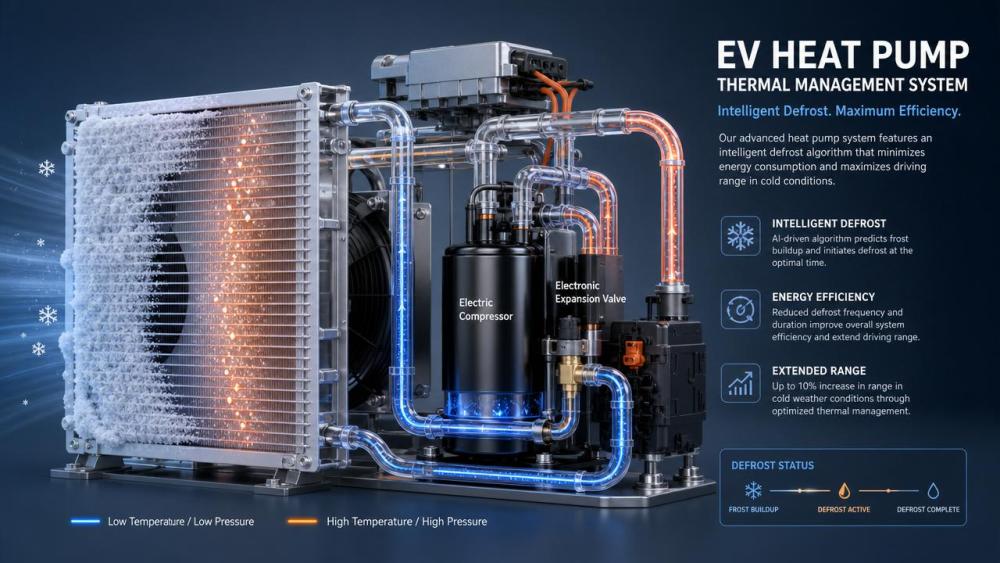
In earlier EV thermal systems, engineering teams often focused on compressor capacity, exchanger size, and valve count. Those hardware choices still matter, but the performance gap between two systems with similar bill-of-material content is increasingly defined by software logic. A well-calibrated control strategy can delay frost onset, shorten defrost duration from 6 minutes to 3 minutes, and reduce cabin temperature fluctuation by 2°C to 4°C during cold operation.
For GACT’s target audience, the key question is not whether a system can defrost, but how intelligently it decides when, how, and for how long to defrost. Poor logic can protect the evaporator yet waste battery energy. Overly aggressive defrosting may improve exchanger cleanliness while reducing vehicle range by 3% to 8% over a winter drive cycle. Delayed defrosting may preserve energy in the short term but degrade cabin heating and create unstable refrigerant pressures.
The Shift From Fixed Rules to Adaptive Control
Conventional strategies often rely on fixed timers, simple ambient thresholds, or binary coil temperature triggers. These methods are easy to validate, but they cannot account for dynamic driving patterns, variable humidity, partial load operation, or multi-zone thermal demands. In a modern NEV thermal management system, defrosting algorithms increasingly use 5 to 8 input categories, including ambient temperature, exchanger surface temperature, compressor speed, refrigerant pressure, blower flow, vehicle speed, humidity estimation, and cabin thermal request.
Adaptive control improves heat pump range because it treats frost as a predicted operating state rather than a sudden fault. Instead of waiting for severe frosting, the system can optimize compressor frequency, valve position, and airflow to slow frost accumulation. This reduces the number of full reverse-cycle events and preserves usable battery energy over longer trips.
What Technical Evaluators Should Measure
For a meaningful assessment, technical evaluators should compare control performance across at least 4 dimensions: frost detection accuracy, defrost execution efficiency, occupant comfort stability, and energy penalty per event. A supplier that highlights only compressor COP or heating power at 7°C may be masking weak cold-climate behavior at -7°C and 85% relative humidity.
- Frost detection delay under low-load and high-humidity conditions
- Average defrost cycle duration and restart smoothness
- Cabin outlet air temperature drop during defrost events
- Impact on battery SOC consumption over a 60 to 90 minute winter cycle
- Pressure and compressor speed oscillation after defrost completion
These indicators help evaluators identify whether a supplier’s thermal control architecture is tuned for real-world vehicle use or only for laboratory point tests.
Core Logic Paths Behind Effective Defrosting Algorithms
Not all defrosting algorithms are built on the same logic path. In practice, the most effective systems combine detection, prediction, intervention, and recovery in a closed loop. This matters in automotive thermal systems because defrost control does not operate in isolation. It affects battery preconditioning, motor waste heat utilization, cabin comfort priorities, and inverter power allocation.
H4-Level View: Four Functional Layers
1. Frost Recognition Layer
This layer estimates whether the outdoor heat exchanger is entering a frost-prone state. Input sources may include coil temperature approaching 0°C, a pressure differential shift of 5% to 12%, falling airside heat transfer, or an inferred humidity model. The strongest strategies avoid relying on a single sensor because sensor drift or packaging bias can distort the frost signal.
2. Pre-Defrost Mitigation Layer
Before initiating a full defrost event, the algorithm may reduce frosting rate by changing compressor speed, adjusting electronic expansion valve opening, or redistributing airflow. In integrated NEV systems, it may also blend waste heat from the e-drive loop or battery loop to reduce reliance on reverse-cycle heating. This step can lower total defrost frequency by 10% to 20% in typical damp winter operation.
3. Active Defrost Execution Layer
The most common automotive method remains reverse-cycle defrost, but execution quality varies widely. Good control limits unnecessary overshoot, shortens melt time, and manages compressor loading during mode reversal. A poorly tuned system may trigger noise spikes, suction pressure instability, or a noticeable cabin air drop lasting more than 90 seconds.
4. Recovery and Re-Optimization Layer
After frost removal, the system must quickly restore heating output without inducing a second instability. Recovery should be measured over the first 30 to 120 seconds after defrost termination. This period often reveals whether the supplier’s defrosting algorithms are robust enough for high-integration thermal platforms.
The table below shows how common control approaches differ in technical evaluation value and winter operating impact.
For technical evaluation teams, the progression from timer logic to model-based control is one of the clearest signs that a supplier understands software-defined thermal performance rather than relying only on mechanical oversizing.
How Defrost Control Directly Affects EV Range, Comfort, and Reliability
The phrase “improve heat pump range” is sometimes used too loosely. In practice, defrosting algorithms improve range through three concrete mechanisms: they reduce heat exchanger blockage time, minimize unnecessary reverse-cycle events, and shorten post-defrost recovery losses. Each mechanism compounds over long winter driving cycles.
Range Retention Under Cold and Wet Conditions
When frosting causes exchanger efficiency to collapse, the compressor must work harder to deliver the same cabin heat. If the algorithm delays intervention too long, power draw increases while heating output falls. If intervention is too frequent, each defrost cycle consumes energy and interrupts productive heating. The best thermal management systems hold the balance point where total energy cost per kilometer is minimized across a 45 to 120 minute winter drive profile.
In comparative testing, evaluators should look at net heating effectiveness instead of isolated COP peaks. A system that shows strong COP at a single operating point may still underperform over a full route if it enters defrost 2 times more often than a better-calibrated competitor.
Cabin Comfort During Defrost Events
Cabin discomfort is one of the first customer-visible symptoms of weak defrost control. During reverse-cycle operation, the cabin may receive less warm air or even brief cool airflow if blending logic is poor. For passenger vehicles, a 1°C to 2°C temporary drop may be acceptable, but a repeated 3°C to 5°C drop during urban stop-go driving can quickly damage perceived product quality.
This is why high-quality defrosting algorithms coordinate with blower speed, PTC assistance, recirculation ratio, and windshield defog demand. Comfort management is not a separate module; it is part of the defrost control problem.
Reliability and Component Stress
A thermal control strategy that repeatedly swings compressor speed, valve state, and pressure across wide bands can increase mechanical and electrical stress. Over hundreds of winter operating hours, excessive cycling may contribute to seal wear, noise, or control instability. Technical evaluators should therefore assess not only whether frost is removed, but whether the removal process stays within stable system pressure and temperature envelopes.
The following comparison helps frame where range and reliability gains usually come from when evaluating supplier control strategies.
This type of comparison is especially useful when screening thermal module suppliers that claim equivalent hardware performance but deliver very different software maturity.
A Practical Evaluation Framework for Technical Assessors
For procurement-linked engineering teams, the challenge is turning a complex control problem into a repeatable supplier assessment process. A useful evaluation framework combines bench validation, vehicle-level testing, calibration review, and integration risk screening. The goal is not only to identify the best present performance, but also to estimate calibration scalability across vehicle platforms.
Five-Step Review Process
- Confirm heat pump architecture, refrigerant loop layout, and valve topology.
- Review defrost trigger inputs, fallback logic, and sensor dependency map.
- Test in at least 3 climate bands, such as 0°C/90% RH, -7°C/80% RH, and -15°C/dry air.
- Measure cycle duration, comfort deviation, and battery energy impact over repeated runs.
- Assess software maintainability, calibration effort, and controller integration path.
This process helps evaluators compare not just system output, but the engineering discipline behind the output. In the automotive supply chain, that difference often determines launch readiness and long-term warranty risk.
Questions to Ask Thermal System Suppliers
Many supplier presentations focus on best-case heating power, but technical assessors need deeper answers. Useful questions include whether the defrosting algorithms support vehicle-speed compensation, whether humidity is measured or estimated, how the logic handles sensor plausibility faults, and how quickly calibration can be adapted for a second platform with different cabin volume or exchanger packaging.
- How many inputs are used in frost-state detection?
- What is the typical defrost duration range under medium frost loading?
- Is there fallback logic if one temperature or pressure sensor fails plausibility checks?
- How is cabin comfort preserved during reverse-cycle operation?
- Can the control strategy coordinate with battery preheating and waste heat recovery?
- What validation coverage exists across altitude, humidity, and stop-start traffic conditions?
Common Evaluation Mistakes
A frequent mistake is relying on a single cold-room test point. Another is treating defrost as a binary success-fail event rather than a continuous optimization problem. Some teams also underestimate software recalibration workload when moving from one compressor supplier or heat exchanger geometry to another. In reality, even a 10% change in exchanger face area or refrigerant flow characteristics can alter frost growth behavior enough to require control retuning.
For this reason, technical evaluation should include both current-state performance and future integration flexibility. That is particularly relevant as smart cabin electronics, centralized thermal domain control, and multi-source heat recovery become more tightly coupled.
Strategic Implications for NEV Thermal Management and Supplier Competitiveness
Within the broader NEV thermal management market, defrosting algorithms are emerging as a differentiation layer that connects controls engineering with commercial value. As heat pumps become standard in more vehicle segments, hardware architecture may converge, but software execution quality can still separate one supplier from another in launch programs and platform awards.
Why This Matters to GACT Readers
GACT tracks the core subsystems shaping vehicle reliability and comfort, from wiring harnesses and power steering to electric compressors and smart cabin controls. Defrost control sits at the intersection of these domains. It depends on sensor reliability, controller response speed, compressor modulation accuracy, and thermal system integration. That makes it a strong indicator of whether a supplier is building real technical barriers or simply assembling standard components.
For Tier 1 suppliers and OE technical teams, the commercial implication is clear: a better defrost strategy can support winter range claims, reduce customer complaints, and strengthen the business case for higher-integration thermal modules. In sourcing reviews, a robust algorithm may justify preference even when hardware cost is not the lowest, because lifecycle efficiency and calibration resilience can offset upfront price differences.
What to Prioritize Over the Next 12 to 24 Months
The next phase of competition will likely focus on domain-level control, not isolated thermal devices. Technical evaluators should therefore prioritize suppliers that can demonstrate 3 capabilities: integrated thermal orchestration across cabin, battery, and e-drive loops; scalable calibration for multiple vehicle platforms; and data-backed winter validation under varied humidity and traffic conditions.
In practical terms, defrosting algorithms should be reviewed as part of a larger control stack that supports energy efficiency, occupant comfort, and component durability at the same time. Suppliers that can document this balance with consistent engineering logic are more likely to remain competitive as electrification deepens.
For technical evaluators, the real value of defrosting algorithms lies in measurable operating outcomes: fewer unnecessary cycles, tighter comfort control, more stable compressor loading, and better winter range retention. These are not abstract software claims. They are decision factors that influence supplier selection, platform integration risk, and long-term thermal system performance.
If you are assessing next-generation heat pump systems, GACT can help you examine the control logic behind the hardware, compare supplier strategies, and identify where integrated thermal management creates durable competitive advantage. Contact us to discuss evaluation criteria, request a tailored intelligence perspective, or learn more about advanced thermal system solutions.
Have questions about this sector analysis, or seeking best practices specific to your niche? Drop us a line below and let the senior consultants at GAC assist you.
“We respect your privacy. Your information is strictly confidential.”
Related News
- 00
0000-00
How to assess a smart cockpit electronics manufacturer's integration capability - 00
0000-00
How does a shielded HSD cable reduce interference in vehicles? - 00
0000-00
What drives demand for scroll compressors in the automotive market? - 00
0000-00
Does AEC-Q200 apply to flexible printed circuits? - 00
0000-00
How does production volume affect automotive flexible electronics costs?
Weekly Insights
Stay ahead with our curated technology reports delivered every Monday.
Recommended News
 How to assess a smart cockpit electronics manufacturer's integration capabilityAssess a smart cockpit electronics manufacturer's integration capability with practical checks for interfaces, testing, safety, cybersecurity and supplier support.Author:Time:Nov 18, 2026
 How does a shielded HSD cable reduce interference in vehicles?Discover how a shielded HSD cable reduces vehicle interference, and learn why connector design, routing, and testing matter for reliable high-speed data links.Author:Time:Nov 17, 2026
 What drives demand for scroll compressors in the automotive market?Explore the scroll compressor for automobile market and discover how EV adoption, heat pumps, efficiency, and supplier capabilities shape demand.Author:Time:Nov 16, 2026
 Does AEC-Q200 apply to flexible printed circuits?Flexible Printed Circuit AEC-Q200 requirements explained: discover which components qualify and how to assess automotive FPC reliability.Author:Time:Nov 15, 2026
 How does production volume affect automotive flexible electronics costs?Explore how production volume affects automotive flexible electronics cost, from tooling and yield to testing. Compare quotes and negotiate smarter.Author:Time:Nov 14, 2026
 How much does an in-vehicle infotainment system cost to replace?Explore in-vehicle infotainment cost, from affordable repairs to factory replacements. Compare options, installation fees, and compatibility before you buy.Author:Time:Nov 13, 2026
 How does condenser efficiency affect heat pump performance?Discover how condenser high efficiency can improve heat pump performance, reduce compressor power, and boost heating COP—plus the trade-offs to watch.Author:Time:Nov 12, 2026
 What does each FAKRA cable color code mean?FAKRA cable color code explained: Explore common connector colors, typical uses and key compatibility checks before choosing a replacement.Author:Time:Nov 11, 2026
 How to compare noise ratings for battery coolant pumpsCompare coolant pump low noise ratings with confidence. Learn how test conditions, hydraulic duty, tonal noise and installation affect your choice.Author:Time:Nov 10, 2026
 How bright should automotive display systems be in sunlight?Automotive Display Systems need more than brightness to stay readable in sunlight. Discover why 1,000 nits is a starting point and how to evaluate glare and heat.Author:Time:Nov 09, 2026
 How heat pumps improve the efficiency of EV thermal systemsEV Thermal Systems use heat pumps to reduce heating energy demand. Explore how they work, where they excel, and what limits efficiency in cold weather.Author:Time:Nov 08, 2026
 Can a smart cockpit platform support multiple displays?Can a smart cockpit platform support multiple displays? Explore key requirements for performance, safety, connectivity, and supplier evaluation.Author:Time:Nov 07, 2026
 How is automotive connector vibration resistance tested?Automotive connector vibration resistance testing reveals hidden contact failures. Explore test profiles, continuity monitoring and pass criteria.Author:Time:Nov 06, 2026
 How heat pumps save energy in automotive cabin climate systemsAutomotive Cabin Climate Systems energy saving starts with smarter heat pump design. Explore real-world efficiency, cold-weather trade-offs, and testing tips.Author:Time:Nov 05, 2026
 Is an EV heat pump worth it for winter driving range?Is a heat pump worth using in a cold-climate EV? Discover how it affects winter range, when it pays off, and what to check before buying.Author:Time:Nov 04, 2026
 When should you use 50-ohm coaxial cable instead of 75-ohm?Coaxial cable 50 ohm or 75 ohm? Learn when to use each, avoid impedance mismatches, and choose the right cable for reliable RF and video performance.Author:Time:Nov 03, 2026
 How to select a high temperature motor harness for an EVChoose the right high temperature motor harness for your EV. Compare thermal limits, current capacity, shielding, routing, and validation evidence.Author:Time:Nov 02, 2026
 How much does electric power steering replacement cost?Electric power steering price typically ranges from $1,000 to $3,000 for major replacements. Discover cost factors, repair options, and tips for comparing quotes.Author:Time:Nov 01, 2026
 How to size an EV A/C compressor for the required cooling capacitySize an EV A/C Compressor with confidence. Explore cooling loads, performance maps and power limits to select the right compressor for your vehicle.Author:Time:Oct 31, 2026
 How to choose the right pitch for an FPC board connectorFPC board connector pitch affects space, assembly and reliability. Learn how to compare options and select the best fit for your design.Author:Time:Oct 30, 2026
 How zonal design affects harness routing in high-voltage EV architecturesExplore high-voltage electrical architecture zonal design and its impact on EV harness routing. Discover key trade-offs in cable length, safety, thermal performance, and service access.Author:Time:Oct 29, 2026
 How tariffs affect costs in global automotive parts supply chainsNavigate tariffs in the global automotive parts trade supply chain. Learn to compare landed costs, manage duty exposure, and uncover smarter sourcing strategies to protect your margins.Author:Time:Oct 28, 2026
 How to assess vendor lock-in in a software-defined vehicle platformAssess Software-Defined Vehicle platform lock-in with practical tests for API portability, data access, update control, and exit costs. Learn how to choose a platform with a proven exit path.Author:Time:Oct 27, 2026
 How ISO 26262 guides functional safety in steer-by-wire systemsExplore steering systems functional safety through ISO 26262. Learn how hazard analysis, fault-tolerant design, and validation build a stronger steer-by-wire safety case.Author:Time:Oct 26, 2026
 How to evaluate a steering angle sensor manufacturer's accuracy claimsEvaluate steering angle sensor manufacturer accuracy claims with practical checks on calibration, latency, and test evidence. Compare suppliers confidently and avoid costly selection mistakes.Author:Time:Oct 25, 2026
 How to diagnose CAN bus faults in a hybrid vehicle control unitDiagnose Hybrid Vehicle Systems control unit CAN bus faults with step-by-step power, wiring, and waveform checks. Find the root cause and avoid unnecessary replacement.Author:Time:Oct 24, 2026
 How does battery cooling pipe diameter affect coolant pressure drop?Battery Cooling Pipe diameter affects coolant pressure drop and pump power. Explore sizing calculations and practical tips to optimize EV battery cooling and compare options with confidence.Author:Time:Oct 23, 2026
 How to assess PPAP readiness of automotive sensor system manufacturersAssess Automotive Sensor Systems manufacturers for PPAP readiness. Learn to verify production evidence, measurement capability, validation, and traceability to reduce sourcing risks.Author:Time:Oct 22, 2026
 What to ask an FPC connector manufacturer about reliability testingChoosing an FPC Connector manufacturer? Learn what to ask about reliability testing, failure limits, and traceable results to reduce design risks and select with confidence.Author:Time:Oct 21, 2026
 How to verify vehicle fitment for an aftermarket AC evaporatorNavigating the evaporator aftermarket? Verify vehicle fitment with VIN data, OE numbers, and physical interface checks. Use this guide to avoid costly mismatches and order confidently.Author:Time:Oct 20, 2026