How refrigerant choice affects automotive HVAC system efficiency




How refrigerant choice affects automotive HVAC system efficiency
In automotive thermal management, refrigerant selection is not a background detail. It changes how the entire HVAC loop behaves: compressor load, heat exchanger sizing, control strategy, oil return, pull-down speed, high-side pressure, and, in electric vehicles, the amount of battery energy consumed for cabin comfort. When technical teams compare one automotive HVAC system refrigerant against another, they are really comparing a system architecture, not just a fluid.
That distinction matters even more now. Internal combustion vehicles, hybrids, and battery electric platforms no longer share the same operating priorities. A conventional A/C system can tolerate some efficiency loss if engine waste heat and mechanical drive cover part of the penalty. An EV cannot. Every extra watt taken by an electric compressor or PTC heater can affect driving range, especially at high ambient temperatures or during winter heat pump operation.
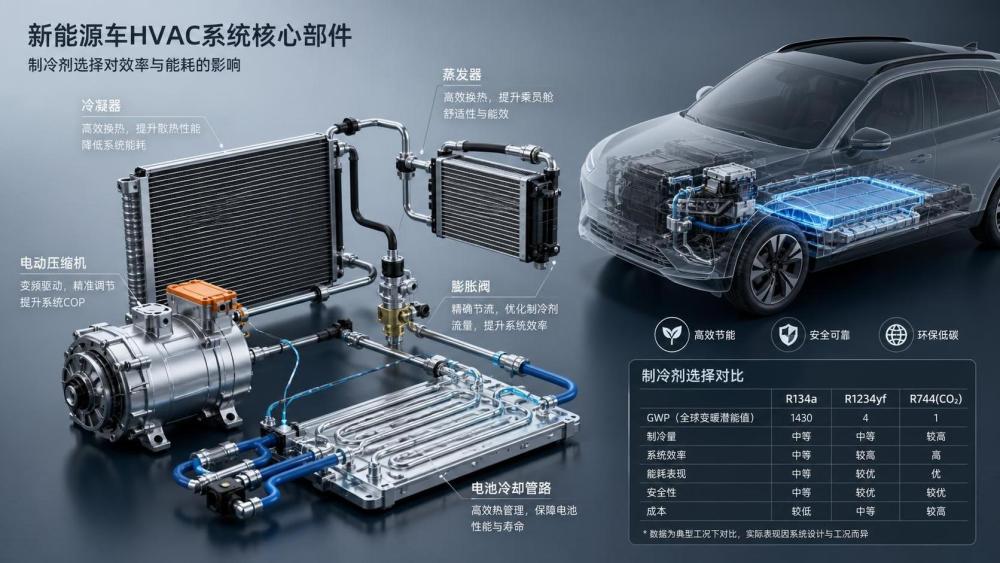
For evaluators working across compressors, heat pump systems, integrated valves, battery liquid cooling loops, and high-voltage electrical architecture, refrigerant choice sits at the center of several trade-offs: thermodynamic performance, safety classification, serviceability, material compatibility, and regulatory acceptance in target markets.
Efficiency starts with thermodynamics, but it does not end there
A refrigerant with favorable pressure-enthalpy characteristics can improve cooling capacity and coefficient of performance under certain conditions, but vehicle efficiency is never determined by refrigerant properties alone. The same fluid may perform differently depending on compressor type, condenser effectiveness, evaporator design, expansion device calibration, and software control logic.
This is why direct comparisons between refrigerants can be misleading if they ignore the rest of the system. For example, a switch from a legacy fluid to a lower-global-warming-potential alternative often changes discharge pressure and mass flow behavior. That can require a different compressor displacement strategy, new heat exchanger circuitry, revised hose and seal materials, and tighter control of charge quantity. If those changes are not optimized together, the expected efficiency gain may not appear in real vehicle testing.
In practice, technical assessments usually come down to a few questions:
- How much cooling or heating capacity is needed at the vehicle’s design ambient conditions?
- What compressor technology is being used—swash plate, scroll, or electric compressor?
- Will the same refrigerant support both cabin HVAC and battery or power electronics thermal functions?
- What safety and service requirements apply in the target region?
- How sensitive is the platform to efficiency losses at part load rather than peak load?
Why compressor behavior changes with refrigerant choice
The compressor is usually where refrigerant choice becomes visible first. Different refrigerants operate at different pressure levels and compression ratios, which affects shaft power, discharge temperature, lubrication, NVH behavior, and durability margins. In ICE vehicles using belt-driven compressors, the penalty appears as engine load. In EVs using high-voltage electric compressors, it appears as direct battery consumption.
Some fluids may allow strong cooling performance but require higher operating pressures. Others may reduce environmental burden but need more careful oil management or leak control. In heat pump applications, compressor performance across a wide ambient window becomes especially important. A refrigerant that works acceptably for summer cabin cooling may not deliver the same confidence in low-temperature heating or defrost scenarios without additional system measures.
This is one reason the market shift toward electrification has increased attention on scroll compressors, electric compressors, integrated thermal valves, and smarter control algorithms. Platforms such as GACT, which track auto A/C compressors and NEV thermal management together rather than as isolated product categories, reflect how the engineering decision is actually made on modern programs.
The pressure question: efficiency gain or hardware penalty
A refrigerant’s pressure characteristics shape more than compressor power. They influence pipe wall thickness, joint design, valve specification, condenser robustness, and the calibration window for expansion devices. Higher pressures can support strong heat transfer, but they also raise demands on sealing integrity, burst safety margins, and service procedures.
From an evaluator’s perspective, the right question is not whether a higher-pressure refrigerant is “better” or “worse.” It is whether the platform was designed around it from the start. If the answer is yes, the system may deliver good performance. If the answer is no and the refrigerant is being treated as a near drop-in substitute, efficiency and reliability risks usually increase.
This is also where standards and compliance work enter the picture. Refrigerant handling is tied to safety classifications, component marking, service equipment, and regional vehicle regulations. The exact compliance path depends on market and vehicle type, so teams typically need to check current requirements in the destination region rather than rely on assumptions carried over from previous programs.
Heat transfer, charge sensitivity, and real-world control stability
On paper, heat transfer performance often gets summarized into simple comparisons. In the vehicle, it is less tidy. Refrigerant choice affects evaporator superheat control, condenser approach temperature, frost behavior, start-stop response, and transient performance during pull-down. Small deviations in refrigerant charge can also have different consequences depending on the fluid and system layout.
Charge sensitivity matters because production tolerances, hose routing, and service practices are never perfect. A system that looks efficient in laboratory conditions but becomes unstable with modest undercharge or overcharge may create problems later in fleet use. Technical reviews should therefore look beyond nominal COP and ask how the system behaves under off-design conditions: idle, urban cycling, steep ambient swings, partial blockage, and aging-related leakage.
This is where data from field service, supplier validation, and regional operating experience becomes more useful than a generic refrigerant ranking. A thermal management intelligence platform can help here by connecting compressor technology updates, standards interpretation, application analysis, and supply chain trends in one place rather than forcing engineers to piece the picture together from scattered sources.
EVs make refrigerant choice more strategic
In battery electric vehicles, cabin HVAC is no longer a stand-alone comfort feature. It interacts with battery conditioning, inverter cooling, power electronics temperature control, and sometimes motor thermal loops. That changes how refrigerant selection should be evaluated.
A refrigerant that supports efficient heat pump operation across a wider ambient range can reduce the need for supplemental electric heating. In cold weather, that may have a measurable effect on usable range, though the exact impact depends on vehicle insulation, control logic, battery chemistry, and driving profile. At the same time, integrating cabin and battery thermal functions around one refrigerant circuit can improve packaging and system responsiveness, but it raises the bar for valve logic, fault management, and compressor reliability.
This is why refrigerant discussions in EV programs increasingly overlap with battery liquid cooling systems, integrated thermal valves, electric compressors, and high-voltage harness considerations. The fluid choice does not just affect the refrigeration loop. It influences the architecture around it.
A practical comparison framework for technical evaluation
This kind of framework is more useful than a simple refrigerant “winner” list because it links fluid properties to system outcomes. The same automotive HVAC system refrigerant may look attractive in one platform and problematic in another, depending on whether the target is a compact ICE export model, a premium EV heat pump system, or a commercial vehicle facing harsh ambient cycles.
Common evaluation mistakes
One recurring mistake is treating refrigerant choice as a late-stage compliance item. By that point, compressor selection, packaging space, condenser size, and electronic control logic may already be fixed. The result is often compromise rather than optimization.
Another is focusing only on peak cooling capacity. Vehicle HVAC efficiency is often decided in part-load operation, traffic conditions, shoulder seasons, and winter heating mode. That is especially true for EVs, where seasonal efficiency matters more than one strong summer test point.
A third mistake is ignoring service reality. Some refrigerants demand stricter contamination control, trained handling, or dedicated recovery equipment. If the service network in the destination market is not ready, nominal technical efficiency may be offset by maintenance errors, charge deviations, or downtime risk.
Where the market is heading
The trend is clearly toward lower-emission refrigerants, but the engineering path is not one-size-fits-all. Passenger cars, light commercial vehicles, and new energy platforms do not necessarily converge on the same thermal architecture. What is changing is the level of integration. Refrigerant selection is increasingly evaluated together with compressor electrification, multi-loop thermal management, software-defined control, and regional compliance planning.
That broader view is also shaping how industry information is consumed. Portals such as GACT are useful not because they present a single answer, but because they connect auto A/C compressors, heat pump systems, battery cooling, wiring harness development, standards interpretation, and export market differences in one technical context. For engineers and sourcing teams working across China, Europe, North America, Japan, India, or Southeast Asia, those connections matter more than isolated product headlines.
If a refrigerant decision is under review, the next step is usually not to ask which fluid is best in general. It is to confirm the operating envelope, compressor technology, thermal loads, compliance targets, and service conditions for the specific program. Once those are clear, refrigerant choice becomes a system decision with defensible trade-offs rather than a guess based on trend alone.
Have questions about this sector analysis, or seeking best practices specific to your niche? Drop us a line below and let the senior consultants at GAC assist you.
“We respect your privacy. Your information is strictly confidential.”
Related News
- 00
0000-00
How to assess a smart cockpit electronics manufacturer's integration capability - 00
0000-00
How does a shielded HSD cable reduce interference in vehicles? - 00
0000-00
What drives demand for scroll compressors in the automotive market? - 00
0000-00
Does AEC-Q200 apply to flexible printed circuits? - 00
0000-00
How does production volume affect automotive flexible electronics costs?
Tags
- auto A/C compressors
- NEV thermal management
- electric compressors
- high-voltage harness
- heat pump systems
- electric vehicles
- automotive thermal management
- thermal valves
- high-voltage electrical architecture
- Heat Pump System
- EV Heat Pump System
- Evaporator
- Condenser
- PTC Heater
- Electric Compressor
- battery liquid cooling
- automotive HVAC system
- liquid cooling systems
- automotive HVAC system refrigerant
Weekly Insights
Stay ahead with our curated technology reports delivered every Monday.
Recommended News
 How to assess a smart cockpit electronics manufacturer's integration capabilityAssess a smart cockpit electronics manufacturer's integration capability with practical checks for interfaces, testing, safety, cybersecurity and supplier support.Author:Time:Nov 18, 2026
 How does a shielded HSD cable reduce interference in vehicles?Discover how a shielded HSD cable reduces vehicle interference, and learn why connector design, routing, and testing matter for reliable high-speed data links.Author:Time:Nov 17, 2026
 What drives demand for scroll compressors in the automotive market?Explore the scroll compressor for automobile market and discover how EV adoption, heat pumps, efficiency, and supplier capabilities shape demand.Author:Time:Nov 16, 2026
 Does AEC-Q200 apply to flexible printed circuits?Flexible Printed Circuit AEC-Q200 requirements explained: discover which components qualify and how to assess automotive FPC reliability.Author:Time:Nov 15, 2026
 How does production volume affect automotive flexible electronics costs?Explore how production volume affects automotive flexible electronics cost, from tooling and yield to testing. Compare quotes and negotiate smarter.Author:Time:Nov 14, 2026
 How much does an in-vehicle infotainment system cost to replace?Explore in-vehicle infotainment cost, from affordable repairs to factory replacements. Compare options, installation fees, and compatibility before you buy.Author:Time:Nov 13, 2026
 How does condenser efficiency affect heat pump performance?Discover how condenser high efficiency can improve heat pump performance, reduce compressor power, and boost heating COP—plus the trade-offs to watch.Author:Time:Nov 12, 2026
 What does each FAKRA cable color code mean?FAKRA cable color code explained: Explore common connector colors, typical uses and key compatibility checks before choosing a replacement.Author:Time:Nov 11, 2026
 How to compare noise ratings for battery coolant pumpsCompare coolant pump low noise ratings with confidence. Learn how test conditions, hydraulic duty, tonal noise and installation affect your choice.Author:Time:Nov 10, 2026
 How bright should automotive display systems be in sunlight?Automotive Display Systems need more than brightness to stay readable in sunlight. Discover why 1,000 nits is a starting point and how to evaluate glare and heat.Author:Time:Nov 09, 2026
 How heat pumps improve the efficiency of EV thermal systemsEV Thermal Systems use heat pumps to reduce heating energy demand. Explore how they work, where they excel, and what limits efficiency in cold weather.Author:Time:Nov 08, 2026
 Can a smart cockpit platform support multiple displays?Can a smart cockpit platform support multiple displays? Explore key requirements for performance, safety, connectivity, and supplier evaluation.Author:Time:Nov 07, 2026
 How is automotive connector vibration resistance tested?Automotive connector vibration resistance testing reveals hidden contact failures. Explore test profiles, continuity monitoring and pass criteria.Author:Time:Nov 06, 2026
 How heat pumps save energy in automotive cabin climate systemsAutomotive Cabin Climate Systems energy saving starts with smarter heat pump design. Explore real-world efficiency, cold-weather trade-offs, and testing tips.Author:Time:Nov 05, 2026
 Is an EV heat pump worth it for winter driving range?Is a heat pump worth using in a cold-climate EV? Discover how it affects winter range, when it pays off, and what to check before buying.Author:Time:Nov 04, 2026
 When should you use 50-ohm coaxial cable instead of 75-ohm?Coaxial cable 50 ohm or 75 ohm? Learn when to use each, avoid impedance mismatches, and choose the right cable for reliable RF and video performance.Author:Time:Nov 03, 2026
 How to select a high temperature motor harness for an EVChoose the right high temperature motor harness for your EV. Compare thermal limits, current capacity, shielding, routing, and validation evidence.Author:Time:Nov 02, 2026
 How much does electric power steering replacement cost?Electric power steering price typically ranges from $1,000 to $3,000 for major replacements. Discover cost factors, repair options, and tips for comparing quotes.Author:Time:Nov 01, 2026
 How to size an EV A/C compressor for the required cooling capacitySize an EV A/C Compressor with confidence. Explore cooling loads, performance maps and power limits to select the right compressor for your vehicle.Author:Time:Oct 31, 2026
 How to choose the right pitch for an FPC board connectorFPC board connector pitch affects space, assembly and reliability. Learn how to compare options and select the best fit for your design.Author:Time:Oct 30, 2026
 How zonal design affects harness routing in high-voltage EV architecturesExplore high-voltage electrical architecture zonal design and its impact on EV harness routing. Discover key trade-offs in cable length, safety, thermal performance, and service access.Author:Time:Oct 29, 2026
 How tariffs affect costs in global automotive parts supply chainsNavigate tariffs in the global automotive parts trade supply chain. Learn to compare landed costs, manage duty exposure, and uncover smarter sourcing strategies to protect your margins.Author:Time:Oct 28, 2026
 How to assess vendor lock-in in a software-defined vehicle platformAssess Software-Defined Vehicle platform lock-in with practical tests for API portability, data access, update control, and exit costs. Learn how to choose a platform with a proven exit path.Author:Time:Oct 27, 2026
 How ISO 26262 guides functional safety in steer-by-wire systemsExplore steering systems functional safety through ISO 26262. Learn how hazard analysis, fault-tolerant design, and validation build a stronger steer-by-wire safety case.Author:Time:Oct 26, 2026
 How to evaluate a steering angle sensor manufacturer's accuracy claimsEvaluate steering angle sensor manufacturer accuracy claims with practical checks on calibration, latency, and test evidence. Compare suppliers confidently and avoid costly selection mistakes.Author:Time:Oct 25, 2026
 How to diagnose CAN bus faults in a hybrid vehicle control unitDiagnose Hybrid Vehicle Systems control unit CAN bus faults with step-by-step power, wiring, and waveform checks. Find the root cause and avoid unnecessary replacement.Author:Time:Oct 24, 2026
 How does battery cooling pipe diameter affect coolant pressure drop?Battery Cooling Pipe diameter affects coolant pressure drop and pump power. Explore sizing calculations and practical tips to optimize EV battery cooling and compare options with confidence.Author:Time:Oct 23, 2026
 How to assess PPAP readiness of automotive sensor system manufacturersAssess Automotive Sensor Systems manufacturers for PPAP readiness. Learn to verify production evidence, measurement capability, validation, and traceability to reduce sourcing risks.Author:Time:Oct 22, 2026
 What to ask an FPC connector manufacturer about reliability testingChoosing an FPC Connector manufacturer? Learn what to ask about reliability testing, failure limits, and traceable results to reduce design risks and select with confidence.Author:Time:Oct 21, 2026
 How to verify vehicle fitment for an aftermarket AC evaporatorNavigating the evaporator aftermarket? Verify vehicle fitment with VIN data, OE numbers, and physical interface checks. Use this guide to avoid costly mismatches and order confidently.Author:Time:Oct 20, 2026