Thermal Fluid Analysis: 5 Warning Signs of Cooling System Degradation




Thermal Fluid Analysis: 5 Warning Signs of Cooling System Degradation
Thermal fluid analysis is often the earliest clue that a vehicle cooling system is losing efficiency before major failures appear.
In daily service work, that early visibility matters more than many teams expect.
A fluid sample can reveal chemical stress, contamination, and heat transfer decline long before a dashboard warning appears.
That is especially true in modern vehicles using compact cooling packages, electric compressors, battery liquid cooling loops, and integrated thermal valves.
From a practical standpoint, thermal fluid analysis helps turn vague overheating complaints into clear maintenance decisions.
Instead of waiting for pump failure, radiator blockage, or seal damage, teams can act when the warning signs are still manageable.
Why Thermal Fluid Analysis Matters in Modern Cooling Systems
Traditional cooling checks often focus on level, leaks, and visible corrosion.
Those are still important, but they rarely show the full condition of the system fluid.
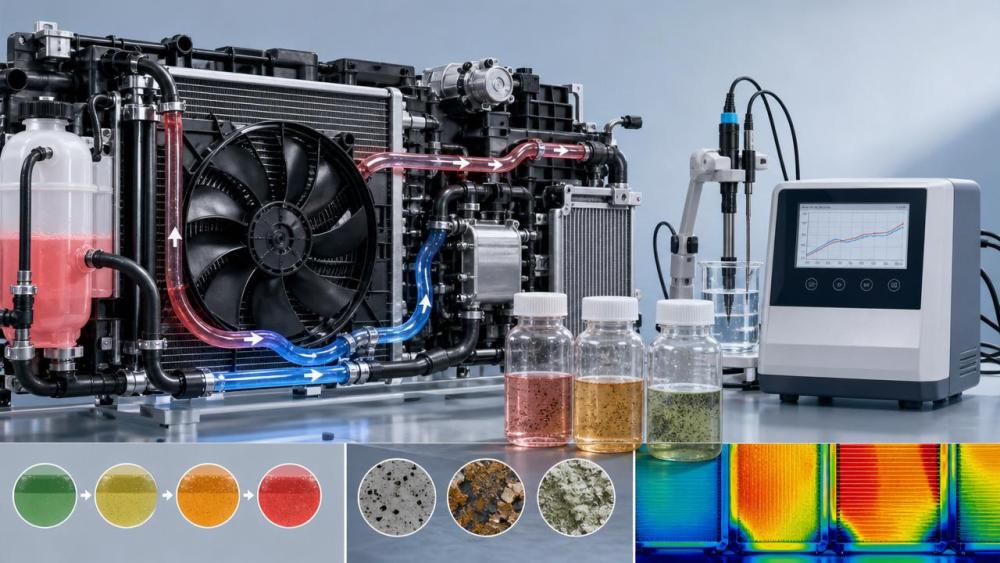
Thermal fluid analysis goes deeper by looking at pH, inhibitor depletion, suspended particles, conductivity, and fluid stability.
In newer platforms, cooling circuits support not only engines but also inverters, batteries, e-motors, cabin HVAC, and heat pump functions.
That means poor coolant condition can damage far more than a radiator or water pump.
It can reduce thermal efficiency across multiple subsystems and increase the risk of unplanned downtime.
What Thermal Fluid Analysis Helps You Detect
- Loss of corrosion protection inside mixed-metal cooling circuits.
- Contamination from oil, debris, seal breakdown, or external ingress.
- Reduced heat transfer caused by scaling, sludge, or fluid aging.
- Chemical imbalance that accelerates hose, gasket, and pump wear.
- Early signs of failure in battery liquid cooling and thermal management loops.
Warning Sign 1: Coolant Color and Clarity Start Changing
The first warning sign is usually visual, and it is easy to miss.
When coolant shifts from clear and stable to cloudy, rusty, or oily, thermal fluid analysis becomes necessary.
Discoloration often points to oxidation, internal corrosion, mixed fluid chemistry, or contamination from another system.
A brown tint may suggest iron corrosion.
A milky appearance can suggest oil intrusion or additive breakdown.
Particles floating in the sample may indicate scale release, casting residue, or deteriorating internal surfaces.
What to Do
- Compare the sample with new coolant from the approved specification.
- Check for cross-contamination from oil coolers, head gaskets, or seal failures.
- Review service history for mixed coolant types or top-off errors.
- Flush only after identifying the contamination source.
Warning Sign 2: Operating Temperature Becomes Less Stable
A cooling system does not need to overheat completely to show degradation.
More often, the pattern starts with unstable temperature behavior under normal load.
You may see longer warm-up, rising fan activity, or wider temperature swings during idle, traffic, towing, or fast charging.
From recent service trends, this is a common trigger for thermal fluid analysis in both ICE and NEV platforms.
The fluid may still circulate, but weakened heat transfer can limit system performance.
That means the issue is chemical as much as mechanical.
Typical Root Causes
- Additive depletion reducing heat exchange efficiency.
- Micro-scale deposits insulating internal passages.
- Air entrainment caused by leaks or poor refill procedures.
- Improper coolant concentration affecting boiling and freezing margins.
Warning Sign 3: pH and Conductivity Move Out of Range
This is where thermal fluid analysis becomes far more valuable than a visual inspection.
A coolant may look acceptable while its chemistry has already moved into a damaging range.
If pH drops too low, corrosion risk increases across aluminum, steel, and other metals.
If conductivity rises too high, ion buildup may signal contamination or additive breakdown.
In electrified vehicles, that trend deserves closer attention because sensitive components depend on controlled thermal behavior.
A small chemical drift today can become a pump, valve, or heat exchanger problem later.
Service Tip
Do not judge coolant condition by age alone.
Duty cycle, charging behavior, climate, and repeated topping off can change chemistry faster than the schedule suggests.
Thermal fluid analysis gives a more reliable basis for service timing.
Warning Sign 4: Sediment, Scale, or Sludge Begins to Build
A more obvious signal is the presence of sediment or sludge in the expansion tank, radiator neck, or drained sample.
This usually means the cooling system has moved past early chemical change and into material deposition.
Once deposits form, heat transfer surfaces become less effective.
Flow paths narrow, hotspots develop, and pressure drop can increase across the loop.
This matters even more in compact modules such as battery liquid cooling plates and small thermal control valves.
Restricted passages there can quickly affect thermal management accuracy.
Common Sources of Deposit Formation
- Hard water used during refill or dilution.
- Mixing incompatible coolant technologies.
- Long drain intervals under severe heat load.
- Internal corrosion products circulating through the loop.
Warning Sign 5: Repeated Component Failures Point to a System Issue
Sometimes the clearest warning sign is not the fluid sample alone.
It is the pattern of repeat failures around the cooling loop.
If pumps, thermostats, valves, seals, or heat exchangers fail too often, fluid condition should be questioned immediately.
In real service operations, replacing parts without thermal fluid analysis often solves the symptom, not the cause.
Acidic coolant can attack seals.
Abrasive particles can shorten pump life.
Deposits can hold thermal valves open or closed at the wrong time.
A Simple Decision Rule
If the same cooling-related complaint returns after component replacement, test the fluid before replacing another part.
That approach reduces guesswork and protects service margins.
How to Use Thermal Fluid Analysis as a Practical Maintenance Tool
The most effective approach is to treat thermal fluid analysis as part of a repeatable inspection routine.
It works best when paired with operating data, repair history, and component inspection.
This is especially useful for fleets, high-mileage vehicles, export units, and mixed powertrain workshops.
Recommended Workflow
- Take a clean sample at a consistent service point.
- Record mileage, load pattern, ambient conditions, and recent repairs.
- Check visual condition, concentration, pH, and conductivity first.
- Investigate particles, oil traces, or unusual odor if present.
- Compare findings with OEM guidance and actual system symptoms.
- Correct the root cause before refilling or replacing major components.
Final Takeaway
Thermal fluid analysis is not just a lab exercise.
It is a practical way to catch cooling system degradation before it becomes a costly repair event.
When coolant color changes, temperatures drift, chemistry moves out of range, deposits appear, or parts keep failing, the system is already asking for attention.
Used correctly, thermal fluid analysis supports better diagnostics, smarter parts decisions, and more stable vehicle thermal performance.
That also means fewer repeat repairs and more confidence in every maintenance recommendation.
For any shop dealing with advanced cooling circuits, this is one of the most useful early-warning tools available.
Start with one consistent sampling process, track changes over time, and let thermal fluid analysis guide the next service action with evidence, not guesswork.
Have questions about this sector analysis, or seeking best practices specific to your niche? Drop us a line below and let the senior consultants at GAC assist you.
“We respect your privacy. Your information is strictly confidential.”
Related News
- 00
0000-00
Can a smart cockpit platform support multiple displays? - 00
0000-00
How is automotive connector vibration resistance tested? - 00
0000-00
How heat pumps save energy in automotive cabin climate systems - 00
0000-00
Is an EV heat pump worth it for winter driving range? - 00
0000-00
When should you use 50-ohm coaxial cable instead of 75-ohm?
Weekly Insights
Stay ahead with our curated technology reports delivered every Monday.
Recommended News
 Can a smart cockpit platform support multiple displays?Can a smart cockpit platform support multiple displays? Explore key requirements for performance, safety, connectivity, and supplier evaluation.Author:Time:Nov 07, 2026
 How is automotive connector vibration resistance tested?Automotive connector vibration resistance testing reveals hidden contact failures. Explore test profiles, continuity monitoring and pass criteria.Author:Time:Nov 06, 2026
 How heat pumps save energy in automotive cabin climate systemsAutomotive Cabin Climate Systems energy saving starts with smarter heat pump design. Explore real-world efficiency, cold-weather trade-offs, and testing tips.Author:Time:Nov 05, 2026
 Is an EV heat pump worth it for winter driving range?Is a heat pump worth using in a cold-climate EV? Discover how it affects winter range, when it pays off, and what to check before buying.Author:Time:Nov 04, 2026
 When should you use 50-ohm coaxial cable instead of 75-ohm?Coaxial cable 50 ohm or 75 ohm? Learn when to use each, avoid impedance mismatches, and choose the right cable for reliable RF and video performance.Author:Time:Nov 03, 2026
 How to select a high temperature motor harness for an EVChoose the right high temperature motor harness for your EV. Compare thermal limits, current capacity, shielding, routing, and validation evidence.Author:Time:Nov 02, 2026
 How much does electric power steering replacement cost?Electric power steering price typically ranges from $1,000 to $3,000 for major replacements. Discover cost factors, repair options, and tips for comparing quotes.Author:Time:Nov 01, 2026
 How to size an EV A/C compressor for the required cooling capacitySize an EV A/C Compressor with confidence. Explore cooling loads, performance maps and power limits to select the right compressor for your vehicle.Author:Time:Oct 31, 2026
 How to choose the right pitch for an FPC board connectorFPC board connector pitch affects space, assembly and reliability. Learn how to compare options and select the best fit for your design.Author:Time:Oct 30, 2026
 How zonal design affects harness routing in high-voltage EV architecturesExplore high-voltage electrical architecture zonal design and its impact on EV harness routing. Discover key trade-offs in cable length, safety, thermal performance, and service access.Author:Time:Oct 29, 2026
 How tariffs affect costs in global automotive parts supply chainsNavigate tariffs in the global automotive parts trade supply chain. Learn to compare landed costs, manage duty exposure, and uncover smarter sourcing strategies to protect your margins.Author:Time:Oct 28, 2026
 How to assess vendor lock-in in a software-defined vehicle platformAssess Software-Defined Vehicle platform lock-in with practical tests for API portability, data access, update control, and exit costs. Learn how to choose a platform with a proven exit path.Author:Time:Oct 27, 2026
 How ISO 26262 guides functional safety in steer-by-wire systemsExplore steering systems functional safety through ISO 26262. Learn how hazard analysis, fault-tolerant design, and validation build a stronger steer-by-wire safety case.Author:Time:Oct 26, 2026
 How to evaluate a steering angle sensor manufacturer's accuracy claimsEvaluate steering angle sensor manufacturer accuracy claims with practical checks on calibration, latency, and test evidence. Compare suppliers confidently and avoid costly selection mistakes.Author:Time:Oct 25, 2026
 How to diagnose CAN bus faults in a hybrid vehicle control unitDiagnose Hybrid Vehicle Systems control unit CAN bus faults with step-by-step power, wiring, and waveform checks. Find the root cause and avoid unnecessary replacement.Author:Time:Oct 24, 2026
 How does battery cooling pipe diameter affect coolant pressure drop?Battery Cooling Pipe diameter affects coolant pressure drop and pump power. Explore sizing calculations and practical tips to optimize EV battery cooling and compare options with confidence.Author:Time:Oct 23, 2026
 How to assess PPAP readiness of automotive sensor system manufacturersAssess Automotive Sensor Systems manufacturers for PPAP readiness. Learn to verify production evidence, measurement capability, validation, and traceability to reduce sourcing risks.Author:Time:Oct 22, 2026
 What to ask an FPC connector manufacturer about reliability testingChoosing an FPC Connector manufacturer? Learn what to ask about reliability testing, failure limits, and traceable results to reduce design risks and select with confidence.Author:Time:Oct 21, 2026
 How to verify vehicle fitment for an aftermarket AC evaporatorNavigating the evaporator aftermarket? Verify vehicle fitment with VIN data, OE numbers, and physical interface checks. Use this guide to avoid costly mismatches and order confidently.Author:Time:Oct 20, 2026
 How electric compressor speed affects EV battery cooling capacityElectric compressor technology: battery cooling depends on more than RPM. Discover how speed, refrigerant flow, and system limits affect EV cooling capacity and energy efficiency.Author:Time:Oct 19, 2026
 How to verify a variable frequency compressor supplier’s efficiency claimsVerify a variable frequency compressor supplier’s efficiency claims using COP boundaries, matched test conditions, and duty-cycle data. Learn how to choose with confidence.Author:Time:Oct 18, 2026
 How bend radius affects FPC reliability in automotive camera modulesAutomotive FPC applications: camera module reliability starts with bend radius. Learn how stack-up, strain, and validation guide robust designs and help prevent costly failures.Author:Time:Oct 17, 2026
 How to diagnose intermittent loss of electric power steering assistMaster power steering system diagnostics to trace intermittent EPS assist loss. Learn proven checks for voltage, wiring, and fault codes to avoid costly guesswork.Author:Time:Oct 16, 2026
 How to size automotive power modules for electric compressorsSize automotive power modules for electric compressors with confidence. Learn how voltage, phase current, losses, and cooling shape reliable selection—and avoid costly oversizing.Author:Time:Oct 15, 2026
 Why automotive power electronics are shifting to silicon carbideAutomotive Power Electronics are shifting to silicon carbide. Discover how SiC can cut losses, boost EV power density, and reshape cooling, reliability, and system costs.Author:Time:Oct 14, 2026
 How EV adoption shapes the electrically driven compressor marketExplore how EV adoption shapes the electrically driven compressor market, from battery cooling and heat pumps to supplier margins. Discover the drivers of profitable growth.Author:Time:Oct 13, 2026
 How to size a PTC heater for reliable EV cabin heatingPTC Heater sizing for EV cabins: learn how to balance defrost performance, heat-pump integration, airflow, voltage range, and battery power for reliable winter comfort.Author:Time:Oct 12, 2026
 What determines the cooling output of electric automotive AC compressors?Automotive air conditioning compressors electric systems: explore how speed, voltage, refrigerant, controls, and heat exchangers shape EV cooling capacity and efficiency.Author:Time:Oct 11, 2026
 What makes a touchscreen media head unit responsive enough for daily use?Touchscreen media head unit performance explained: discover what delivers fast starts, smooth maps, reliable phone pairing, and responsive daily driving.Author:Time:Oct 10, 2026
 How Does a Battery Management System Communicate Cooling Demand?How does a battery management system communicate cooling demand? Explore CAN signals, thermal priorities, fault handling, and EV cooling control strategies.Author:Time:Oct 20, 2026