How to Evaluate a Battery Cooling Module Factory for EV Projects




How to Evaluate a Battery Cooling Module Factory for EV Projects
A battery cooling module factory is not just a place that assembles pipes, plates, pumps, and brackets. In an EV program, it is part thermal engineering house, part manufacturing system, and part quality risk manager. That distinction matters because many sourcing teams still evaluate suppliers as if they were buying a mature, low-variation mechanical part. A battery cooling module sits much closer to vehicle safety, battery life, fast-charging stability, and platform efficiency than its appearance suggests.
For technical evaluation teams, the real question is not whether a factory can produce a module drawing. The question is whether it can repeatedly deliver a cooling assembly that behaves the same way across validation builds, SOP ramp-up, and field conditions. In battery thermal management, small production deviations can become system-level problems: pressure drop shifts, uneven coolant distribution, leakage after vibration, weak brazing or welding consistency, contamination inside the loop, or poor sealing compatibility with glycol-based coolants. These are not purchasing details. They shape the thermal margin of the pack.
That is why factory selection should start with engineering scope. Some suppliers are strong at metal fabrication but weak in system integration. Others can build to print but cannot support design iteration on cold plates, manifolds, connectors, integrated valves, or module routing logic. If the EV project still has open thermal targets, packaging changes, or evolving cell layouts, a factory with only fabrication capacity may slow the program down.
What a competent supplier is really expected to control
In practice, a battery cooling module supplier may cover different boundaries depending on the OEM or Tier 1 architecture. Sometimes the scope is limited to a liquid cooling plate and its interfaces. In other programs it includes hoses, quick connectors, manifolds, brackets, sensors, valves, insulation features, and partial integration with the battery enclosure. Evaluation should therefore begin with a basic but often skipped clarification: what exactly is the factory responsible for designing, validating, and warranting?
A capable manufacturer should be able to discuss more than nominal cooling capacity. It should understand flow distribution, pressure loss, material compatibility, corrosion risk, leak tightness strategy, joining process windows, and serviceability constraints. If conversations remain limited to annual capacity, machine count, and price quotation speed, you are probably looking at a production vendor, not a technically reliable program partner.
This is also where many teams overvalue prototype responsiveness. Fast samples are useful, but prototype agility is not a substitute for disciplined process development. A factory that can ship a sample in two weeks but has weak PPAP discipline, incomplete traceability, or unstable leak test capability may still become the source of launch delays later.
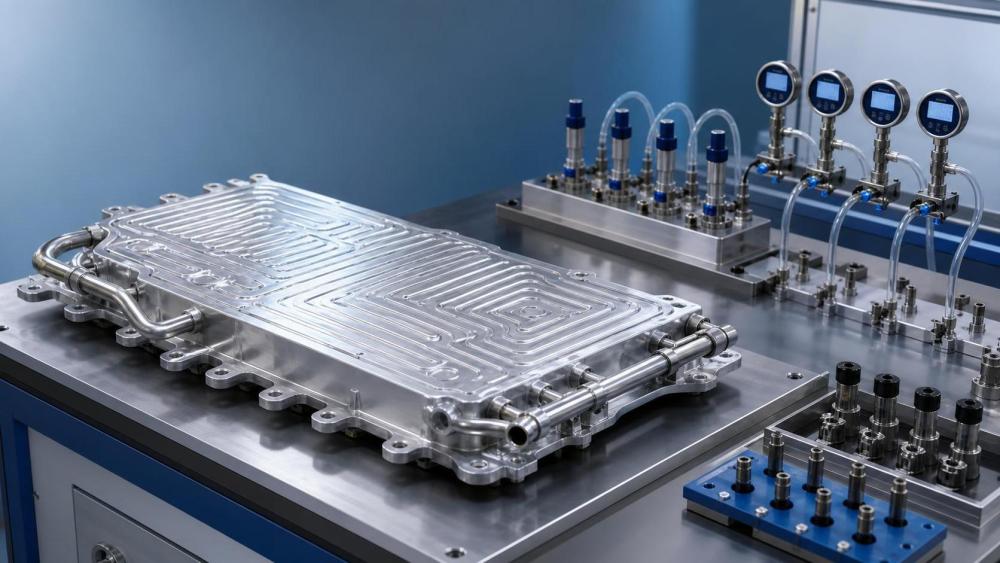
Look beyond drawings: review the thermal manufacturing logic
The best technical audits usually move upstream from the finished part to the process logic behind it. For a battery cooling module factory, that means understanding how the design intent is translated into production controls. If the module relies on brazed aluminum channels, ask how braze quality is monitored and what defect modes are screened. If it uses friction stir welding, laser welding, TIG welding, or mechanical joining, the key issue is not simply whether the equipment exists, but whether the process window is narrow, repeatable, and documented.
Internal cleanliness is another underappreciated checkpoint. Battery liquid cooling circuits are sensitive to particulates, residues, and flux carryover. A factory should be able to explain its cleaning steps, contamination limits if defined by customer specifications, and packaging controls after end-of-line testing. If this answer is vague, the risk is not cosmetic. Debris in the loop can affect valves, pumps, narrow flow channels, and long-term reliability.
Review the factory’s leak test philosophy in the same way. Different projects may use pressure decay, helium-based methods, or other customer-specified approaches. There is no single mandatory method across all programs, but there should be a coherent rationale linking leak testing to module design, target sensitivity, and production takt time. A factory that treats leak testing as a generic final check rather than a critical process linked to joint design is not showing enough depth.
Validation capability matters more than brochure claims
A strong battery cooling module factory does not need to own every possible lab resource in-house, but it must show that validation is built into development rather than outsourced as an afterthought. For EV projects, teams usually need evidence around pressure resistance, leak integrity, vibration durability, thermal cycling, corrosion-related behavior, and coolant compatibility. The exact validation matrix depends on customer standards and vehicle architecture, yet the supplier should already know how these test themes affect design decisions.
Ask a practical question: when a prototype fails thermal cycling or shows leakage after vibration, how does the factory close the loop? Mature suppliers can explain failure analysis flow, corrective action ownership, and design-process interaction. Weak suppliers often jump directly to “we can modify the part” without showing how they identify root cause. That difference is critical in EV launches, where thermal modules often sit in tightly coupled design spaces with limited room for repeated trial-and-error.
It is also worth checking whether the factory can support documentation formats expected in automotive supply chains, including APQP and PPAP-related deliverables when required by the customer. Not every evaluation needs a textbook audit checklist, but if a supplier cannot navigate automotive change control and production approval requirements, the project will eventually feel that weakness.
Material choices and interface control are often where risk hides
Battery cooling modules are interface-heavy products. Even when the thermal core is well designed, failures often begin at transitions: metal-to-polymer joints, hose connections, sealing grooves, mounting interfaces, connector tolerances, or mating surfaces to the pack structure. Evaluation should therefore include the supplier’s competence in stack-up management and tolerance analysis, not only heat transfer design.
Material compatibility deserves equal attention. Aluminum alloys, stainless steel parts, engineering plastics, elastomers, coatings, and coolant chemistry all interact. Some factories are comfortable manufacturing mixed-material assemblies but rely heavily on customer specifications to define compatibility boundaries. That is acceptable to a point, but for a development-stage EV program, it is better when the supplier can proactively flag risks such as galvanic corrosion exposure, sealing material mismatch, or long-term degradation under temperature cycling.
This is one of the most common sourcing mistakes: assuming the module is a simple fabricated subassembly because major performance calculations were completed at system level. In reality, the factory still influences the outcome through material substitutions, joining consistency, cleanliness, and interface discipline.
What to verify during a factory audit
A useful audit does not try to inspect everything. It focuses on the points where thermal function and manufacturing variation meet. The table below is a practical way to organize that review.
One more point: certifications can support credibility, but they should not replace process evidence. For automotive projects, quality management certifications such as IATF 16949 may be relevant depending on the supplier profile, and ISO 9001 is common as a baseline. Still, a certificate alone does not prove competence in battery thermal assemblies. The technical depth has to be visible on the shop floor and in project documentation.
Capacity is not just output volume
When buyers ask about capacity, the answer they usually receive is annual unit volume. That is only one part of the picture. For battery cooling module programs, useful capacity assessment should include ramp flexibility, tooling redundancy, maintenance planning for critical equipment, operator training stability, and the supplier’s ability to manage engineering changes without disrupting mass production.
This becomes especially important for platforms that may launch with one battery pack configuration and later introduce chemistry, cell format, or pack layout updates. A factory that can only run one rigid process route may look efficient on paper but become fragile once variant complexity increases. Technical evaluation should therefore include a discussion of product family strategy: how much design commonality the supplier can absorb before quality or throughput starts to degrade.
Common misreadings during supplier selection
One mistake is assuming that experience in HVAC heat exchangers or general liquid pipelines automatically translates into battery cooling module competence. There is overlap in materials and joining technologies, but EV battery applications introduce a tighter combination of packaging constraints, durability exposure, electrical safety context, and validation expectations.
Another is overemphasizing cost breakdown before technical risk is understood. Cooling modules may look cost-sensitive, and they are, but an unrealistically low quote can hide unproven process assumptions, outsourced critical steps, or limited validation ownership. In sourcing reviews, low price often deserves more technical questioning, not less.
There is also a tendency to separate product engineering from factory audit. In battery thermal systems, that separation is artificial. The product cannot be evaluated cleanly without its manufacturing logic, and the factory cannot be judged properly without understanding the module’s thermal and sealing demands.
A practical decision lens
If two candidate suppliers both meet the drawing and both present acceptable quotations, the better choice is usually the one that explains failure modes more clearly, controls interfaces more rigorously, and shows stronger discipline in validation and traceability. That sounds less dramatic than a capacity headline, but it is closer to what protects an EV project in the field.
Evaluating a battery cooling module factory is really an exercise in reading how deeply the supplier understands the consequences of thermal manufacturing decisions. The strongest factories do not just promise compliance. They can show how design intent, process control, and automotive program discipline connect. For technical teams making a selection decision, that is the difference between a vendor that can make parts and a partner that can support a battery platform through launch, change, and long-term reliability.
Have questions about this sector analysis, or seeking best practices specific to your niche? Drop us a line below and let the senior consultants at GAC assist you.
“We respect your privacy. Your information is strictly confidential.”
Related News
- 00
0000-00
How to compare noise ratings for battery coolant pumps - 00
0000-00
How bright should automotive display systems be in sunlight? - 00
0000-00
How heat pumps improve the efficiency of EV thermal systems - 00
0000-00
Can a smart cockpit platform support multiple displays? - 00
0000-00
How is automotive connector vibration resistance tested?
Weekly Insights
Stay ahead with our curated technology reports delivered every Monday.
Recommended News
 How to compare noise ratings for battery coolant pumpsCompare coolant pump low noise ratings with confidence. Learn how test conditions, hydraulic duty, tonal noise and installation affect your choice.Author:Time:Nov 10, 2026
 How bright should automotive display systems be in sunlight?Automotive Display Systems need more than brightness to stay readable in sunlight. Discover why 1,000 nits is a starting point and how to evaluate glare and heat.Author:Time:Nov 09, 2026
 How heat pumps improve the efficiency of EV thermal systemsEV Thermal Systems use heat pumps to reduce heating energy demand. Explore how they work, where they excel, and what limits efficiency in cold weather.Author:Time:Nov 08, 2026
 Can a smart cockpit platform support multiple displays?Can a smart cockpit platform support multiple displays? Explore key requirements for performance, safety, connectivity, and supplier evaluation.Author:Time:Nov 07, 2026
 How is automotive connector vibration resistance tested?Automotive connector vibration resistance testing reveals hidden contact failures. Explore test profiles, continuity monitoring and pass criteria.Author:Time:Nov 06, 2026
 How heat pumps save energy in automotive cabin climate systemsAutomotive Cabin Climate Systems energy saving starts with smarter heat pump design. Explore real-world efficiency, cold-weather trade-offs, and testing tips.Author:Time:Nov 05, 2026
 Is an EV heat pump worth it for winter driving range?Is a heat pump worth using in a cold-climate EV? Discover how it affects winter range, when it pays off, and what to check before buying.Author:Time:Nov 04, 2026
 When should you use 50-ohm coaxial cable instead of 75-ohm?Coaxial cable 50 ohm or 75 ohm? Learn when to use each, avoid impedance mismatches, and choose the right cable for reliable RF and video performance.Author:Time:Nov 03, 2026
 How to select a high temperature motor harness for an EVChoose the right high temperature motor harness for your EV. Compare thermal limits, current capacity, shielding, routing, and validation evidence.Author:Time:Nov 02, 2026
 How much does electric power steering replacement cost?Electric power steering price typically ranges from $1,000 to $3,000 for major replacements. Discover cost factors, repair options, and tips for comparing quotes.Author:Time:Nov 01, 2026
 How to size an EV A/C compressor for the required cooling capacitySize an EV A/C Compressor with confidence. Explore cooling loads, performance maps and power limits to select the right compressor for your vehicle.Author:Time:Oct 31, 2026
 How to choose the right pitch for an FPC board connectorFPC board connector pitch affects space, assembly and reliability. Learn how to compare options and select the best fit for your design.Author:Time:Oct 30, 2026
 How zonal design affects harness routing in high-voltage EV architecturesExplore high-voltage electrical architecture zonal design and its impact on EV harness routing. Discover key trade-offs in cable length, safety, thermal performance, and service access.Author:Time:Oct 29, 2026
 How tariffs affect costs in global automotive parts supply chainsNavigate tariffs in the global automotive parts trade supply chain. Learn to compare landed costs, manage duty exposure, and uncover smarter sourcing strategies to protect your margins.Author:Time:Oct 28, 2026
 How to assess vendor lock-in in a software-defined vehicle platformAssess Software-Defined Vehicle platform lock-in with practical tests for API portability, data access, update control, and exit costs. Learn how to choose a platform with a proven exit path.Author:Time:Oct 27, 2026
 How ISO 26262 guides functional safety in steer-by-wire systemsExplore steering systems functional safety through ISO 26262. Learn how hazard analysis, fault-tolerant design, and validation build a stronger steer-by-wire safety case.Author:Time:Oct 26, 2026
 How to evaluate a steering angle sensor manufacturer's accuracy claimsEvaluate steering angle sensor manufacturer accuracy claims with practical checks on calibration, latency, and test evidence. Compare suppliers confidently and avoid costly selection mistakes.Author:Time:Oct 25, 2026
 How to diagnose CAN bus faults in a hybrid vehicle control unitDiagnose Hybrid Vehicle Systems control unit CAN bus faults with step-by-step power, wiring, and waveform checks. Find the root cause and avoid unnecessary replacement.Author:Time:Oct 24, 2026
 How does battery cooling pipe diameter affect coolant pressure drop?Battery Cooling Pipe diameter affects coolant pressure drop and pump power. Explore sizing calculations and practical tips to optimize EV battery cooling and compare options with confidence.Author:Time:Oct 23, 2026
 How to assess PPAP readiness of automotive sensor system manufacturersAssess Automotive Sensor Systems manufacturers for PPAP readiness. Learn to verify production evidence, measurement capability, validation, and traceability to reduce sourcing risks.Author:Time:Oct 22, 2026
 What to ask an FPC connector manufacturer about reliability testingChoosing an FPC Connector manufacturer? Learn what to ask about reliability testing, failure limits, and traceable results to reduce design risks and select with confidence.Author:Time:Oct 21, 2026
 How to verify vehicle fitment for an aftermarket AC evaporatorNavigating the evaporator aftermarket? Verify vehicle fitment with VIN data, OE numbers, and physical interface checks. Use this guide to avoid costly mismatches and order confidently.Author:Time:Oct 20, 2026
 How electric compressor speed affects EV battery cooling capacityElectric compressor technology: battery cooling depends on more than RPM. Discover how speed, refrigerant flow, and system limits affect EV cooling capacity and energy efficiency.Author:Time:Oct 19, 2026
 How to verify a variable frequency compressor supplier’s efficiency claimsVerify a variable frequency compressor supplier’s efficiency claims using COP boundaries, matched test conditions, and duty-cycle data. Learn how to choose with confidence.Author:Time:Oct 18, 2026
 How bend radius affects FPC reliability in automotive camera modulesAutomotive FPC applications: camera module reliability starts with bend radius. Learn how stack-up, strain, and validation guide robust designs and help prevent costly failures.Author:Time:Oct 17, 2026
 How to diagnose intermittent loss of electric power steering assistMaster power steering system diagnostics to trace intermittent EPS assist loss. Learn proven checks for voltage, wiring, and fault codes to avoid costly guesswork.Author:Time:Oct 16, 2026
 How to size automotive power modules for electric compressorsSize automotive power modules for electric compressors with confidence. Learn how voltage, phase current, losses, and cooling shape reliable selection—and avoid costly oversizing.Author:Time:Oct 15, 2026
 Why automotive power electronics are shifting to silicon carbideAutomotive Power Electronics are shifting to silicon carbide. Discover how SiC can cut losses, boost EV power density, and reshape cooling, reliability, and system costs.Author:Time:Oct 14, 2026
 How EV adoption shapes the electrically driven compressor marketExplore how EV adoption shapes the electrically driven compressor market, from battery cooling and heat pumps to supplier margins. Discover the drivers of profitable growth.Author:Time:Oct 13, 2026
 How to size a PTC heater for reliable EV cabin heatingPTC Heater sizing for EV cabins: learn how to balance defrost performance, heat-pump integration, airflow, voltage range, and battery power for reliable winter comfort.Author:Time:Oct 12, 2026