How automotive thermal management modules affect EV battery cooling




An automotive thermal management module plays a critical role in EV battery cooling by coordinating coolant flow, heat exchange, valve control, and energy use across the battery, motor, and cabin systems. Its effect is not limited to keeping battery temperature within a safe range. The module influences fast-charging capability, usable power, cell ageing, thermal-runaway mitigation strategy, winter performance, compressor operating load, and the packaging complexity of the vehicle.
For an EV platform team, the important question is not whether a thermal module is present, but whether its hydraulic architecture, actuator response, control logic, refrigerant interface, and fault behavior are appropriate for the battery chemistry, pack layout, electrical architecture, and target markets. A module that performs well in a mild-climate urban vehicle may be inadequate for a high-power SUV expected to support repeated DC fast charging in high ambient temperatures.
Why battery cooling is now a vehicle-level problem
Early electric vehicles commonly used relatively separate loops for the battery, electric drive, power electronics, and cabin HVAC system. This arrangement was easier to define but could require multiple pumps, valves, heat exchangers, hoses, sensors, and control interfaces. As vehicle range, battery energy density, charging rates, and cabin comfort expectations increased, the limitations became clearer: separate systems can add mass, cost, refrigerant-system complexity, and avoidable energy consumption.
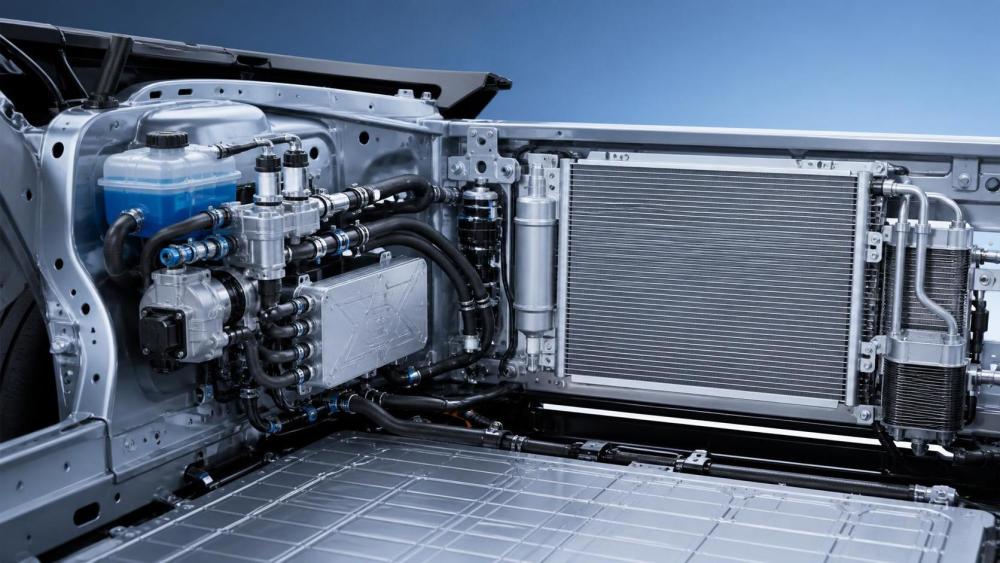
The modern automotive thermal management module is intended to coordinate these thermal domains. Depending on vehicle architecture, it may combine or control coolant manifolds, multi-way valves, electric pumps, expansion tanks, plate heat exchangers, battery chillers, heaters, refrigerant valves, sensors, and electronic controls. Some modules are primarily coolant-distribution assemblies. Others are more integrated “thermal islands” that bring together coolant and refrigerant functions near the front compartment or powertrain zone.
This integration matters because battery cooling is not a single steady-state process. The pack may require:
- Heat removal during high-load driving or repeated acceleration;
- Cooling during DC charging, when cell heat generation rises significantly;
- Pre-conditioning before arrival at a fast-charging station;
- Heating before charging or driving in cold ambient conditions;
- Temperature equalisation between modules and cells;
- Isolation from other heat sources during sensitive operating conditions.
The thermal module determines which heat source or sink is available at each point. It can reject heat to ambient air through a radiator, transfer heat to the refrigerant circuit through a chiller, recover waste heat from the e-motor or inverter, use a heat pump, or isolate circuits to avoid unwanted thermal coupling. Its quality therefore has a direct effect on the difference between a nominal thermal design and real-world thermal performance.
Cooling performance depends on flow management, not simply on pump capacity
A common assessment error is to focus on pump flow rate or radiator area without examining the complete hydraulic circuit. Battery cooling depends on the heat transfer chain from cell to cooling plate, coolant to chiller or radiator, and heat exchanger to ambient or refrigerant loop. Restriction, uneven distribution, trapped air, valve leakage, and poorly controlled bypass paths can undermine the system even when the nominal components appear adequately sized.
Within the battery loop, coolant distribution must achieve sufficient flow through the cold plates while maintaining acceptable pressure drop. More flow can improve convective heat transfer, but the relationship is not linear. At a certain point, additional pump power produces limited thermal benefit and reduces vehicle efficiency. The target is therefore not maximum flow; it is controlled flow that supports cell-temperature uniformity at the lowest practical electrical input.
Uniformity is particularly important. A battery pack can show an acceptable average temperature while individual cells or modules operate outside the desired range. Temperature gradients contribute to uneven ageing, imbalance in internal resistance, variation in charging acceptance, and potentially earlier power derating. The thermal management module cannot correct a poorly designed cold plate, but its valve paths, pump control, sensor placement, and flow-balancing strategy strongly influence whether the cold plate performs as intended in the assembled vehicle.
Multi-way valves are central to this task. A three-way or four-way valve may divert coolant between the battery, radiator, chiller, drive-unit loop, heater, or bypass path. The practical issues are valve authority, internal leakage, response time, pressure loss, low-temperature actuation, contamination tolerance, and position feedback. In a fast transient, such as the transition into high-rate charging after highway driving, delayed or unstable valve movement can leave the battery outside its preferred charging window longer than simulation suggests.
The chiller is often the limiting interface during fast charging
For liquid-cooled battery packs, the battery chiller is frequently the critical link between the coolant circuit and the refrigerant circuit. During high ambient temperatures or high-power charging, the radiator alone may not maintain coolant temperature low enough to protect charging performance. The chiller allows the air-conditioning refrigerant loop to absorb heat from the battery coolant and reject it through the condenser.
Its effectiveness is affected by more than heat-exchanger size. Refrigerant mass flow, compressor speed range, expansion-device control, condenser air flow, refrigerant charge, coolant inlet temperature, and competing cabin-cooling demand all affect available battery cooling capacity. If the cabin evaporator and battery chiller compete for limited compressor capacity, control calibration becomes a product decision rather than a purely thermal one. The vehicle may prioritize passenger comfort, charging speed, battery protection, or a defined balance between them.
Integrated systems can reduce the number of separate interfaces, but they also create tighter coupling. A compressor issue, refrigerant leak, condenser blockage, or control fault may affect both cabin climate control and battery cooling. Fault containment and degraded-mode operation should therefore be examined early. The vehicle should have clear logic for reducing charge power, limiting propulsion output, or switching to radiator-only cooling where refrigerant-based cooling is unavailable.
Heat-pump integration changes the battery-cooling trade-off
Heat pumps improve winter energy efficiency by moving heat rather than generating all cabin heat through high-voltage PTC heaters. They can also use waste heat from the electric drive system or power electronics. However, heat-pump integration makes thermal control more complicated because the battery can alternately be a heat source, a heat sink, or a thermal mass requiring protection.
In cold weather, a battery may need heating before it can accept high charging power. Heat can be supplied by a coolant heater, recovered from the drive unit, transferred through the refrigerant system, or generated through carefully managed battery self-heating strategies where the vehicle design supports this approach. Each route has different efficiency, time, component-cost, and control implications.
The key engineering question is whether the integrated module can direct heat where it has the highest vehicle-level value. Recovering motor waste heat is attractive, but available heat may be limited when the vehicle has been parked or is approaching a charger under low-load operation. Conversely, drawing heat from the battery to warm the cabin may reduce immediate electrical consumption but can compromise battery temperature margin. The best strategy depends on trip profile, parking duration, charging-network use, climate target, and customer expectations.
Control strategy is as important as physical integration
An automotive thermal management module is increasingly defined by its control strategy. Hardware determines possible flow paths; software decides when those paths are used. A calibration that simply reacts to current temperature will generally underperform one that anticipates route, charging events, ambient conditions, power demand, and thermal inertia.
Battery pre-conditioning is the clearest example. If the navigation system identifies a compatible DC charging destination and the driver has accepted route guidance, the thermal controller can begin bringing the battery toward its charging temperature range before arrival. The exact target depends on cell chemistry, battery supplier guidance, charge-power curve, and vehicle conditions. A generic target should not be assumed across platforms.
Predictive control also needs safeguards. Routing data may be wrong, the charger may be unavailable, a driver may change destination, or the battery may have limited energy reserve. The control system should weigh the expected reduction in charging time against energy consumed for pre-conditioning. It must also avoid excessive compressor cycling, pump operation, and valve switching that can increase NVH, wear, or parasitic electrical load.
Sensor plausibility is another critical area. Temperature sensors at pack inlet and outlet, cell-level sensing, refrigerant pressure and temperature sensors, coolant pressure signals, pump current, valve position feedback, and compressor operating data may all contribute to thermal decisions. But no sensor should be treated as infallible. Diagnostic logic needs to identify implausible combinations, such as a commanded high-flow state with no measurable coolant-temperature response, or a valve position signal inconsistent with pressure behavior.
What to examine in module architecture
When comparing thermal module concepts, it is useful to separate the evaluation into thermal capacity, hydraulic behavior, electrical and software integration, serviceability, and failure response.
Thermal and hydraulic capability
Assess the heat-rejection requirement across credible duty cycles rather than at one headline operating point. Relevant cases often include sustained uphill load, towing where applicable, hot-weather urban operation, repeated acceleration, high-speed driving followed by fast charging, and DC charging after a heat-soaked parking event. Battery inlet temperature, outlet temperature, cell-temperature spread, coolant flow, pump power, chiller capacity, and radiator performance should be reviewed together.
Pressure-drop maps are essential. A module may achieve adequate performance when new but become sensitive to coolant degradation, debris, air entrainment, or manufacturing variation. The system should maintain stable operation over expected coolant properties, low-temperature viscosity, and component ageing. Attention should also be given to filling and degassing procedures, because trapped air can create noise, corrosion risk, local flow starvation, and inaccurate temperature response.
Material compatibility and coolant specification
Coolant is not an interchangeable commodity. The corrosion-inhibitor package, electrical conductivity requirements, freeze protection, compatibility with aluminium, polymers, elastomers, brazed joints, and seal materials must match the entire loop. Inappropriate coolant selection can affect corrosion protection, valve operation, pump life, heat-transfer performance, and warranty exposure.
Where battery cooling plates and high-voltage components are involved, the consequences of leakage deserve particular attention. The design must provide robust sealing, controlled drainage where required, leak detection strategy, and protection against coolant ingress into sensitive electrical areas. Testing should cover thermal cycling, pressure pulsation, vibration, chemical exposure, freeze-thaw conditions, and realistic assembly tolerances.
Actuator and electronics integration
Electric pumps and valves need to remain functional under vehicle voltage variation, electromagnetic compatibility requirements, low-temperature start conditions, and elevated underhood temperatures. Their communication architecture should align with the vehicle network and diagnostics concept. A highly integrated module can reduce harness length and assembly steps, but it may increase replacement cost and impose stricter requirements on electronic sealing and connector reliability.
Functional safety analysis should consider how thermal faults propagate into vehicle-level hazards. Not every thermal fault is immediately safety-critical, but loss of cooling during high-power charging or severe overheating requires controlled mitigation. The relevant work should be aligned with the vehicle’s ISO 26262 safety concept where the item analysis identifies safety-related functions. Cybersecurity requirements under ISO/SAE 21434 may also apply when thermal controls are connected to vehicle networks or remote pre-conditioning functions.
Standards and compliance are broader than the module itself
There is no single global standard that certifies an automotive thermal management module as a complete universal product category. Compliance is normally established through a combination of vehicle regulations, component standards, OEM specifications, refrigerant rules, environmental requirements, and validation procedures.
For battery safety, UN Regulation No. 100 is relevant in markets applying the UNECE framework, particularly for rechargeable energy storage systems in electric vehicles. In the United States, FMVSS No. 305 addresses certain electric-powered vehicle safety requirements. These regulations do not prescribe one cooling-module architecture, but thermal performance and fault behavior may contribute to the vehicle’s ability to meet system-level safety expectations.
Refrigerant choices and refrigerant-circuit design are also shaped by regional environmental rules and vehicle safety practices. In Europe, fluorinated greenhouse gas rules affect refrigerant use and servicing considerations. Any module incorporating refrigerant-side components must be assessed against the applicable vehicle and market requirements, not only against laboratory thermal performance.
For exports and cross-border sourcing, documentation should clearly identify coolant compatibility, refrigerant compatibility where relevant, pressure ratings, leak-test methods, traceability expectations, environmental test conditions, communication protocols, diagnostic capability, and change-control procedures. A component can be technically sound yet difficult to industrialise if these interfaces are undocumented or differ between suppliers.
Integration can reduce cost, but it can also concentrate risk
Integration is often presented as inherently beneficial because it reduces hose count, connectors, mounting points, and assembly time. These benefits are real when the module is designed around a stable vehicle architecture. It can also shorten coolant paths, reduce fill volume, lower mass, and improve coordinated control.
The trade-off is that a single module may become a high-consequence failure point. A leak, actuator fault, software issue, or supplier manufacturing defect can influence several thermal functions at once. Replacement may require refrigerant recovery, coolant draining, software configuration, and calibration checks. The most compact design is not necessarily the best lifecycle design if diagnosis and repair are difficult in the intended service network.
A balanced assessment should therefore include modular repair strategy, access to valves and sensors, pump replacement options, sealing-joint count, software update process, end-of-line testing, and fault isolation. These details are rarely visible in a simplified system schematic but often determine field reliability and warranty cost.
Making the right technical judgment
The effectiveness of an automotive thermal management module should be judged by how well it supports the battery under demanding and changing conditions, not by the number of integrated functions it contains. A strong design delivers stable cell temperatures, acceptable temperature uniformity, efficient pump and compressor use, rapid response during charging events, robust low-temperature behavior, and understandable degradation modes.
Battery cooling performance is ultimately a system outcome. The module, pack cold plate, chiller, radiator, compressor, heat pump, software, sensors, coolant, and vehicle operating strategy must work as one controlled thermal network. Evaluation should therefore move beyond component datasheets toward vehicle-level duty cycles, fault cases, manufacturing tolerance, and service realities. That is where the real value of thermal integration—and its hidden limitations—becomes visible.
Have questions about this sector analysis, or seeking best practices specific to your niche? Drop us a line below and let the senior consultants at GAC assist you.
“We respect your privacy. Your information is strictly confidential.”
Related News
- 00
0000-00
How to assess a smart cockpit electronics manufacturer's integration capability - 00
0000-00
How does a shielded HSD cable reduce interference in vehicles? - 00
0000-00
What drives demand for scroll compressors in the automotive market? - 00
0000-00
Does AEC-Q200 apply to flexible printed circuits? - 00
0000-00
How does production volume affect automotive flexible electronics costs?
Weekly Insights
Stay ahead with our curated technology reports delivered every Monday.
Recommended News
 How to assess a smart cockpit electronics manufacturer's integration capabilityAssess a smart cockpit electronics manufacturer's integration capability with practical checks for interfaces, testing, safety, cybersecurity and supplier support.Author:Time:Nov 18, 2026
 How does a shielded HSD cable reduce interference in vehicles?Discover how a shielded HSD cable reduces vehicle interference, and learn why connector design, routing, and testing matter for reliable high-speed data links.Author:Time:Nov 17, 2026
 What drives demand for scroll compressors in the automotive market?Explore the scroll compressor for automobile market and discover how EV adoption, heat pumps, efficiency, and supplier capabilities shape demand.Author:Time:Nov 16, 2026
 Does AEC-Q200 apply to flexible printed circuits?Flexible Printed Circuit AEC-Q200 requirements explained: discover which components qualify and how to assess automotive FPC reliability.Author:Time:Nov 15, 2026
 How does production volume affect automotive flexible electronics costs?Explore how production volume affects automotive flexible electronics cost, from tooling and yield to testing. Compare quotes and negotiate smarter.Author:Time:Nov 14, 2026
 How much does an in-vehicle infotainment system cost to replace?Explore in-vehicle infotainment cost, from affordable repairs to factory replacements. Compare options, installation fees, and compatibility before you buy.Author:Time:Nov 13, 2026
 How does condenser efficiency affect heat pump performance?Discover how condenser high efficiency can improve heat pump performance, reduce compressor power, and boost heating COP—plus the trade-offs to watch.Author:Time:Nov 12, 2026
 What does each FAKRA cable color code mean?FAKRA cable color code explained: Explore common connector colors, typical uses and key compatibility checks before choosing a replacement.Author:Time:Nov 11, 2026
 How to compare noise ratings for battery coolant pumpsCompare coolant pump low noise ratings with confidence. Learn how test conditions, hydraulic duty, tonal noise and installation affect your choice.Author:Time:Nov 10, 2026
 How bright should automotive display systems be in sunlight?Automotive Display Systems need more than brightness to stay readable in sunlight. Discover why 1,000 nits is a starting point and how to evaluate glare and heat.Author:Time:Nov 09, 2026
 How heat pumps improve the efficiency of EV thermal systemsEV Thermal Systems use heat pumps to reduce heating energy demand. Explore how they work, where they excel, and what limits efficiency in cold weather.Author:Time:Nov 08, 2026
 Can a smart cockpit platform support multiple displays?Can a smart cockpit platform support multiple displays? Explore key requirements for performance, safety, connectivity, and supplier evaluation.Author:Time:Nov 07, 2026
 How is automotive connector vibration resistance tested?Automotive connector vibration resistance testing reveals hidden contact failures. Explore test profiles, continuity monitoring and pass criteria.Author:Time:Nov 06, 2026
 How heat pumps save energy in automotive cabin climate systemsAutomotive Cabin Climate Systems energy saving starts with smarter heat pump design. Explore real-world efficiency, cold-weather trade-offs, and testing tips.Author:Time:Nov 05, 2026
 Is an EV heat pump worth it for winter driving range?Is a heat pump worth using in a cold-climate EV? Discover how it affects winter range, when it pays off, and what to check before buying.Author:Time:Nov 04, 2026
 When should you use 50-ohm coaxial cable instead of 75-ohm?Coaxial cable 50 ohm or 75 ohm? Learn when to use each, avoid impedance mismatches, and choose the right cable for reliable RF and video performance.Author:Time:Nov 03, 2026
 How to select a high temperature motor harness for an EVChoose the right high temperature motor harness for your EV. Compare thermal limits, current capacity, shielding, routing, and validation evidence.Author:Time:Nov 02, 2026
 How much does electric power steering replacement cost?Electric power steering price typically ranges from $1,000 to $3,000 for major replacements. Discover cost factors, repair options, and tips for comparing quotes.Author:Time:Nov 01, 2026
 How to size an EV A/C compressor for the required cooling capacitySize an EV A/C Compressor with confidence. Explore cooling loads, performance maps and power limits to select the right compressor for your vehicle.Author:Time:Oct 31, 2026
 How to choose the right pitch for an FPC board connectorFPC board connector pitch affects space, assembly and reliability. Learn how to compare options and select the best fit for your design.Author:Time:Oct 30, 2026
 How zonal design affects harness routing in high-voltage EV architecturesExplore high-voltage electrical architecture zonal design and its impact on EV harness routing. Discover key trade-offs in cable length, safety, thermal performance, and service access.Author:Time:Oct 29, 2026
 How tariffs affect costs in global automotive parts supply chainsNavigate tariffs in the global automotive parts trade supply chain. Learn to compare landed costs, manage duty exposure, and uncover smarter sourcing strategies to protect your margins.Author:Time:Oct 28, 2026
 How to assess vendor lock-in in a software-defined vehicle platformAssess Software-Defined Vehicle platform lock-in with practical tests for API portability, data access, update control, and exit costs. Learn how to choose a platform with a proven exit path.Author:Time:Oct 27, 2026
 How ISO 26262 guides functional safety in steer-by-wire systemsExplore steering systems functional safety through ISO 26262. Learn how hazard analysis, fault-tolerant design, and validation build a stronger steer-by-wire safety case.Author:Time:Oct 26, 2026
 How to evaluate a steering angle sensor manufacturer's accuracy claimsEvaluate steering angle sensor manufacturer accuracy claims with practical checks on calibration, latency, and test evidence. Compare suppliers confidently and avoid costly selection mistakes.Author:Time:Oct 25, 2026
 How to diagnose CAN bus faults in a hybrid vehicle control unitDiagnose Hybrid Vehicle Systems control unit CAN bus faults with step-by-step power, wiring, and waveform checks. Find the root cause and avoid unnecessary replacement.Author:Time:Oct 24, 2026
 How does battery cooling pipe diameter affect coolant pressure drop?Battery Cooling Pipe diameter affects coolant pressure drop and pump power. Explore sizing calculations and practical tips to optimize EV battery cooling and compare options with confidence.Author:Time:Oct 23, 2026
 How to assess PPAP readiness of automotive sensor system manufacturersAssess Automotive Sensor Systems manufacturers for PPAP readiness. Learn to verify production evidence, measurement capability, validation, and traceability to reduce sourcing risks.Author:Time:Oct 22, 2026
 What to ask an FPC connector manufacturer about reliability testingChoosing an FPC Connector manufacturer? Learn what to ask about reliability testing, failure limits, and traceable results to reduce design risks and select with confidence.Author:Time:Oct 21, 2026
 How to verify vehicle fitment for an aftermarket AC evaporatorNavigating the evaporator aftermarket? Verify vehicle fitment with VIN data, OE numbers, and physical interface checks. Use this guide to avoid costly mismatches and order confidently.Author:Time:Oct 20, 2026