Automotive HUD Design Challenges: Brightness, Ghosting, and Packaging Trade-Offs




Automotive HUD Design Challenges: Brightness, Ghosting, and Packaging Trade-Offs
Automotive HUD programs rarely fail because of one dramatic issue.
More often, they struggle with several linked compromises.
Brightness, ghosting, and packaging sit at the center of that tension.
For any Automotive HUD platform, these three factors influence cost, driver experience, and launch readiness.
That is especially true as windshields become more complex and cockpits become more crowded.
In practice, Automotive HUD decisions now affect optics, electronics, thermal behavior, supplier capability, and vehicle architecture at the same time.
This makes early trade-off management far more important than late-stage correction.
A clear technical view helps teams avoid redesign loops and unrealistic targets.
Why Automotive HUD Brightness Is Harder Than It Looks
Brightness sounds simple on paper.
The real challenge is visible performance under changing daylight, tinted glass, dashboard reflections, and windshield losses.
An Automotive HUD must remain readable in direct sun without becoming thermally unstable or electrically inefficient.
That balance is harder in larger field-of-view designs.
Larger images usually demand higher luminous output.
Higher output raises heat, power draw, and component stress.
This also pushes thermal design closer to the limits of compact cockpit modules.
Key brightness variables
- Display source efficiency, including TFT, DLP, or LCoS optical paths.
- Windshield reflectivity and transmission across the designed eye box.
- Ambient light load in real driving conditions, not only in lab settings.
- Thermal derating behavior during long exposure to summer cabin temperatures.
- Power budget limits set by vehicle electrical architecture.
From a program view, brightness targets should never be defined by headline numbers alone.
Teams need use-case based visibility criteria.
A compact city EV and a premium SUV may require very different Automotive HUD tuning strategies.
The windshield angle, cabin depth, and dashboard color all matter.
Ghosting in Automotive HUD Systems: The Hidden Quality Risk
Ghosting is one of the most common reasons an Automotive HUD looks impressive in demos but disappointing in real vehicles.
Drivers notice double images quickly.
Once seen, they are hard to ignore.
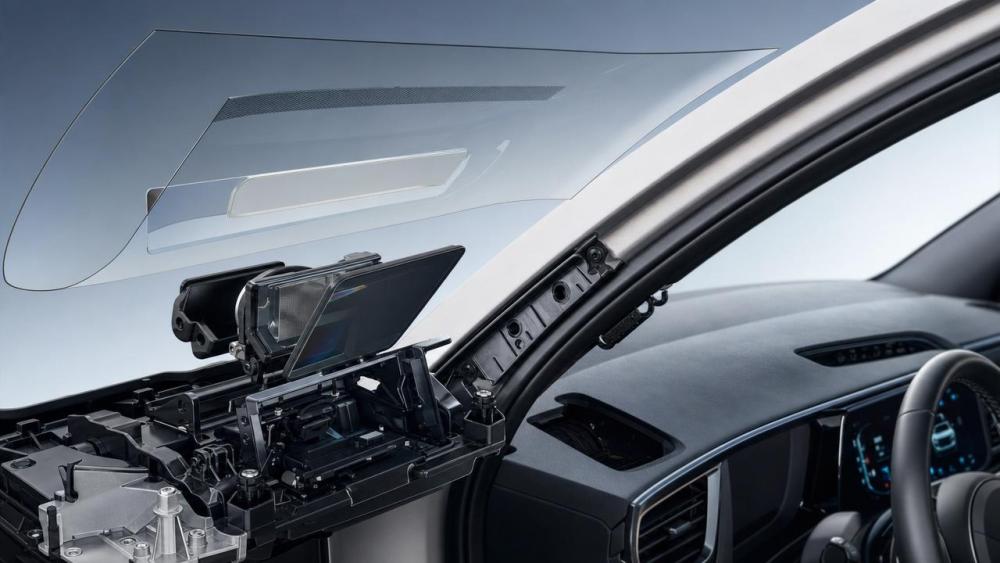
Ghosting usually comes from laminated windshield structure and the two reflective surfaces inside the glass.
If wedge angle, PVB layer behavior, and projection geometry are not matched, the duplicate image becomes visible.
This is not only an optical issue.
It is also a sourcing and validation issue.
Where ghosting risk increases
- Shared windshields across multiple trims without HUD-specific optical tuning.
- Late changes in glass supplier, lamination process, or wedge tolerance.
- Wide field-of-view Automotive HUD layouts with aggressive projection angles.
- Insufficient alignment control between HUD module and windshield datum.
- Validation plans that rely too heavily on bench optics.
A more practical approach is to treat windshield and Automotive HUD as one coupled system.
That means involving glass suppliers early, not after package freeze.
It also means defining acceptable ghosting thresholds by driver perception, not only by optical simulation outputs.
Recent vehicle programs show a clear pattern.
When ghosting appears late, the fix usually becomes expensive.
It can force windshield changes, display repositioning, or software compensation with limited results.
Packaging Trade-Offs Inside Modern Cockpit Architecture
Packaging is where many Automotive HUD ambitions meet physical reality.
The module competes for space with ducts, cross-car beams, airbags, speakers, displays, and wiring harnesses.
As smart cockpit electronics expand, available space rarely gets easier.
This also affects serviceability and assembly sequence.
A high-performance Automotive HUD may require mirror paths and housing depth that clash with the instrument panel structure.
Shrinking the module can solve package conflicts, but often reduces optical freedom.
That may hurt brightness uniformity, eyebox size, or image distance targets.
Typical packaging decisions
- Choose compact optics and accept narrower performance margins.
- Retain larger optics and redesign nearby cockpit components.
- Shift the Automotive HUD position and recalibrate image geometry.
- Use a premium windshield solution to reduce optical compromise.
- Separate vehicle variants by trim level and feature package.
In actual development, packaging should be reviewed with thermal and harness teams together.
That cross-functional view is often missed.
Yet it matters because airflow, connector routing, and structural vibration can all change Automotive HUD performance.
GACT’s wider coverage of cockpit displays, wiring systems, and thermal management reflects this exact integration reality.
How Standards and Validation Shape Automotive HUD Decisions
Technical choices become more robust when validation is aligned with standards and real operating conditions.
For Automotive HUD, this includes optical performance, environmental durability, vibration, EMC, and human factors.
The exact standard set varies by market and vehicle program.
Still, the main lesson is consistent.
A test plan should mirror the true integration stack.
What strong validation usually includes
- Daylight readability checks across several windshield and dashboard combinations.
- Ghost image evaluation from different driver heights and seating positions.
- Thermal soak and recovery tests under repeated cabin heat cycles.
- Mechanical stability checks after vibration and shock exposure.
- Image distortion review after assembly tolerance variation.
- Software brightness control tuning in realistic traffic scenes.
This also means supplier reports should be challenged with vehicle-level evidence.
A capable Automotive HUD supplier may still struggle inside a different windshield ecosystem.
That is why gateway reviews need measurable criteria tied to customer perception.
Without that discipline, issues remain hidden until pilot build or pre-launch quality reviews.
A Practical Framework for Managing Automotive HUD Trade-Offs
The most effective teams do not chase maximum specification in every area.
They define the best balanced Automotive HUD for the target vehicle.
That requires structured decision-making from concept phase onward.
Recommended project checkpoints
- Lock user scenarios before fixing brightness and field-of-view targets.
- Review windshield strategy before freezing Automotive HUD optical architecture.
- Assess thermal load with real package constraints, not ideal bench layouts.
- Build joint tolerance studies across glass, cockpit, and module suppliers.
- Use early mule testing to confirm ghosting and readability assumptions.
- Reserve cost contingency for windshield or packaging corrections.
This process reduces conflict between engineering goals and sourcing pressure.
It also creates cleaner communication with Tier 1 partners and internal cockpit teams.
More importantly, it helps prevent late surprises that damage timing.
Automotive HUD integration is no longer a niche display issue.
It is a vehicle systems issue.
Final Takeaway
The strongest Automotive HUD programs succeed by managing compromise early and transparently.
Brightness must be visible, but also efficient and thermally stable.
Ghosting must be controlled through system-level optical alignment.
Packaging must fit the real cockpit, not an idealized CAD space.
When these trade-offs are treated as connected decisions, Automotive HUD development becomes more predictable and commercially stronger.
For teams tracking smart cockpit evolution, supplier capability, and global component trends, that systems perspective is now essential.
The next useful step is simple.
Review current Automotive HUD assumptions against windshield, thermal, and cockpit package realities before the next program gate.
Have questions about this sector analysis, or seeking best practices specific to your niche? Drop us a line below and let the senior consultants at GAC assist you.
“We respect your privacy. Your information is strictly confidential.”
Related News
- 00
0000-00
How to assess a smart cockpit electronics manufacturer's integration capability - 00
0000-00
How does a shielded HSD cable reduce interference in vehicles? - 00
0000-00
What drives demand for scroll compressors in the automotive market? - 00
0000-00
Does AEC-Q200 apply to flexible printed circuits? - 00
0000-00
How does production volume affect automotive flexible electronics costs?
Weekly Insights
Stay ahead with our curated technology reports delivered every Monday.
Recommended News
 How to assess a smart cockpit electronics manufacturer's integration capabilityAssess a smart cockpit electronics manufacturer's integration capability with practical checks for interfaces, testing, safety, cybersecurity and supplier support.Author:Time:Nov 18, 2026
 How does a shielded HSD cable reduce interference in vehicles?Discover how a shielded HSD cable reduces vehicle interference, and learn why connector design, routing, and testing matter for reliable high-speed data links.Author:Time:Nov 17, 2026
 What drives demand for scroll compressors in the automotive market?Explore the scroll compressor for automobile market and discover how EV adoption, heat pumps, efficiency, and supplier capabilities shape demand.Author:Time:Nov 16, 2026
 Does AEC-Q200 apply to flexible printed circuits?Flexible Printed Circuit AEC-Q200 requirements explained: discover which components qualify and how to assess automotive FPC reliability.Author:Time:Nov 15, 2026
 How does production volume affect automotive flexible electronics costs?Explore how production volume affects automotive flexible electronics cost, from tooling and yield to testing. Compare quotes and negotiate smarter.Author:Time:Nov 14, 2026
 How much does an in-vehicle infotainment system cost to replace?Explore in-vehicle infotainment cost, from affordable repairs to factory replacements. Compare options, installation fees, and compatibility before you buy.Author:Time:Nov 13, 2026
 How does condenser efficiency affect heat pump performance?Discover how condenser high efficiency can improve heat pump performance, reduce compressor power, and boost heating COP—plus the trade-offs to watch.Author:Time:Nov 12, 2026
 What does each FAKRA cable color code mean?FAKRA cable color code explained: Explore common connector colors, typical uses and key compatibility checks before choosing a replacement.Author:Time:Nov 11, 2026
 How to compare noise ratings for battery coolant pumpsCompare coolant pump low noise ratings with confidence. Learn how test conditions, hydraulic duty, tonal noise and installation affect your choice.Author:Time:Nov 10, 2026
 How bright should automotive display systems be in sunlight?Automotive Display Systems need more than brightness to stay readable in sunlight. Discover why 1,000 nits is a starting point and how to evaluate glare and heat.Author:Time:Nov 09, 2026
 How heat pumps improve the efficiency of EV thermal systemsEV Thermal Systems use heat pumps to reduce heating energy demand. Explore how they work, where they excel, and what limits efficiency in cold weather.Author:Time:Nov 08, 2026
 Can a smart cockpit platform support multiple displays?Can a smart cockpit platform support multiple displays? Explore key requirements for performance, safety, connectivity, and supplier evaluation.Author:Time:Nov 07, 2026
 How is automotive connector vibration resistance tested?Automotive connector vibration resistance testing reveals hidden contact failures. Explore test profiles, continuity monitoring and pass criteria.Author:Time:Nov 06, 2026
 How heat pumps save energy in automotive cabin climate systemsAutomotive Cabin Climate Systems energy saving starts with smarter heat pump design. Explore real-world efficiency, cold-weather trade-offs, and testing tips.Author:Time:Nov 05, 2026
 Is an EV heat pump worth it for winter driving range?Is a heat pump worth using in a cold-climate EV? Discover how it affects winter range, when it pays off, and what to check before buying.Author:Time:Nov 04, 2026
 When should you use 50-ohm coaxial cable instead of 75-ohm?Coaxial cable 50 ohm or 75 ohm? Learn when to use each, avoid impedance mismatches, and choose the right cable for reliable RF and video performance.Author:Time:Nov 03, 2026
 How to select a high temperature motor harness for an EVChoose the right high temperature motor harness for your EV. Compare thermal limits, current capacity, shielding, routing, and validation evidence.Author:Time:Nov 02, 2026
 How much does electric power steering replacement cost?Electric power steering price typically ranges from $1,000 to $3,000 for major replacements. Discover cost factors, repair options, and tips for comparing quotes.Author:Time:Nov 01, 2026
 How to size an EV A/C compressor for the required cooling capacitySize an EV A/C Compressor with confidence. Explore cooling loads, performance maps and power limits to select the right compressor for your vehicle.Author:Time:Oct 31, 2026
 How to choose the right pitch for an FPC board connectorFPC board connector pitch affects space, assembly and reliability. Learn how to compare options and select the best fit for your design.Author:Time:Oct 30, 2026
 How zonal design affects harness routing in high-voltage EV architecturesExplore high-voltage electrical architecture zonal design and its impact on EV harness routing. Discover key trade-offs in cable length, safety, thermal performance, and service access.Author:Time:Oct 29, 2026
 How tariffs affect costs in global automotive parts supply chainsNavigate tariffs in the global automotive parts trade supply chain. Learn to compare landed costs, manage duty exposure, and uncover smarter sourcing strategies to protect your margins.Author:Time:Oct 28, 2026
 How to assess vendor lock-in in a software-defined vehicle platformAssess Software-Defined Vehicle platform lock-in with practical tests for API portability, data access, update control, and exit costs. Learn how to choose a platform with a proven exit path.Author:Time:Oct 27, 2026
 How ISO 26262 guides functional safety in steer-by-wire systemsExplore steering systems functional safety through ISO 26262. Learn how hazard analysis, fault-tolerant design, and validation build a stronger steer-by-wire safety case.Author:Time:Oct 26, 2026
 How to evaluate a steering angle sensor manufacturer's accuracy claimsEvaluate steering angle sensor manufacturer accuracy claims with practical checks on calibration, latency, and test evidence. Compare suppliers confidently and avoid costly selection mistakes.Author:Time:Oct 25, 2026
 How to diagnose CAN bus faults in a hybrid vehicle control unitDiagnose Hybrid Vehicle Systems control unit CAN bus faults with step-by-step power, wiring, and waveform checks. Find the root cause and avoid unnecessary replacement.Author:Time:Oct 24, 2026
 How does battery cooling pipe diameter affect coolant pressure drop?Battery Cooling Pipe diameter affects coolant pressure drop and pump power. Explore sizing calculations and practical tips to optimize EV battery cooling and compare options with confidence.Author:Time:Oct 23, 2026
 How to assess PPAP readiness of automotive sensor system manufacturersAssess Automotive Sensor Systems manufacturers for PPAP readiness. Learn to verify production evidence, measurement capability, validation, and traceability to reduce sourcing risks.Author:Time:Oct 22, 2026
 What to ask an FPC connector manufacturer about reliability testingChoosing an FPC Connector manufacturer? Learn what to ask about reliability testing, failure limits, and traceable results to reduce design risks and select with confidence.Author:Time:Oct 21, 2026
 How to verify vehicle fitment for an aftermarket AC evaporatorNavigating the evaporator aftermarket? Verify vehicle fitment with VIN data, OE numbers, and physical interface checks. Use this guide to avoid costly mismatches and order confidently.Author:Time:Oct 20, 2026