
How to Evaluate an Automotive Display Supplier in China




How to Evaluate an Automotive Display Supplier in China
Choosing the right automotive display supplier China can directly affect product quality, delivery stability, compliance, and long-term cost control. For procurement teams, evaluating suppliers goes far beyond pricing. It means checking whether the supplier can consistently build displays that survive the automotive environment, fit the vehicle program timeline, support engineering changes, and meet export expectations without creating hidden risk later in SOP or aftersales.
That sounds obvious, but automotive displays are often underestimated because they look like a familiar consumer product. In practice, they sit at the intersection of optics, electronics, software, mechanical integration, vehicle validation, and supply chain discipline. A display that works well on a bench sample is not automatically a production-ready automotive component. This is usually where supplier evaluation gets more serious.
Start with the real product scope, not the brochure
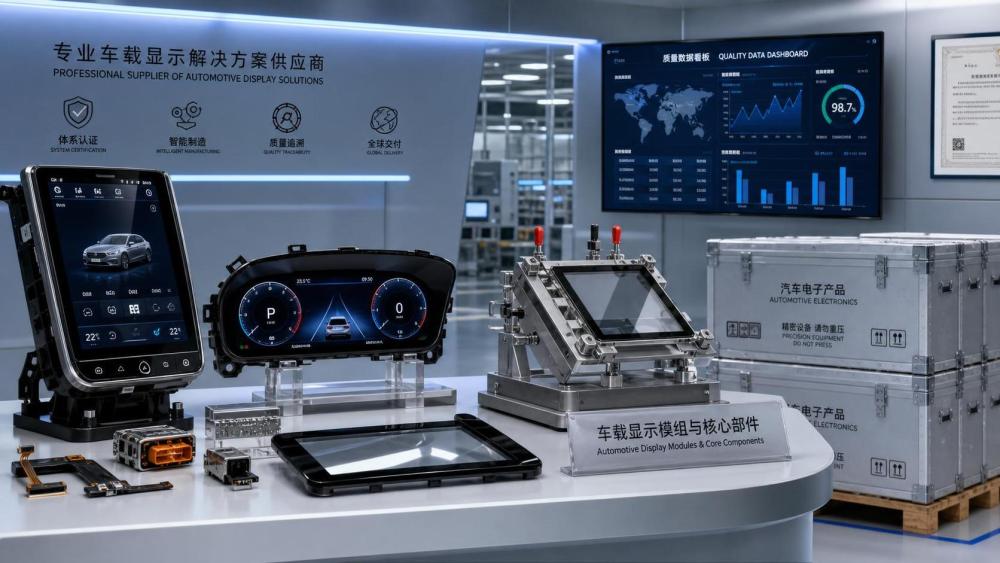
Before comparing suppliers, define what “automotive display” means in your project. In China, one supplier may focus on cockpit display modules, another on center stack touch displays, another on instrument cluster panels, and another on integrated display assemblies that include cover glass, touch sensor, backlight, bonding, controller board, and software adaptation. These are not interchangeable capabilities.
A supplier that is strong in panel sourcing may still be weak in optical bonding. A company with good touch integration may rely heavily on outsourced electronics. Some are essentially module houses; others manage a more complete chain covering design support, validation coordination, and program management. Procurement teams should clarify whether they are buying a bare display, a display module, or a cockpit HMI subassembly. The evaluation criteria change with that definition.
This matters especially in smart cockpit programs, where the display is no longer just a screen. It can affect boot performance, EMI behavior, sunlight readability, driver interaction, dashboard packaging, and even thermal design around the cockpit domain controller.
Manufacturing capability is more important than a sample that looks good
A polished sample proves very little on its own. Procurement should ask how the supplier controls the manufacturing process that sits behind appearance: lamination yield, dust control, bonding consistency, traceability, inspection flow, rework policy, and incoming material management. Automotive display quality problems are often not dramatic at the beginning. They show up months later as mura, bubbles, touch drift, delamination, uneven backlight, connector issues, or field failures under temperature cycling and vibration.
The useful question is not “Can you make this display?” but “Can you make it repeatedly at program volume with controlled variation?” If a Chinese supplier cannot explain its process window, critical quality checkpoints, and major defect modes in a concrete way, the procurement risk is already visible.
For automotive programs, process discipline usually matters more than an aggressive quotation. A low quoted price can disappear quickly if engineering support is slow, scrap rates are unstable, or production deviations trigger repeated line interruptions at the customer side.
Read the quality system in automotive terms
Many buyers begin with certifications, and that is reasonable, but certifications are only a first filter. For automotive electronics suppliers in China, IATF 16949 is often a baseline expectation rather than a final proof of capability. It indicates the supplier is working within an automotive quality management framework, but it does not tell you whether the company is genuinely experienced in display-specific failure modes.
The same applies to environmental and regulatory compliance. Depending on target market and vehicle platform, buyers may need to check alignment with requirements related to RoHS, REACH, or OEM-specific substance controls. If the display includes wireless, camera-related, or software-linked functions, additional compliance interfaces may appear elsewhere in the system, even if they do not sit inside the display itself.
A better evaluation approach is to connect the quality system to actual project execution. Ask how the supplier handles APQP documentation, PPAP submissions when required, engineering change control, lot traceability, 8D response, and validation coordination. A supplier that can name the documents but struggles to show working examples may still create trouble once the program enters trial build or mass production.
Technical capability is not just panel size and resolution
Buyers often compare display suppliers using visible specifications: screen size, aspect ratio, brightness, contrast, resolution, and touch type. Those matter, but automotive evaluation goes deeper. The real issue is whether the supplier understands how these specs behave in the vehicle environment.
For example, high brightness on a datasheet does not automatically mean good in-cabin readability. Optical bonding, surface treatment, viewing angle behavior, reflection control, and cover lens design all influence perceived performance. Likewise, a responsive touch demo at room temperature does not answer how the system behaves in gloves, under condensation risk, or during low-temperature startup.
In exports and multi-market programs, it is also worth checking whether the supplier has experience with localization requirements such as different UI integration paths, language rendering needs, regional EMC expectations, or mechanical packaging differences across vehicle variants. A supplier that has only served short-cycle domestic aftermarket projects may not be ready for a longer OEM or Tier 1 program rhythm.
What to verify during supplier assessment
Supply chain depth often decides whether the supplier is dependable
China has deep electronics and display manufacturing resources, which is one reason buyers search for an automotive display supplier China in the first place. But that same ecosystem creates wide variation between companies. Some suppliers have stable upstream relationships for TFT panels, ICs, touch components, backlight materials, and cover glass. Others are more exposed to spot buying or single-source dependence.
Procurement teams should look past the immediate factory and understand where the fragile points are. Which parts have long lead times? Which materials are customer-nominated? What happens if a panel model is discontinued? Is there lifecycle management for a vehicle program that may run much longer than consumer electronics cycles? These questions tend to reveal whether the supplier is built for automotive continuity or short-term trading.
This is especially relevant in cockpit electronics, where component obsolescence can become a commercial and engineering issue long before the vehicle reaches end of life.
Customization support should be judged by change management, not by willingness alone
Many Chinese suppliers are flexible during quotation and prototype stages. That is useful, but flexibility by itself is not enough. Buyers should examine how customization is controlled: design review records, drawing revision management, sample approval flow, validation responsibility split, and timeline impact when specifications move.
A supplier may say yes to custom cover glass, UI touch layout, connector change, or mechanical bracket update, but the real question is whether those changes remain manageable when tooling, test plans, and production documentation must all stay aligned. Projects start to slip when customization is handled informally.
Common evaluation mistakes
One common mistake is treating automotive displays as a commodity purchase. They are not. Even when two suppliers quote similar visible specifications, the difference in validation discipline, material control, and engineering response can be substantial.
Another mistake is overvaluing factory scale without checking product fit. A larger electronics manufacturer is not automatically the right partner for a specialized display program. If the company’s internal priorities are elsewhere, your project may receive limited technical attention.
There is also a tendency to use consumer display benchmarks when making sourcing decisions. Automotive requirements are different: longer lifecycle, wider environmental stress, stricter documentation, and more painful failure consequences. A supplier with strong consumer experience may still need careful qualification before it is trusted in vehicle platforms.
What a strong supplier conversation sounds like
A credible supplier usually speaks in specifics. It can explain where its value sits in the display chain, what it controls internally, which validation items typically drive risk, how it handles process deviations, and what assumptions are built into lead time and tooling schedules. It is usually transparent about capability boundaries as well. That is often a better sign than broad claims about full-service competence.
For procurement, the most useful signal is consistency between sales language, engineering detail, and plant reality. If the commercial team promises one thing, the engineering team describes another, and the factory visit shows something looser, the evaluation should slow down.
A practical way to make the final decision
In the end, selecting an automotive display supplier is less about finding the cheapest screen and more about choosing a manufacturing partner that can survive the full program cycle. A practical decision model usually balances five factors: technical fit, quality maturity, supply chain resilience, program management discipline, and commercial reasonableness. Price belongs in that mix, but it should not dominate it.
If two suppliers look similar on quotation, the one with clearer change control, better traceability, stronger upstream visibility, and more grounded answers on validation risk is usually the safer choice. In automotive sourcing, that difference often becomes visible only after nomination. By then, changing course is expensive.
When evaluating the automotive display supplier China market, the best procurement decisions come from asking narrower, harder questions early. Not just whether the supplier can make the display, but whether it can carry the responsibility that comes with putting that display into a vehicle program.
Have questions about this sector analysis, or seeking best practices specific to your niche? Drop us a line below and let the senior consultants at GAC assist you.
“We respect your privacy. Your information is strictly confidential.”
Related News
- 00
0000-00
What does each FAKRA cable color code mean? - 00
0000-00
How to compare noise ratings for battery coolant pumps - 00
0000-00
How bright should automotive display systems be in sunlight? - 00
0000-00
How heat pumps improve the efficiency of EV thermal systems - 00
0000-00
Can a smart cockpit platform support multiple displays?
Weekly Insights
Stay ahead with our curated technology reports delivered every Monday.
Recommended News
 What does each FAKRA cable color code mean?FAKRA cable color code explained: Explore common connector colors, typical uses and key compatibility checks before choosing a replacement.Author:Time:Nov 11, 2026
 How to compare noise ratings for battery coolant pumpsCompare coolant pump low noise ratings with confidence. Learn how test conditions, hydraulic duty, tonal noise and installation affect your choice.Author:Time:Nov 10, 2026
 How bright should automotive display systems be in sunlight?Automotive Display Systems need more than brightness to stay readable in sunlight. Discover why 1,000 nits is a starting point and how to evaluate glare and heat.Author:Time:Nov 09, 2026
 How heat pumps improve the efficiency of EV thermal systemsEV Thermal Systems use heat pumps to reduce heating energy demand. Explore how they work, where they excel, and what limits efficiency in cold weather.Author:Time:Nov 08, 2026
 Can a smart cockpit platform support multiple displays?Can a smart cockpit platform support multiple displays? Explore key requirements for performance, safety, connectivity, and supplier evaluation.Author:Time:Nov 07, 2026
 How is automotive connector vibration resistance tested?Automotive connector vibration resistance testing reveals hidden contact failures. Explore test profiles, continuity monitoring and pass criteria.Author:Time:Nov 06, 2026
 How heat pumps save energy in automotive cabin climate systemsAutomotive Cabin Climate Systems energy saving starts with smarter heat pump design. Explore real-world efficiency, cold-weather trade-offs, and testing tips.Author:Time:Nov 05, 2026
 Is an EV heat pump worth it for winter driving range?Is a heat pump worth using in a cold-climate EV? Discover how it affects winter range, when it pays off, and what to check before buying.Author:Time:Nov 04, 2026
 When should you use 50-ohm coaxial cable instead of 75-ohm?Coaxial cable 50 ohm or 75 ohm? Learn when to use each, avoid impedance mismatches, and choose the right cable for reliable RF and video performance.Author:Time:Nov 03, 2026
 How to select a high temperature motor harness for an EVChoose the right high temperature motor harness for your EV. Compare thermal limits, current capacity, shielding, routing, and validation evidence.Author:Time:Nov 02, 2026
 How much does electric power steering replacement cost?Electric power steering price typically ranges from $1,000 to $3,000 for major replacements. Discover cost factors, repair options, and tips for comparing quotes.Author:Time:Nov 01, 2026
 How to size an EV A/C compressor for the required cooling capacitySize an EV A/C Compressor with confidence. Explore cooling loads, performance maps and power limits to select the right compressor for your vehicle.Author:Time:Oct 31, 2026
 How to choose the right pitch for an FPC board connectorFPC board connector pitch affects space, assembly and reliability. Learn how to compare options and select the best fit for your design.Author:Time:Oct 30, 2026
 How zonal design affects harness routing in high-voltage EV architecturesExplore high-voltage electrical architecture zonal design and its impact on EV harness routing. Discover key trade-offs in cable length, safety, thermal performance, and service access.Author:Time:Oct 29, 2026
 How tariffs affect costs in global automotive parts supply chainsNavigate tariffs in the global automotive parts trade supply chain. Learn to compare landed costs, manage duty exposure, and uncover smarter sourcing strategies to protect your margins.Author:Time:Oct 28, 2026
 How to assess vendor lock-in in a software-defined vehicle platformAssess Software-Defined Vehicle platform lock-in with practical tests for API portability, data access, update control, and exit costs. Learn how to choose a platform with a proven exit path.Author:Time:Oct 27, 2026
 How ISO 26262 guides functional safety in steer-by-wire systemsExplore steering systems functional safety through ISO 26262. Learn how hazard analysis, fault-tolerant design, and validation build a stronger steer-by-wire safety case.Author:Time:Oct 26, 2026
 How to evaluate a steering angle sensor manufacturer's accuracy claimsEvaluate steering angle sensor manufacturer accuracy claims with practical checks on calibration, latency, and test evidence. Compare suppliers confidently and avoid costly selection mistakes.Author:Time:Oct 25, 2026
 How to diagnose CAN bus faults in a hybrid vehicle control unitDiagnose Hybrid Vehicle Systems control unit CAN bus faults with step-by-step power, wiring, and waveform checks. Find the root cause and avoid unnecessary replacement.Author:Time:Oct 24, 2026
 How does battery cooling pipe diameter affect coolant pressure drop?Battery Cooling Pipe diameter affects coolant pressure drop and pump power. Explore sizing calculations and practical tips to optimize EV battery cooling and compare options with confidence.Author:Time:Oct 23, 2026
 How to assess PPAP readiness of automotive sensor system manufacturersAssess Automotive Sensor Systems manufacturers for PPAP readiness. Learn to verify production evidence, measurement capability, validation, and traceability to reduce sourcing risks.Author:Time:Oct 22, 2026
 What to ask an FPC connector manufacturer about reliability testingChoosing an FPC Connector manufacturer? Learn what to ask about reliability testing, failure limits, and traceable results to reduce design risks and select with confidence.Author:Time:Oct 21, 2026
 How to verify vehicle fitment for an aftermarket AC evaporatorNavigating the evaporator aftermarket? Verify vehicle fitment with VIN data, OE numbers, and physical interface checks. Use this guide to avoid costly mismatches and order confidently.Author:Time:Oct 20, 2026
 How electric compressor speed affects EV battery cooling capacityElectric compressor technology: battery cooling depends on more than RPM. Discover how speed, refrigerant flow, and system limits affect EV cooling capacity and energy efficiency.Author:Time:Oct 19, 2026
 How to verify a variable frequency compressor supplier’s efficiency claimsVerify a variable frequency compressor supplier’s efficiency claims using COP boundaries, matched test conditions, and duty-cycle data. Learn how to choose with confidence.Author:Time:Oct 18, 2026
 How bend radius affects FPC reliability in automotive camera modulesAutomotive FPC applications: camera module reliability starts with bend radius. Learn how stack-up, strain, and validation guide robust designs and help prevent costly failures.Author:Time:Oct 17, 2026
 How to diagnose intermittent loss of electric power steering assistMaster power steering system diagnostics to trace intermittent EPS assist loss. Learn proven checks for voltage, wiring, and fault codes to avoid costly guesswork.Author:Time:Oct 16, 2026
 How to size automotive power modules for electric compressorsSize automotive power modules for electric compressors with confidence. Learn how voltage, phase current, losses, and cooling shape reliable selection—and avoid costly oversizing.Author:Time:Oct 15, 2026
 Why automotive power electronics are shifting to silicon carbideAutomotive Power Electronics are shifting to silicon carbide. Discover how SiC can cut losses, boost EV power density, and reshape cooling, reliability, and system costs.Author:Time:Oct 14, 2026
 How EV adoption shapes the electrically driven compressor marketExplore how EV adoption shapes the electrically driven compressor market, from battery cooling and heat pumps to supplier margins. Discover the drivers of profitable growth.Author:Time:Oct 13, 2026





























