
What is driving growth in the automotive E/E architecture market?




Growth in the automotive E/E architecture market is being driven less by the simple addition of electronic features than by a deeper redesign of how vehicles distribute power, process data, run software, and manage safety-critical functions. Electrification, automated driving functions, connected services, and cockpit digitalization all add electronic content, but the decisive shift is architectural: centralized computing and zonal control are replacing a vehicle model built around many isolated electronic control units and long, function-specific wiring paths.
That distinction matters commercially. A vehicle can contain more sensors, screens, inverters, and controllers without fundamentally changing its architecture. By contrast, a platform that consolidates computing, adopts high-speed in-vehicle networks, uses high-voltage power distribution, and supports remote software updates changes the supplier base, validation burden, bill of materials, tooling requirements, and lifecycle revenue model. The automotive electric electronic systems architecture market is therefore being shaped by a convergence of hardware demand and platform-level design decisions.
Electrification makes electrical architecture a core vehicle system
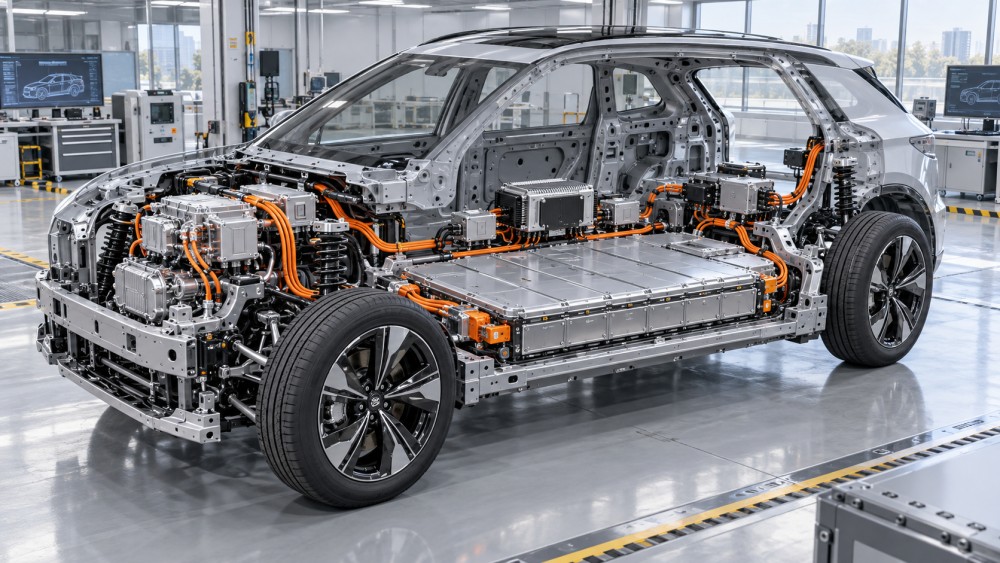
Internal-combustion vehicles have long relied on a 12 V electrical system for body electronics, infotainment, lighting, starting, and conventional actuators. Battery-electric and hybrid platforms add a separate high-voltage domain that may power traction motors, inverters, onboard chargers, DC/DC converters, electric compressors, PTC heaters, and battery thermal-management equipment. This is not a marginal electrical upgrade. It requires a coordinated architecture for energy distribution, isolation monitoring, crash disconnect, charging, thermal control, diagnostics, and functional safety.
High-voltage harnesses, connectors, junction boxes, contactors, fuses, busbars, and battery management interfaces consequently become strategic parts of the platform rather than commodity additions. Their commercial value is tied not only to current-carrying capacity but also to insulation performance, electromagnetic compatibility, sealing, assembly design, maintenance access, and fault-detection logic.
Electrification also links the E/E architecture directly to vehicle range, charging performance, and battery life. The thermal system provides a clear example. Battery cooling loops, heat pumps, electric compressors, integrated valves, pumps, heaters, sensors, and controllers must exchange information continuously. A thermal control decision may affect cabin comfort, battery temperature, charging speed, component durability, and available traction power. As these systems become more integrated, the boundary between a thermal component supplier and an E/E supplier becomes less distinct.
For commercial assessment, this means high-voltage content should not be evaluated only by the number of harnesses or connectors supplied per vehicle. The more relevant question is whether a supplier can participate in a validated subsystem that includes physical distribution, sensing, communications, diagnostics, and safety compliance. Components that cannot support the electrical, thermal, and software requirements of the broader system face increasing substitution risk.
Software-defined vehicles are changing the value of the hardware layer
A software-defined vehicle does not eliminate hardware complexity; it concentrates and standardizes it. Rather than assigning each new function to a dedicated ECU with its own software stack, vehicle developers are moving toward fewer, more capable computing units supported by common middleware, centralized data management, and reusable software services.
This transition is commercially important because the traditional distributed ECU model creates substantial integration overhead. Each additional controller brings a housing, processor, power supply, network interface, software, calibration task, diagnostics requirement, cybersecurity exposure, and supplier interface. Over time, the vehicle may accumulate dozens of controllers with overlapping functions and difficult-to-manage communication routes.
Central compute architectures seek to reduce that fragmentation. Domain controllers consolidate functions such as body electronics, cockpit systems, driver assistance, or powertrain control. More advanced designs use central computers combined with zonal controllers placed near groups of actuators and sensors. The zonal controller handles local input/output, power distribution, and gateway duties, while compute-intensive applications are managed centrally.
The commercial case is not based solely on reducing ECU count. It rests on a platform’s ability to introduce features after vehicle sale, correct software issues remotely, manage variants across multiple models, and shorten the engineering effort required to deploy a function across a vehicle range. A centralized architecture can make these outcomes more achievable, but it also shifts cost and responsibility toward software integration, cybersecurity engineering, system validation, and long-term update support.
That shift affects supplier competitiveness. A hardware supplier with strong manufacturing capability but limited software interfaces may remain relevant in standardized components, yet may be excluded from higher-value system packages. Conversely, suppliers that offer robust electronic hardware, embedded software, diagnostics, cybersecurity processes, and transparent interface documentation can become harder to replace, even where their individual part price is higher.
Zonal architectures respond to wiring weight, complexity, and bandwidth limits
Wiring harnesses remain one of the most consequential physical expressions of E/E architecture. In a conventional vehicle, wiring often runs from multiple controllers to sensors and actuators spread throughout the body. As feature content rises, harness routing becomes heavier, more crowded, and harder to manufacture. It also complicates assembly sequencing, repair access, and variant management.
Zonal architecture changes the routing logic. Instead of connecting every device back to a dedicated controller or central point through long harnesses, local devices connect to a nearby zonal controller. The zone controller aggregates local inputs and outputs, distributes low-voltage power, and connects to central compute units through higher-speed network links.
Potential benefits include shorter wire runs, reduced copper use in some applications, simpler assembly architecture, and more modular vehicle zones. However, these benefits should not be treated as automatic. They depend on vehicle packaging, local load density, network topology, redundancy requirements, and the allocation of intelligent functions between zone and central controllers. A zonal design can reduce harness complexity in one vehicle class while introducing additional engineering effort in power distribution, connector standardization, and service diagnostics.
The shift also changes demand within the wiring supply chain. The market opportunity is not limited to lower-voltage cable volume. It includes smart power distribution units, compact connectors, sealed local controllers, high-speed data cables, shielding solutions, flexible printed circuits, and automated harness testing. Suppliers need to demonstrate process consistency because an architecture with fewer centralized interfaces can make a single connection or sealing failure more consequential.
For export and sourcing decisions, production geography matters as much as engineering capability. Wiring harnesses are labor-intensive, vehicle-specific, and tightly connected to OEM assembly schedules. Zonal designs may increase modularity, but they do not remove the need for local engineering support, traceability, rapid change management, and synchronized delivery. A low quoted unit price is of limited value if the supplier cannot manage late-stage design changes, connector revisions, or plant-level quality containment.
ADAS and automated functions increase demand for deterministic data flow
Advanced driver-assistance systems are another major force behind E/E architecture investment. Cameras, radar, ultrasonic sensors, driver-monitoring systems, parking functions, and perception processors generate far greater data and processing demands than conventional body electronics. The issue is not simply moving more data; safety-relevant functions require predictable latency, time synchronization, redundancy where needed, and reliable fault handling.
Legacy automotive networks remain useful for many applications. CAN and LIN are established, cost-effective choices for numerous control tasks. Yet they are not sufficient for every high-bandwidth or compute-intensive function. Automotive Ethernet, gateways, domain controllers, and high-speed connectors are increasingly relevant where image data, sensor fusion, centralized computing, or service-oriented communication is involved.
This expands the commercial importance of network design. Suppliers of cables and connectors must address insertion loss, shielding, vibration resistance, temperature exposure, connector mating cycles, and manufacturing repeatability. Electronics providers must support network management, diagnostics, secure communication, and software compatibility. A component that performs well in a laboratory may still fail commercial qualification if it complicates vehicle-level electromagnetic compatibility testing or requires proprietary interfaces that restrict platform scalability.
Driver assistance also creates a more demanding safety case. Fail-operational requirements are not universal across all functions, but architecture decisions must identify what happens when power, communications, sensors, or compute resources become unavailable. Redundant power paths, independent communication channels, safety monitors, and degraded-mode strategies may be required depending on the function. The resulting value is concentrated in components and engineering services that support demonstrable system reliability, not merely feature availability.
The cockpit is becoming an E/E architecture issue, not just an HMI issue
Smart cockpit development adds another layer of compute, display, connectivity, and software complexity. Large displays, head-up displays, rear-seat entertainment, voice interfaces, premium audio, navigation, smartphone integration, telematics, and in-cabin sensing all compete for processing resources, power, thermal capacity, and network bandwidth.
Early cockpit upgrades could be treated as relatively self-contained infotainment projects. That is less practical when the cockpit shares compute resources with vehicle services, receives over-the-air updates, processes personal data, and interacts with driver-assistance functions. The architecture must define clear separation between safety-relevant and non-safety applications while allowing controlled information exchange.
Thermal performance is often underestimated in commercial evaluations of cockpit electronics. High-performance processors, displays, communication modules, and power electronics add heat in confined spaces. Cooling methods, materials, board layouts, airflow paths, and software-based thermal throttling can affect perceived quality and product durability. A visually advanced cockpit system that suffers from slow boot times, unstable connectivity, display degradation, or thermal derating can undermine the intended vehicle experience.
The implication for suppliers is that a media unit, display module, HUD, or telematics device cannot be assessed independently from its integration environment. Power supply behavior, boot sequencing, network compatibility, cybersecurity maintenance, and thermal interfaces may determine whether the solution can scale across a vehicle platform.
Cybersecurity and update capability are now architecture-level requirements
Connected E/E systems introduce a lifecycle obligation that does not end at vehicle production. Remote diagnostics, mobile applications, cloud services, fleet management, and over-the-air updates create new pathways into the vehicle. This makes cybersecurity a design requirement spanning ECUs, gateways, communication networks, manufacturing processes, software keys, and supplier access controls.
UNECE Regulations No. 155 and No. 156 have increased regulatory attention on cybersecurity management systems and software update management systems in vehicle type approval markets where they apply. Their practical significance extends beyond formal certification. OEMs and higher-tier suppliers increasingly need evidence that lower-tier partners can manage vulnerabilities, control software versions, protect development and production environments, and support incident response.
ISO/SAE 21434 provides a widely recognized engineering framework for automotive cybersecurity, while ISO 26262 remains central to functional safety. Neither standard removes the need for vehicle-specific engineering judgment. The relevant commercial question is whether a supplier’s development process can produce the documentation, traceability, testing evidence, and change-control discipline required by a program’s safety and security case.
This requirement can alter supplier selection. Lower-cost electronics may lose their price advantage if the provider cannot sustain software maintenance, manage vulnerability disclosure, or deliver controlled updates over the expected vehicle lifecycle. Business evaluators should distinguish between a supplier that can provide an initial production component and one that can remain accountable as the component’s software, security status, and vehicle interfaces evolve.
Architecture consolidation changes the supply-chain bargaining position
The move from many discrete ECUs toward centralized and zonal systems does not simply reduce the supplier count. It redistributes influence. Central compute platforms, operating environments, vehicle middleware, power-distribution strategies, and network gateways become points of architectural control. Companies that own or strongly influence those layers may gain a larger role in setting component interfaces, data access rules, and upgrade roadmaps.
For component manufacturers, this can create both opportunity and exposure. A supplier that previously sold a standalone controller may need to adapt to being a module provider within a larger zonal system. Its differentiation may move from proprietary control logic toward hardware reliability, standardized interfaces, manufacturing quality, or specialist functions that are difficult to commoditize. At the same time, suppliers capable of delivering integrated subsystems—such as high-voltage distribution with sensing and diagnostics, or thermal-management modules with electronic control—may address a broader value pool.
Platform consolidation also raises the cost of switching once a supplier is embedded in a validated architecture. That can support longer commercial relationships, but it raises entry barriers. Winning an initial nomination may require investment in software integration, functional safety documentation, cyber processes, test capability, and local application engineering before volume production is secured.
What should be tested in a market assessment
The most useful assessments separate structural growth drivers from feature-driven excitement. A large display, a new sensor, or an extra ECU may increase electronic content, but it does not necessarily signal a durable architecture opportunity. More defensible opportunities are linked to platform decisions that persist across multiple vehicle programs: high-voltage distribution standards, zonal topology, centralized compute strategies, network protocols, update infrastructure, and thermal-electrical integration.
Several questions reveal the quality of an opportunity:
- Is the component required by the underlying platform architecture, or is it optional content tied to a trim level?
- Does it perform a safety, power-management, connectivity, or computing function that is difficult to replace without vehicle-level revalidation?
- Can the supplier meet hardware quality requirements while also supporting software, diagnostics, cybersecurity, and lifecycle changes?
- Are the interfaces open, standardized, and scalable, or dependent on a single proprietary controller or software stack?
- Does the sourcing model account for regional production, vehicle-program timing, repairability, and traceability requirements?
The automotive E/E architecture market is expanding because the vehicle is becoming an integrated electrical and software platform, not because electronics are being added indiscriminately. Electrification raises the stakes for power and thermal control. Automated functions demand dependable data movement and fault management. Connected services require secure lifecycle support. Zonal and centralized architectures attempt to make that complexity manageable at vehicle scale.
The strongest commercial positions will be held by suppliers that understand where their component sits in this larger architecture—and can prove that it supports the vehicle’s electrical, software, safety, thermal, and manufacturing requirements over time.
Have questions about this sector analysis, or seeking best practices specific to your niche? Drop us a line below and let the senior consultants at GAC assist you.
“We respect your privacy. Your information is strictly confidential.”
Related News
- 00
0000-00
How to compare noise ratings for battery coolant pumps - 00
0000-00
How bright should automotive display systems be in sunlight? - 00
0000-00
How heat pumps improve the efficiency of EV thermal systems - 00
0000-00
Can a smart cockpit platform support multiple displays? - 00
0000-00
How is automotive connector vibration resistance tested?
Weekly Insights
Stay ahead with our curated technology reports delivered every Monday.
Recommended News
 How to compare noise ratings for battery coolant pumpsCompare coolant pump low noise ratings with confidence. Learn how test conditions, hydraulic duty, tonal noise and installation affect your choice.Author:Time:Nov 10, 2026
 How bright should automotive display systems be in sunlight?Automotive Display Systems need more than brightness to stay readable in sunlight. Discover why 1,000 nits is a starting point and how to evaluate glare and heat.Author:Time:Nov 09, 2026
 How heat pumps improve the efficiency of EV thermal systemsEV Thermal Systems use heat pumps to reduce heating energy demand. Explore how they work, where they excel, and what limits efficiency in cold weather.Author:Time:Nov 08, 2026
 Can a smart cockpit platform support multiple displays?Can a smart cockpit platform support multiple displays? Explore key requirements for performance, safety, connectivity, and supplier evaluation.Author:Time:Nov 07, 2026
 How is automotive connector vibration resistance tested?Automotive connector vibration resistance testing reveals hidden contact failures. Explore test profiles, continuity monitoring and pass criteria.Author:Time:Nov 06, 2026
 How heat pumps save energy in automotive cabin climate systemsAutomotive Cabin Climate Systems energy saving starts with smarter heat pump design. Explore real-world efficiency, cold-weather trade-offs, and testing tips.Author:Time:Nov 05, 2026
 Is an EV heat pump worth it for winter driving range?Is a heat pump worth using in a cold-climate EV? Discover how it affects winter range, when it pays off, and what to check before buying.Author:Time:Nov 04, 2026
 When should you use 50-ohm coaxial cable instead of 75-ohm?Coaxial cable 50 ohm or 75 ohm? Learn when to use each, avoid impedance mismatches, and choose the right cable for reliable RF and video performance.Author:Time:Nov 03, 2026
 How to select a high temperature motor harness for an EVChoose the right high temperature motor harness for your EV. Compare thermal limits, current capacity, shielding, routing, and validation evidence.Author:Time:Nov 02, 2026
 How much does electric power steering replacement cost?Electric power steering price typically ranges from $1,000 to $3,000 for major replacements. Discover cost factors, repair options, and tips for comparing quotes.Author:Time:Nov 01, 2026
 How to size an EV A/C compressor for the required cooling capacitySize an EV A/C Compressor with confidence. Explore cooling loads, performance maps and power limits to select the right compressor for your vehicle.Author:Time:Oct 31, 2026
 How to choose the right pitch for an FPC board connectorFPC board connector pitch affects space, assembly and reliability. Learn how to compare options and select the best fit for your design.Author:Time:Oct 30, 2026
 How zonal design affects harness routing in high-voltage EV architecturesExplore high-voltage electrical architecture zonal design and its impact on EV harness routing. Discover key trade-offs in cable length, safety, thermal performance, and service access.Author:Time:Oct 29, 2026
 How tariffs affect costs in global automotive parts supply chainsNavigate tariffs in the global automotive parts trade supply chain. Learn to compare landed costs, manage duty exposure, and uncover smarter sourcing strategies to protect your margins.Author:Time:Oct 28, 2026
 How to assess vendor lock-in in a software-defined vehicle platformAssess Software-Defined Vehicle platform lock-in with practical tests for API portability, data access, update control, and exit costs. Learn how to choose a platform with a proven exit path.Author:Time:Oct 27, 2026
 How ISO 26262 guides functional safety in steer-by-wire systemsExplore steering systems functional safety through ISO 26262. Learn how hazard analysis, fault-tolerant design, and validation build a stronger steer-by-wire safety case.Author:Time:Oct 26, 2026
 How to evaluate a steering angle sensor manufacturer's accuracy claimsEvaluate steering angle sensor manufacturer accuracy claims with practical checks on calibration, latency, and test evidence. Compare suppliers confidently and avoid costly selection mistakes.Author:Time:Oct 25, 2026
 How to diagnose CAN bus faults in a hybrid vehicle control unitDiagnose Hybrid Vehicle Systems control unit CAN bus faults with step-by-step power, wiring, and waveform checks. Find the root cause and avoid unnecessary replacement.Author:Time:Oct 24, 2026
 How does battery cooling pipe diameter affect coolant pressure drop?Battery Cooling Pipe diameter affects coolant pressure drop and pump power. Explore sizing calculations and practical tips to optimize EV battery cooling and compare options with confidence.Author:Time:Oct 23, 2026
 How to assess PPAP readiness of automotive sensor system manufacturersAssess Automotive Sensor Systems manufacturers for PPAP readiness. Learn to verify production evidence, measurement capability, validation, and traceability to reduce sourcing risks.Author:Time:Oct 22, 2026
 What to ask an FPC connector manufacturer about reliability testingChoosing an FPC Connector manufacturer? Learn what to ask about reliability testing, failure limits, and traceable results to reduce design risks and select with confidence.Author:Time:Oct 21, 2026
 How to verify vehicle fitment for an aftermarket AC evaporatorNavigating the evaporator aftermarket? Verify vehicle fitment with VIN data, OE numbers, and physical interface checks. Use this guide to avoid costly mismatches and order confidently.Author:Time:Oct 20, 2026
 How electric compressor speed affects EV battery cooling capacityElectric compressor technology: battery cooling depends on more than RPM. Discover how speed, refrigerant flow, and system limits affect EV cooling capacity and energy efficiency.Author:Time:Oct 19, 2026
 How to verify a variable frequency compressor supplier’s efficiency claimsVerify a variable frequency compressor supplier’s efficiency claims using COP boundaries, matched test conditions, and duty-cycle data. Learn how to choose with confidence.Author:Time:Oct 18, 2026
 How bend radius affects FPC reliability in automotive camera modulesAutomotive FPC applications: camera module reliability starts with bend radius. Learn how stack-up, strain, and validation guide robust designs and help prevent costly failures.Author:Time:Oct 17, 2026
 How to diagnose intermittent loss of electric power steering assistMaster power steering system diagnostics to trace intermittent EPS assist loss. Learn proven checks for voltage, wiring, and fault codes to avoid costly guesswork.Author:Time:Oct 16, 2026
 How to size automotive power modules for electric compressorsSize automotive power modules for electric compressors with confidence. Learn how voltage, phase current, losses, and cooling shape reliable selection—and avoid costly oversizing.Author:Time:Oct 15, 2026
 Why automotive power electronics are shifting to silicon carbideAutomotive Power Electronics are shifting to silicon carbide. Discover how SiC can cut losses, boost EV power density, and reshape cooling, reliability, and system costs.Author:Time:Oct 14, 2026
 How EV adoption shapes the electrically driven compressor marketExplore how EV adoption shapes the electrically driven compressor market, from battery cooling and heat pumps to supplier margins. Discover the drivers of profitable growth.Author:Time:Oct 13, 2026
 How to size a PTC heater for reliable EV cabin heatingPTC Heater sizing for EV cabins: learn how to balance defrost performance, heat-pump integration, airflow, voltage range, and battery power for reliable winter comfort.Author:Time:Oct 12, 2026





























