
When does commercial vehicle thermal management for trucks lower fleet operating costs




If you are evaluating commercial vehicle thermal management for trucks, the cost question is usually simple: does it cut fuel or energy use, reduce failures, and keep more vehicles on the road? That is the point where it starts lowering fleet operating costs. Not every truck gets the same payoff, and not every thermal upgrade deserves budget. The savings tend to show up fastest in fleets with harsh duty cycles, long idling periods, temperature-sensitive powertrains, electrified auxiliaries, or expensive downtime. The real decision is not whether thermal management matters. It is where it delivers measurable return and where it is just extra complexity.
Many buyers still treat thermal systems as a secondary engineering topic. In practice, it affects daily operating cost in very direct ways: engine efficiency, battery temperature stability, HVAC load, compressor workload, aftertreatment consistency, component life, and service intervals. Once those costs are mapped against route type and asset utilization, the procurement discussion becomes much clearer.
When the numbers usually work
A short answer is this: commercial vehicle thermal management for trucks lowers operating costs when thermal losses are already costing you money somewhere else. That “somewhere else” may be fuel burn, battery degradation, DEF-related issues, compressor wear, failed electronics, or missed deliveries caused by heat-related derating.
The strongest business case usually appears in five situations.
- High-utilization fleets where every hour of downtime has a visible revenue impact.
- Regional and urban delivery trucks with stop-start duty cycles, heavy HVAC use, and frequent idling.
- Battery-electric or hybrid trucks that must protect battery temperature to preserve range, charging speed, and battery life.
- Trucks operating across hot summers, cold winters, mountain grades, or mixed climates.
- Fleets running sensitive auxiliary equipment, sleeper climate control, or power electronics that do not tolerate temperature swings well.
If your operation is mostly simple highway hauling in moderate climates with stable engine loads and low downtime cost, the return may be slower. That does not mean the system has no value. It means the savings need to be proven more carefully instead of assumed.
Cost reduction does not come from one place
One common mistake in procurement is looking only at fuel economy. Thermal management can improve fuel or energy efficiency, but that is rarely the only source of value. In many fleets, the bigger savings come from avoided losses.
Take a diesel truck. Better thermal control can help the engine reach and hold its preferred operating range more consistently. That can improve combustion stability, reduce inefficient warm-up periods, and support emissions-related systems that dislike cold operation or repeated thermal cycling. The result may be lower fuel use, but just as important, it may reduce maintenance disruption tied to thermal stress.
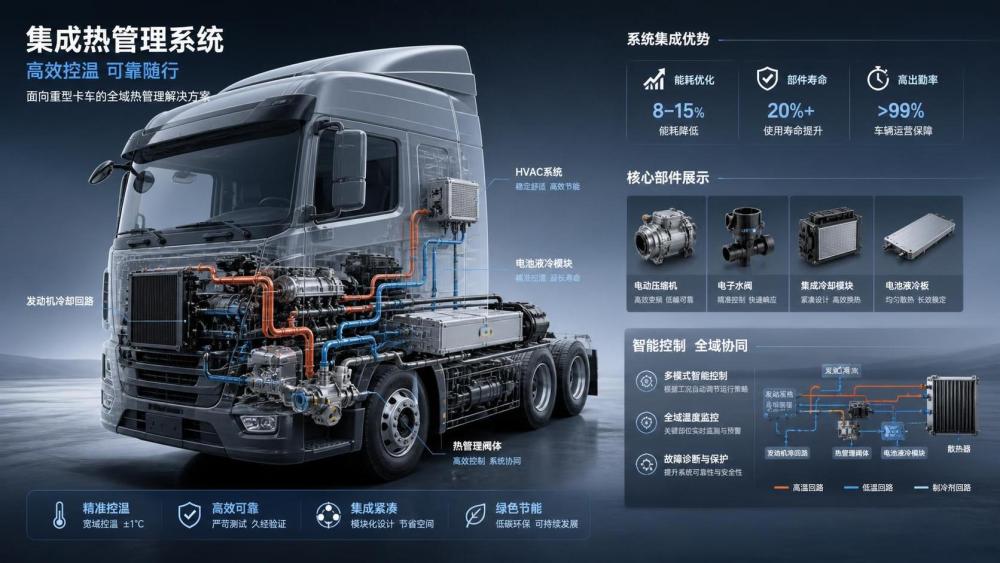
Now look at an electric truck. Here the thermal conversation is even more direct. Battery liquid cooling, integrated thermal valves, electric compressors, and heat pump systems affect range retention, charging behavior, cabin comfort load, and battery aging. A poorly managed battery pack may still move the vehicle, but it often does so with hidden costs: faster degradation, reduced usable capacity, and less predictable performance in heat or cold.
That is why experienced buyers look at total cost of ownership instead of asking whether one component is “efficient.” Thermal systems pay back when they improve the economic behavior of the whole truck.
Where fleets often underestimate the savings
Downtime is the first blind spot. A truck that fails in service because a compressor, hose, valve, cooling loop, or thermal control module has been specified poorly does not just create a repair bill. It interrupts route commitments, driver schedules, cargo timing, and workshop planning. For fleets with tight delivery windows, one preventable thermal issue can erase the apparent savings of buying the cheaper system.
The second blind spot is component life.
Thermal stress affects batteries, inverters, ECUs, compressors, seals, wiring protection, and power electronics. Heat is cumulative. Cold starts are cumulative too. Decision-makers sometimes focus on purchase price differences between systems while ignoring the replacement timing of expensive downstream parts. That is not a minor oversight, especially in electrified fleets where the cost of battery health is central to residual value.
The third is driver and operational behavior. A system that reduces uncontrolled cabin cooling load, manages auxiliary thermal demand more intelligently, or shortens warm-up time can change how drivers use the vehicle in real life. Those small changes compound over a year.
Not every truck needs the same thermal architecture
This is where many sourcing discussions become too generic. “Truck thermal management” sounds like one category, but the right specification depends heavily on vehicle type and mission profile.
For internal combustion trucks, the focus may be engine cooling, charge air cooling, HVAC efficiency, compressor durability, and thermal stability for emissions systems. For electric trucks, the center of gravity shifts toward battery cooling, refrigerant loop integration, heat pump efficiency, electric compressor performance, and the coordination of multiple thermal loads inside one system.
A fleet running refrigerated urban delivery vehicles has very different priorities from a long-haul tractor fleet. So does a mining support truck, a municipal sanitation fleet, or a middle-mile electric delivery operator. Buyers who use a one-size-fits-all thermal specification often either overpay or under-protect the asset.
A practical procurement question is not “What is the best thermal system?” It is “What thermal problems are currently driving cost in this vehicle class, on this route, in this climate?” That question leads to better supplier conversations.
What to verify before you approve budget
Before making a sourcing decision, it helps to pressure-test the business case with a few operational checks.
- What is the current cost of heat-related downtime, including lost utilization and service disruption?
- Do you have route-level data showing high idle time, repeated short cycles, or extreme ambient exposure?
- For electrified trucks, do you track battery temperature behavior, charging consistency, and seasonal range loss?
- Are current HVAC or compressor failures creating recurring maintenance cost?
- Is your fleet planning to expand into harsher climates or new duty cycles within the vehicle replacement period?
If the answer to several of these is yes, thermal management should be treated as a cost-control investment rather than a feature upgrade.
There is also a supply-side question. Some fleets buy around a catalog specification without checking whether the supplier can support integration, diagnostics, spare parts continuity, and local service needs. Thermal systems are not isolated boxes. Valves, compressors, control logic, cooling circuits, sensors, and electrical architecture have to work together. Weak support can turn a theoretically efficient design into an operational headache.
Common buying mistakes
The first mistake is buying on initial component price alone. Lower upfront cost can look attractive, especially in large-volume procurement, but thermal systems affect warranty exposure, maintenance planning, and utilization. Cheap hardware is expensive when it increases service events.
The second is copying passenger-vehicle assumptions into commercial duty. Truck operating cycles are harsher, more variable, and more financially sensitive to downtime. What works in light-duty applications may not deliver the same durability or thermal control margin in trucks.
The third is underestimating controls. Hardware matters, but thermal management performance also depends on how the system prioritizes loads, reacts to ambient changes, and protects critical components. A technically decent system with weak control logic may leave savings on the table.
The fourth is assuming the same ROI timeline across diesel, hybrid, and battery-electric fleets. It rarely works that way. Electrified trucks often show the value faster because battery protection and auxiliary power efficiency have a more visible impact on operating economics.
How experienced procurement teams compare options
Strong teams usually compare thermal solutions across four dimensions: operating profile fit, integration risk, serviceability, and cost over life.
Operating profile fit is about climate, payload, route, stop frequency, idle behavior, and annual utilization. Integration risk covers compatibility with the truck platform, electrical system, control architecture, and packaging constraints. Serviceability means technician familiarity, fault diagnosis, replacement part access, and repair time. Cost over life includes energy use, maintenance, component replacement, and residual value impact.
This is also where market intelligence matters. Platforms such as GACT can be useful as a reference point when buyers need to track developments in integrated thermal valves, battery liquid cooling systems, heat pump systems, electric compressors, high-voltage harnesses, and related supply-chain trends across different truck and NEV markets. That kind of visibility helps narrow the field before formal RFQ work begins, especially when procurement teams are comparing suppliers across regions.
Still, market visibility should support field validation, not replace it. Bench claims and brochures are not enough. Ask for duty-cycle relevance, validation logic, and service assumptions.
When thermal upgrades may not justify the spend
There are cases where the savings case is weak. Fleets with low annual mileage, mild climate exposure, light auxiliary demand, and generous downtime tolerance may not recover the added system cost quickly. The same is true when operational problems are being blamed on thermal limits but are actually caused by poor maintenance discipline, airflow blockage, calibration issues, or driver behavior.
In other words, do not use thermal management as a catch-all fix. It works best when the cost source is real and identifiable.
The clearest decision rule
If a thermal system can reduce unplanned downtime, stabilize fuel or energy consumption, protect expensive components, and support vehicle availability in your actual operating conditions, it is doing exactly what a cost-focused fleet investment should do. That is when commercial vehicle thermal management for trucks becomes a practical lever for lower operating cost, not just another engineering line item.
The best next step is usually small and disciplined: identify one or two truck groups where heat, cold, or variable load is already creating measurable cost, then compare thermal solutions against those pain points. Buyers who start there tend to make better decisions than buyers who shop thermal hardware as a generic upgrade.
FAQ
Does thermal management matter more for electric trucks than diesel trucks?
Usually yes, because battery performance, charging behavior, and range are highly temperature-sensitive. Diesel trucks still benefit, but the financial effect is often more visible in electric platforms.
What is the fastest way to estimate ROI?
Start with downtime cost, maintenance history, seasonal efficiency loss, and component replacement trends. If you only model fuel savings, the estimate is often incomplete.
Should fleets prioritize hardware or control strategy?
They need both, but control strategy is often underestimated. Good components with poor thermal coordination can still deliver mediocre field results.
Can smaller fleets benefit, or is this mainly for large operators?
Smaller fleets can benefit if each vehicle has high utilization or expensive downtime. Fleet size matters less than route severity and asset dependence.
Image Placeholder Guide
Suggested placement: after the section explaining multiple sources of cost reduction.
Suggested image content: a simplified truck thermal management diagram showing engine/battery cooling loop, HVAC load, compressor, control valves, and the cost impact points such as fuel, uptime, and component life.
Suggested alt text: Commercial vehicle thermal management system for trucks and its impact on fleet operating costs.
Internal Link Anchor Text Suggestions
- battery liquid cooling systems: category page or technical guide
- electric compressors for commercial vehicles: product or insight page
- heat pump systems in electric trucks: application analysis page
- integrated thermal valves: supplier or component explainer page
- high-voltage harness design for NEV thermal systems: technical article page
External Source Directions
- industry association reports on commercial vehicle efficiency and fleet operating cost
- government or regulatory agency pages covering heavy-duty vehicle energy and emissions requirements
- OEM or Tier 1 official technical documents on truck battery thermal management and HVAC system design
Have questions about this sector analysis, or seeking best practices specific to your niche? Drop us a line below and let the senior consultants at GAC assist you.
“We respect your privacy. Your information is strictly confidential.”
Related News
- 00
0000-00
How to compare noise ratings for battery coolant pumps - 00
0000-00
How bright should automotive display systems be in sunlight? - 00
0000-00
How heat pumps improve the efficiency of EV thermal systems - 00
0000-00
Can a smart cockpit platform support multiple displays? - 00
0000-00
How is automotive connector vibration resistance tested?
Tags
- thermal systems
- electric compressors
- high-voltage harness
- heat pump systems
- battery thermal management
- thermal valves
- Electric Compressor
- battery liquid cooling
- heat pump efficiency
- vehicle thermal management
- commercial vehicle thermal management
- liquid cooling systems
- commercial vehicle thermal management system
- commercial vehicle thermal management for trucks
Weekly Insights
Stay ahead with our curated technology reports delivered every Monday.
Recommended News
 How to compare noise ratings for battery coolant pumpsCompare coolant pump low noise ratings with confidence. Learn how test conditions, hydraulic duty, tonal noise and installation affect your choice.Author:Time:Nov 10, 2026
 How bright should automotive display systems be in sunlight?Automotive Display Systems need more than brightness to stay readable in sunlight. Discover why 1,000 nits is a starting point and how to evaluate glare and heat.Author:Time:Nov 09, 2026
 How heat pumps improve the efficiency of EV thermal systemsEV Thermal Systems use heat pumps to reduce heating energy demand. Explore how they work, where they excel, and what limits efficiency in cold weather.Author:Time:Nov 08, 2026
 Can a smart cockpit platform support multiple displays?Can a smart cockpit platform support multiple displays? Explore key requirements for performance, safety, connectivity, and supplier evaluation.Author:Time:Nov 07, 2026
 How is automotive connector vibration resistance tested?Automotive connector vibration resistance testing reveals hidden contact failures. Explore test profiles, continuity monitoring and pass criteria.Author:Time:Nov 06, 2026
 How heat pumps save energy in automotive cabin climate systemsAutomotive Cabin Climate Systems energy saving starts with smarter heat pump design. Explore real-world efficiency, cold-weather trade-offs, and testing tips.Author:Time:Nov 05, 2026
 Is an EV heat pump worth it for winter driving range?Is a heat pump worth using in a cold-climate EV? Discover how it affects winter range, when it pays off, and what to check before buying.Author:Time:Nov 04, 2026
 When should you use 50-ohm coaxial cable instead of 75-ohm?Coaxial cable 50 ohm or 75 ohm? Learn when to use each, avoid impedance mismatches, and choose the right cable for reliable RF and video performance.Author:Time:Nov 03, 2026
 How to select a high temperature motor harness for an EVChoose the right high temperature motor harness for your EV. Compare thermal limits, current capacity, shielding, routing, and validation evidence.Author:Time:Nov 02, 2026
 How much does electric power steering replacement cost?Electric power steering price typically ranges from $1,000 to $3,000 for major replacements. Discover cost factors, repair options, and tips for comparing quotes.Author:Time:Nov 01, 2026
 How to size an EV A/C compressor for the required cooling capacitySize an EV A/C Compressor with confidence. Explore cooling loads, performance maps and power limits to select the right compressor for your vehicle.Author:Time:Oct 31, 2026
 How to choose the right pitch for an FPC board connectorFPC board connector pitch affects space, assembly and reliability. Learn how to compare options and select the best fit for your design.Author:Time:Oct 30, 2026
 How zonal design affects harness routing in high-voltage EV architecturesExplore high-voltage electrical architecture zonal design and its impact on EV harness routing. Discover key trade-offs in cable length, safety, thermal performance, and service access.Author:Time:Oct 29, 2026
 How tariffs affect costs in global automotive parts supply chainsNavigate tariffs in the global automotive parts trade supply chain. Learn to compare landed costs, manage duty exposure, and uncover smarter sourcing strategies to protect your margins.Author:Time:Oct 28, 2026
 How to assess vendor lock-in in a software-defined vehicle platformAssess Software-Defined Vehicle platform lock-in with practical tests for API portability, data access, update control, and exit costs. Learn how to choose a platform with a proven exit path.Author:Time:Oct 27, 2026
 How ISO 26262 guides functional safety in steer-by-wire systemsExplore steering systems functional safety through ISO 26262. Learn how hazard analysis, fault-tolerant design, and validation build a stronger steer-by-wire safety case.Author:Time:Oct 26, 2026
 How to evaluate a steering angle sensor manufacturer's accuracy claimsEvaluate steering angle sensor manufacturer accuracy claims with practical checks on calibration, latency, and test evidence. Compare suppliers confidently and avoid costly selection mistakes.Author:Time:Oct 25, 2026
 How to diagnose CAN bus faults in a hybrid vehicle control unitDiagnose Hybrid Vehicle Systems control unit CAN bus faults with step-by-step power, wiring, and waveform checks. Find the root cause and avoid unnecessary replacement.Author:Time:Oct 24, 2026
 How does battery cooling pipe diameter affect coolant pressure drop?Battery Cooling Pipe diameter affects coolant pressure drop and pump power. Explore sizing calculations and practical tips to optimize EV battery cooling and compare options with confidence.Author:Time:Oct 23, 2026
 How to assess PPAP readiness of automotive sensor system manufacturersAssess Automotive Sensor Systems manufacturers for PPAP readiness. Learn to verify production evidence, measurement capability, validation, and traceability to reduce sourcing risks.Author:Time:Oct 22, 2026
 What to ask an FPC connector manufacturer about reliability testingChoosing an FPC Connector manufacturer? Learn what to ask about reliability testing, failure limits, and traceable results to reduce design risks and select with confidence.Author:Time:Oct 21, 2026
 How to verify vehicle fitment for an aftermarket AC evaporatorNavigating the evaporator aftermarket? Verify vehicle fitment with VIN data, OE numbers, and physical interface checks. Use this guide to avoid costly mismatches and order confidently.Author:Time:Oct 20, 2026
 How electric compressor speed affects EV battery cooling capacityElectric compressor technology: battery cooling depends on more than RPM. Discover how speed, refrigerant flow, and system limits affect EV cooling capacity and energy efficiency.Author:Time:Oct 19, 2026
 How to verify a variable frequency compressor supplier’s efficiency claimsVerify a variable frequency compressor supplier’s efficiency claims using COP boundaries, matched test conditions, and duty-cycle data. Learn how to choose with confidence.Author:Time:Oct 18, 2026
 How bend radius affects FPC reliability in automotive camera modulesAutomotive FPC applications: camera module reliability starts with bend radius. Learn how stack-up, strain, and validation guide robust designs and help prevent costly failures.Author:Time:Oct 17, 2026
 How to diagnose intermittent loss of electric power steering assistMaster power steering system diagnostics to trace intermittent EPS assist loss. Learn proven checks for voltage, wiring, and fault codes to avoid costly guesswork.Author:Time:Oct 16, 2026
 How to size automotive power modules for electric compressorsSize automotive power modules for electric compressors with confidence. Learn how voltage, phase current, losses, and cooling shape reliable selection—and avoid costly oversizing.Author:Time:Oct 15, 2026
 Why automotive power electronics are shifting to silicon carbideAutomotive Power Electronics are shifting to silicon carbide. Discover how SiC can cut losses, boost EV power density, and reshape cooling, reliability, and system costs.Author:Time:Oct 14, 2026
 How EV adoption shapes the electrically driven compressor marketExplore how EV adoption shapes the electrically driven compressor market, from battery cooling and heat pumps to supplier margins. Discover the drivers of profitable growth.Author:Time:Oct 13, 2026
 How to size a PTC heater for reliable EV cabin heatingPTC Heater sizing for EV cabins: learn how to balance defrost performance, heat-pump integration, airflow, voltage range, and battery power for reliable winter comfort.Author:Time:Oct 12, 2026





























