What is driving consolidation in the electric vehicle components market?




Consolidation in the electric vehicle components market is not simply a reaction to rapid vehicle electrification. It reflects a harder commercial reality: the components that determine EV cost, efficiency, safety, and software performance are becoming more technically interdependent, while OEM purchasing programs demand global scale, lower unit cost, validated quality systems, and long-term engineering support at the same time.
That combination favors suppliers able to control more of the value chain. It also puts pressure on smaller, single-product companies whose capabilities may be technically credible but insufficiently broad, capitalized, or geographically resilient for large platform awards. Mergers, acquisitions, joint ventures, strategic partnerships, and vertical integration are therefore reshaping how value is captured across battery thermal management, electric compressors, high-voltage wiring, power electronics, chassis control, and smart cockpit electronics.
For a business assessment, the important question is not whether consolidation will occur in every component category. It is where integration creates a real economic or technical advantage, and where it instead creates concentration risk, integration difficulty, or reduced sourcing flexibility.
EV architectures reward system-level suppliers
Internal-combustion vehicles were built around mature, relatively separated systems. EVs retain many conventional components, but their critical functions are increasingly connected through the high-voltage electrical architecture, the battery pack, vehicle software, and thermal control strategy. This raises the value of suppliers that can engineer interfaces across several subsystems rather than optimize a single component in isolation.
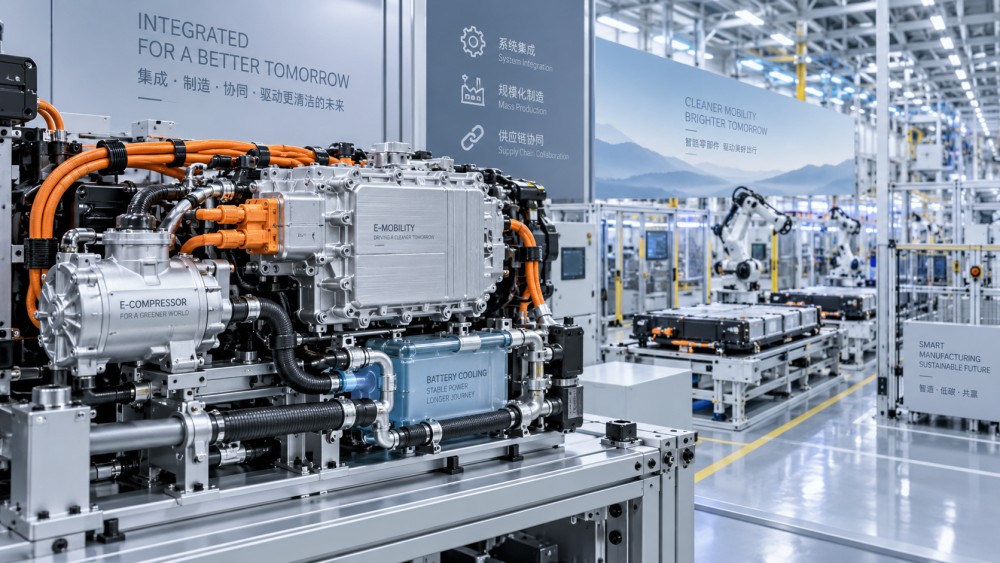
Thermal management is a clear example. A modern EV thermal system may connect battery liquid cooling plates, coolant distribution units, pumps, valves, heat exchangers, HVAC functions, refrigerant circuits, sensors, electronic controls, and an electric compressor. The vehicle-level objective is not merely to cool one component. It is to manage battery temperature, cabin comfort, charging conditions, powertrain efficiency, and energy consumption under widely varying ambient conditions.
A supplier of an individual valve or pump can remain important, but the strategic value increasingly sits in system integration: control logic, packaging, refrigerant and coolant routing, diagnostics, calibration, and compatibility with the vehicle’s energy-management software. Acquiring or partnering with adjacent technology providers can give a supplier a more complete system offer and increase its relevance earlier in an OEM’s design cycle.
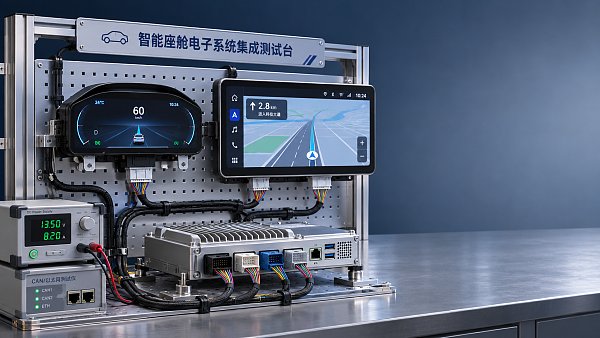
The same pattern applies to cockpit electronics. Displays, head units, HUD systems, cameras, connectivity modules, domain controllers, and software layers are no longer isolated accessories. Their integration affects cybersecurity, user experience, functional safety responsibilities, wiring complexity, power management, and update capability. Suppliers with only a hardware niche may seek software, display, optics, or electronics-manufacturing capabilities to remain competitive in a procurement environment that increasingly evaluates the full delivered function.
Consolidation is therefore partly an architectural response. When vehicle functions are designed as tightly coupled systems, the supply base tends to shift toward companies that can assume broader engineering responsibility.
Scale matters because EV component economics are capital-intensive
Many EV components require substantial investment before production volume is secured. Development spending may include high-voltage validation, electromagnetic compatibility testing, thermal cycling, vibration and durability testing, functional-safety processes, manufacturing automation, software development, tooling, and localized production capability. For batteries, electric drivetrains, power electronics, electric compressors, and advanced cockpit products, the initial burden can be especially high.
A supplier with limited volumes may have difficulty recovering these costs while meeting the aggressive pricing expectations frequently attached to new EV programs. Combining businesses can spread engineering, purchasing, test-lab, and manufacturing costs across a larger revenue base. It may also improve access to financing for factory upgrades and working capital, both of which are important where program launches require inventory build-up and long payment cycles.
Scale is not valuable merely because it makes a company larger. It matters when it improves the supplier’s ability to amortize fixed costs, maintain quality through multiple launch programs, and negotiate more effectively for materials, semiconductor capacity, magnets, aluminum, copper, specialty polymers, and electronic components.
This is particularly relevant in wiring harnesses and high-voltage distribution. The products can appear labor-intensive and commercially straightforward, but the underlying business is sensitive to copper exposure, connector availability, quality traceability, regional manufacturing footprint, vehicle-specific engineering changes, and logistics continuity. A broader group may be better able to operate across multiple production locations, maintain approved second sources, and absorb disruptions that would be financially damaging to a smaller producer.
OEMs are reducing interface risk, not only supplier count
Supplier consolidation is often described as an OEM effort to reduce the number of vendors. That is incomplete. A vehicle manufacturer can still retain many suppliers while seeking fewer critical interfaces in systems that are difficult to validate and expensive to troubleshoot.
When the performance of one component depends heavily on another, fragmented responsibility can lead to disputes over warranty, calibration, packaging, electrical noise, software integration, or efficiency shortfalls. For example, an electric compressor may perform within its own specification yet contribute to poor vehicle energy consumption if the refrigerant loop, thermal valve control, heat-pump strategy, or battery conditioning logic is not properly coordinated.
OEMs may prefer a supplier able to take responsibility for a defined module or subsystem because it reduces the number of technical handoffs. This does not eliminate risk; it relocates more engineering and warranty responsibility to the module supplier. For the supplier, the reward can be a larger content value per vehicle and deeper involvement in platform development. The requirement, however, is greater technical accountability.
That dynamic encourages acquisitions that fill missing capabilities. A thermal supplier may seek controls expertise. A power-electronics company may seek packaging, software, or cooling capabilities. A cockpit hardware supplier may seek HMI software, display integration, or cybersecurity competence. In each case, the transaction logic is stronger when the acquired capability resolves a genuine vehicle-level interface problem rather than simply adding revenue.
Vertical integration is driven by supply security and control over bottlenecks
The electric vehicle components market has exposed the commercial consequences of relying on narrow supply channels. Semiconductor constraints, material volatility, logistics disruptions, and geopolitical uncertainty have all reinforced the value of critical-component visibility. This does not mean every company will bring production in-house. Full vertical integration can be expensive and inflexible. But it has made selective control over bottlenecks more attractive.
Suppliers may move upstream into key materials, power modules, magnet-related capabilities, electronic assemblies, compressor motor technology, connector production, or software tools where external dependence creates an unacceptable risk. Others may move downstream into module assembly, testing, remanufacturing, or localized service in order to control quality and delivery performance closer to the customer.
The choice depends on whether the adjacent activity is strategically scarce, technically differentiated, or difficult to qualify quickly. Commodity inputs with broad availability do not always justify ownership. A component with a long qualification cycle, specialized process knowledge, or limited approved supply sources can justify a closer relationship, an equity investment, a joint venture, or direct acquisition.
For commercial due diligence, a vertically integrated supplier should not automatically be scored as more secure. Integration can reduce external dependency, but it can also introduce new exposure if the acquired operation lacks process maturity, remains geographically concentrated, or relies on a single customer program. The relevant issue is whether integration improves continuity at the actual points of vulnerability.
Regionalization is changing the logic of global supply chains
EV supply chains need global technology access, yet automotive production remains deeply regional. Vehicles must comply with local regulations, meet market-specific performance conditions, and be delivered under demanding logistics schedules. Freight costs, customs processes, rules-of-origin considerations, and customer expectations for local engineering support can all affect sourcing decisions.
Consolidation can provide a faster route to regional capability than building new operations from scratch. An acquisition may offer a local factory, engineering team, supplier network, quality certifications, or established customer relationships. A joint venture may enable market access while distributing capital requirements and local operational risk.
This is visible across North America, Europe, China, Southeast Asia, Mexico, India, Japan, and South Korea, where component groups are balancing local manufacturing needs with the desire to maintain common global platforms. High-voltage harnesses, cooling modules, electric compressors, cockpit assemblies, and steering systems all have varying degrees of localization pressure because they are tied to vehicle assembly schedules, platform-specific integration, and after-sales support.
Regional expansion through acquisition has limits. A local footprint does not automatically create local competitiveness. The acquired business must be able to meet common quality systems, digital traceability requirements, export-control obligations where applicable, and the customer’s engineering-change process. Integration failures often arise when the commercial rationale is sound but the manufacturing and governance systems remain disconnected.
Technology convergence is narrowing the space for isolated specialists
Some EV component categories are becoming more software-defined, while others are becoming more closely tied to energy efficiency and safety requirements. Both trends increase the premium on cross-disciplinary capability.
Steering illustrates this shift. EPS systems, steering columns, sensors, control units, and steer-by-wire architectures involve mechanical design, electric motors, control algorithms, functional safety, cybersecurity, and vehicle-level redundancy concepts. A supplier that is strong in mechanical steering but lacks electronics and software depth may face a strategic gap as vehicle platforms move toward more integrated chassis control.
High-voltage electrical systems present a similar challenge. Harnesses, connectors, fuse and distribution functions, shielding, data communication, thermal protection, and assembly processes must work together. Higher voltage levels and increased power demands make insulation integrity, creepage and clearance design, electromagnetic behavior, termination quality, and serviceability more consequential. Consolidation can bring these capabilities under one engineering organization, making it easier to offer validated solutions rather than a collection of individual parts.
Yet not all specialists are vulnerable. A company with proprietary materials, exceptional manufacturing yield, a highly defensible design capability, or qualification expertise in a narrow critical component can remain strategically important. The issue is whether its specialization solves a problem that cannot be easily replicated by a larger integrated group. Niche suppliers with a weak differentiation story are more exposed than specialists whose technology is embedded in a customer’s performance or safety requirements.
Financial pressure is accelerating transactions, but it is rarely the sole cause
EV programs can strain supplier finances because launch volumes, engineering costs, and pricing assumptions do not always develop in a smooth line. A supplier may invest early in capacity, test capability, and product development only to face delayed vehicle launches, changing platform priorities, or lower-than-expected utilization. In such circumstances, consolidation can provide capital, customer access, or a path to capacity rationalization.
Financial stress alone does not create a durable industrial combination. Acquisitions made solely to add volume can fail if product portfolios overlap without improving technology, customer access, purchasing leverage, or plant utilization. The stronger transactions tend to have an identifiable operational logic: complementary geography, an adjacent subsystem capability, shared customer platforms, a stronger route to localization, or a more efficient manufacturing network.
Business evaluation should distinguish between defensive consolidation and capability-led consolidation. Defensive deals may stabilize an asset or remove duplicated cost, but they can leave the combined company with unresolved technology gaps. Capability-led deals are more likely to change competitive position, provided the buyer can retain engineering talent and integrate development processes without disrupting active customer programs.
What consolidation changes for supplier assessment
A larger supplier is not automatically a lower-risk supplier. Size can improve purchasing power, engineering coverage, and global service capacity, but it can also increase organizational complexity, customer concentration, debt exposure, and the risk that a non-core product line receives less investment after integration.
The practical assessment should focus on the specific component or module being sourced. Useful questions include:
- Does the combined business control the critical design, software, manufacturing, and validation capabilities for the product?
- Are key production sites, sub-tier sources, and engineering centers diversified in ways that improve continuity?
- Will the transaction alter ownership of tooling, intellectual property, warranty obligations, or approved production locations?
- Is there a credible plan for maintaining quality performance during system, plant, and supplier-network integration?
- Does the supplier’s expanded portfolio create a more integrated offer, or merely a broader catalog with separate operating units?
- Could greater market concentration reduce access to qualified alternative sources for a safety- or launch-critical part?
These questions matter more than headline deal value or corporate size. In automotive supply, the operational consequences of integration appear in engineering response time, change management, traceability, launch stability, and warranty handling—not simply in annual revenue.
Consolidation will remain selective rather than uniform
The direction of travel is toward broader capabilities around critical EV systems, but the electric vehicle components market will not consolidate in the same way across every product line. Complex modules with high engineering interdependence, significant validation requirements, and supply-chain bottlenecks create the strongest incentives for integration. Thermal systems, high-voltage architecture, software-linked cockpit functions, power electronics, and advanced chassis control fit this pattern.
More standardized products may remain fragmented where local manufacturing, cost discipline, and customer-specific execution matter more than ownership of a complete system. Even in those categories, however, suppliers may consolidate to gain regional capacity, improve material purchasing, or secure the financial resources required by modern automotive qualification and production requirements.
The central market shift is not simply from many suppliers to fewer suppliers. It is from disconnected component offerings toward organizations able to assume more responsibility for performance, integration, and continuity. That makes the quality of a supplier’s integration strategy as important as the transaction itself. A deal creates value only when it improves the combined company’s ability to deliver a more reliable, technically coherent, and commercially sustainable solution to vehicle manufacturers.
Have questions about this sector analysis, or seeking best practices specific to your niche? Drop us a line below and let the senior consultants at GAC assist you.
“We respect your privacy. Your information is strictly confidential.”
Related News
- 00
0000-00
How to assess a smart cockpit electronics manufacturer's integration capability - 00
0000-00
How does a shielded HSD cable reduce interference in vehicles? - 00
0000-00
What drives demand for scroll compressors in the automotive market? - 00
0000-00
Does AEC-Q200 apply to flexible printed circuits? - 00
0000-00
How does production volume affect automotive flexible electronics costs?
Tags
- vehicle electrification
- thermal systems
- electric compressors
- steer-by-wire
- battery thermal management
- domain controllers
- smart cockpit electronics
- smart cockpit
- head units
- high-voltage electrical architecture
- steering columns
- chassis control
- Electric Compressor
- battery liquid cooling
- integrated chassis control
- steering systems
- electric vehicle components market
Weekly Insights
Stay ahead with our curated technology reports delivered every Monday.
Recommended News
 How to assess a smart cockpit electronics manufacturer's integration capabilityAssess a smart cockpit electronics manufacturer's integration capability with practical checks for interfaces, testing, safety, cybersecurity and supplier support.Author:Time:Nov 18, 2026
 How does a shielded HSD cable reduce interference in vehicles?Discover how a shielded HSD cable reduces vehicle interference, and learn why connector design, routing, and testing matter for reliable high-speed data links.Author:Time:Nov 17, 2026
 What drives demand for scroll compressors in the automotive market?Explore the scroll compressor for automobile market and discover how EV adoption, heat pumps, efficiency, and supplier capabilities shape demand.Author:Time:Nov 16, 2026
 Does AEC-Q200 apply to flexible printed circuits?Flexible Printed Circuit AEC-Q200 requirements explained: discover which components qualify and how to assess automotive FPC reliability.Author:Time:Nov 15, 2026
 How does production volume affect automotive flexible electronics costs?Explore how production volume affects automotive flexible electronics cost, from tooling and yield to testing. Compare quotes and negotiate smarter.Author:Time:Nov 14, 2026
 How much does an in-vehicle infotainment system cost to replace?Explore in-vehicle infotainment cost, from affordable repairs to factory replacements. Compare options, installation fees, and compatibility before you buy.Author:Time:Nov 13, 2026
 How does condenser efficiency affect heat pump performance?Discover how condenser high efficiency can improve heat pump performance, reduce compressor power, and boost heating COP—plus the trade-offs to watch.Author:Time:Nov 12, 2026
 What does each FAKRA cable color code mean?FAKRA cable color code explained: Explore common connector colors, typical uses and key compatibility checks before choosing a replacement.Author:Time:Nov 11, 2026
 How to compare noise ratings for battery coolant pumpsCompare coolant pump low noise ratings with confidence. Learn how test conditions, hydraulic duty, tonal noise and installation affect your choice.Author:Time:Nov 10, 2026
 How bright should automotive display systems be in sunlight?Automotive Display Systems need more than brightness to stay readable in sunlight. Discover why 1,000 nits is a starting point and how to evaluate glare and heat.Author:Time:Nov 09, 2026
 How heat pumps improve the efficiency of EV thermal systemsEV Thermal Systems use heat pumps to reduce heating energy demand. Explore how they work, where they excel, and what limits efficiency in cold weather.Author:Time:Nov 08, 2026
 Can a smart cockpit platform support multiple displays?Can a smart cockpit platform support multiple displays? Explore key requirements for performance, safety, connectivity, and supplier evaluation.Author:Time:Nov 07, 2026
 How is automotive connector vibration resistance tested?Automotive connector vibration resistance testing reveals hidden contact failures. Explore test profiles, continuity monitoring and pass criteria.Author:Time:Nov 06, 2026
 How heat pumps save energy in automotive cabin climate systemsAutomotive Cabin Climate Systems energy saving starts with smarter heat pump design. Explore real-world efficiency, cold-weather trade-offs, and testing tips.Author:Time:Nov 05, 2026
 Is an EV heat pump worth it for winter driving range?Is a heat pump worth using in a cold-climate EV? Discover how it affects winter range, when it pays off, and what to check before buying.Author:Time:Nov 04, 2026
 When should you use 50-ohm coaxial cable instead of 75-ohm?Coaxial cable 50 ohm or 75 ohm? Learn when to use each, avoid impedance mismatches, and choose the right cable for reliable RF and video performance.Author:Time:Nov 03, 2026
 How to select a high temperature motor harness for an EVChoose the right high temperature motor harness for your EV. Compare thermal limits, current capacity, shielding, routing, and validation evidence.Author:Time:Nov 02, 2026
 How much does electric power steering replacement cost?Electric power steering price typically ranges from $1,000 to $3,000 for major replacements. Discover cost factors, repair options, and tips for comparing quotes.Author:Time:Nov 01, 2026
 How to size an EV A/C compressor for the required cooling capacitySize an EV A/C Compressor with confidence. Explore cooling loads, performance maps and power limits to select the right compressor for your vehicle.Author:Time:Oct 31, 2026
 How to choose the right pitch for an FPC board connectorFPC board connector pitch affects space, assembly and reliability. Learn how to compare options and select the best fit for your design.Author:Time:Oct 30, 2026
 How zonal design affects harness routing in high-voltage EV architecturesExplore high-voltage electrical architecture zonal design and its impact on EV harness routing. Discover key trade-offs in cable length, safety, thermal performance, and service access.Author:Time:Oct 29, 2026
 How tariffs affect costs in global automotive parts supply chainsNavigate tariffs in the global automotive parts trade supply chain. Learn to compare landed costs, manage duty exposure, and uncover smarter sourcing strategies to protect your margins.Author:Time:Oct 28, 2026
 How to assess vendor lock-in in a software-defined vehicle platformAssess Software-Defined Vehicle platform lock-in with practical tests for API portability, data access, update control, and exit costs. Learn how to choose a platform with a proven exit path.Author:Time:Oct 27, 2026
 How ISO 26262 guides functional safety in steer-by-wire systemsExplore steering systems functional safety through ISO 26262. Learn how hazard analysis, fault-tolerant design, and validation build a stronger steer-by-wire safety case.Author:Time:Oct 26, 2026
 How to evaluate a steering angle sensor manufacturer's accuracy claimsEvaluate steering angle sensor manufacturer accuracy claims with practical checks on calibration, latency, and test evidence. Compare suppliers confidently and avoid costly selection mistakes.Author:Time:Oct 25, 2026
 How to diagnose CAN bus faults in a hybrid vehicle control unitDiagnose Hybrid Vehicle Systems control unit CAN bus faults with step-by-step power, wiring, and waveform checks. Find the root cause and avoid unnecessary replacement.Author:Time:Oct 24, 2026
 How does battery cooling pipe diameter affect coolant pressure drop?Battery Cooling Pipe diameter affects coolant pressure drop and pump power. Explore sizing calculations and practical tips to optimize EV battery cooling and compare options with confidence.Author:Time:Oct 23, 2026
 How to assess PPAP readiness of automotive sensor system manufacturersAssess Automotive Sensor Systems manufacturers for PPAP readiness. Learn to verify production evidence, measurement capability, validation, and traceability to reduce sourcing risks.Author:Time:Oct 22, 2026
 What to ask an FPC connector manufacturer about reliability testingChoosing an FPC Connector manufacturer? Learn what to ask about reliability testing, failure limits, and traceable results to reduce design risks and select with confidence.Author:Time:Oct 21, 2026
 How to verify vehicle fitment for an aftermarket AC evaporatorNavigating the evaporator aftermarket? Verify vehicle fitment with VIN data, OE numbers, and physical interface checks. Use this guide to avoid costly mismatches and order confidently.Author:Time:Oct 20, 2026