Auto Wiring Harnesses: Cost Drivers and Supplier Evaluation Points




Auto Wiring Harnesses: Cost Drivers and Supplier Evaluation Points
For procurement teams, understanding the true cost structure of auto wiring harnesses is essential to balancing quality, compliance, and supply stability.
This article explains the main cost drivers and the supplier evaluation points that matter most in real sourcing work.
In today’s market, auto wiring harnesses are no longer simple bundles of wires.
They carry power, signals, data, and safety functions across conventional vehicles, hybrids, and battery electric platforms.
That also means sourcing decisions now involve engineering, compliance, and long-term operational risk.
A low quoted price can hide expensive issues later, especially in launch timing, field quality, or change management.
Why Auto Wiring Harnesses Costs Vary So Much
Price variation in auto wiring harnesses often looks surprising at first glance.
Yet the reason is straightforward.
Harness cost is shaped by material content, assembly intensity, design architecture, validation scope, and supplier execution capability.
From recent market shifts, copper volatility and rising electrification are the clearest signals.
More complex vehicles need more circuits, more shielding, and tighter routing requirements.
This pushes both direct cost and manufacturing difficulty higher.
1. Raw Material Content Is the Largest Cost Base
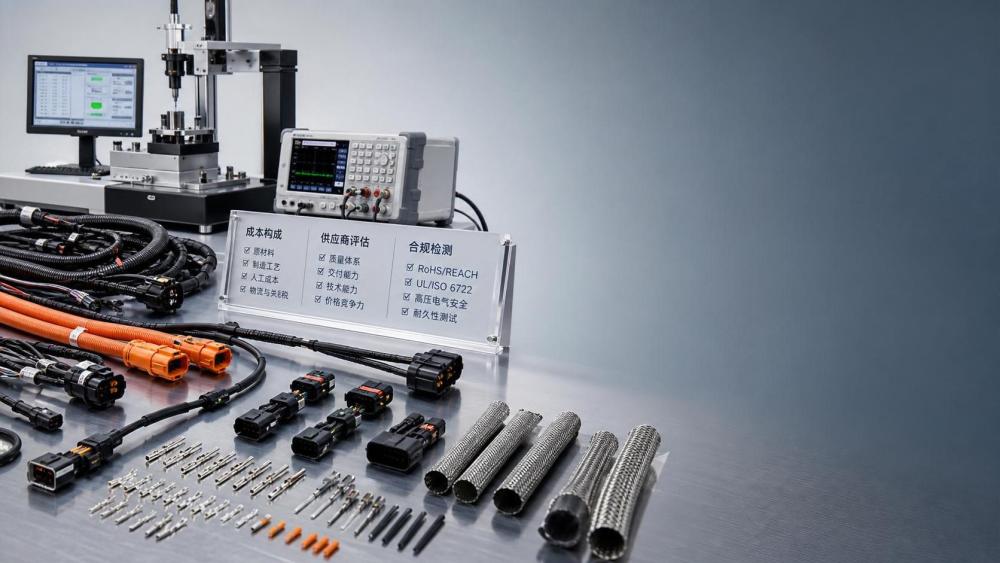
For most auto wiring harnesses, raw materials account for the biggest share of total cost.
Copper conductor is the main driver, followed by terminals, connectors, tapes, tubes, clips, seals, and protective coverings.
In high-voltage auto wiring harnesses, orange cables, shielding layers, and specialized connectors raise the bill further.
When copper prices rise, harness quotations usually follow quickly.
The same pattern appears when resin costs affect connector housings and insulation materials.
- Copper cross-section and total wire length directly change material spend.
- Imported connectors may add tariff, logistics, and currency exposure.
- Shielded and high-temperature materials increase cost per circuit.
- Low-volume custom components reduce purchasing leverage.
2. Labor Intensity Still Matters
Unlike many stamped or molded parts, auto wiring harnesses still rely heavily on manual operations.
Cutting, crimping, loading, taping, branch forming, and final inspection involve many hands.
A harness with many branches can take much longer to assemble than a simpler design with similar material value.
That is why factory location and labor productivity remain important commercial factors.
In practical sourcing, a cheaper labor market does not always mean lower total cost.
Rework, training gaps, and unstable output can erase the apparent saving.
3. Design Complexity Changes Everything
The cost of auto wiring harnesses rises sharply when vehicle architecture becomes more complex.
A dense smart cockpit, ADAS sensors, battery systems, and zonal electronics all increase harness content.
More circuits mean more connection points, more testing steps, and more failure modes to control.
Packaging constraints inside the vehicle add another layer of difficulty.
Tight bend radius, heat exposure, vibration zones, and water ingress points all influence design and manufacturing cost.
4. Testing, Certification, and Traceability Add Necessary Cost
Reliable auto wiring harnesses require validation, not just assembly.
Electrical continuity, crimp pull force, sealing, thermal aging, vibration, and high-voltage safety all require controls.
Suppliers serving global OEM programs also need stronger traceability and document management.
This is especially true under IATF 16949, PPAP, IMDS, RoHS, and market-specific compliance expectations.
These costs are not optional overhead.
They are part of the risk control system behind dependable auto wiring harnesses.
How to Evaluate Auto Wiring Harness Suppliers Beyond Unit Price
A competitive quotation matters, but it should never stand alone.
The more useful question is whether a supplier can support stable cost, quality, and delivery over time.
That is where supplier evaluation becomes more strategic.
1. Check Technical Fit With the Program
Not every harness maker is equally capable across low-voltage, data, and high-voltage applications.
Some suppliers are strong in body harnesses.
Others are better in battery packs, electric drive systems, or infotainment connections.
Before commercial comparison, confirm technical match with the exact program scope.
- Experience with similar vehicle platforms and annual volumes.
- Capability in high-voltage auto wiring harnesses and shielded cable assemblies.
- Engineering support for drawing review, DFM, and routing optimization.
- Validation resources for environmental and electrical performance.
2. Review Supply Chain Depth
A harness supplier is only as strong as its component network.
Terminals, connector systems, copper wire, corrugated tubes, and sealing parts often come from different upstream sources.
If one source is fragile, the entire program can slow down.
This became more visible during logistics disruptions and raw material shortages.
More importantly, it remains a live issue today.
- Ask for approved source lists for critical components.
- Check dual-source strategy for high-risk parts.
- Review inventory policy and buffer stock logic.
- Confirm how engineering changes are cascaded upstream.
3. Audit Manufacturing Control, Not Just Capacity
Published capacity numbers are easy to present.
Process discipline is harder, and far more important.
For auto wiring harnesses, consistent crimp quality, error-proofing, line balancing, and final electrical testing are basic requirements.
A capable plant should also show disciplined change control and operator training records.
That usually tells more than a polished presentation.
4. Measure Quality Performance With the Right Indicators
A low defect rate on paper is not enough by itself.
Look at response speed, containment ability, and recurrence prevention.
In actual business, supplier behavior after a problem often matters more than the first problem itself.
Practical Cost Control Strategies for Auto Wiring Harnesses Sourcing
Reducing cost does not always mean pushing for a lower quoted number.
The better route is to improve total commercial logic around auto wiring harnesses.
Use Early Design Reviews to Remove Hidden Cost
Many avoidable costs are locked in before nomination.
Excess wire length, unnecessary variants, over-specified materials, and inefficient branching can all be challenged early.
A supplier with strong engineering input can improve both cost and manufacturability.
Separate Commodity Risk From Conversion Cost
When negotiating auto wiring harnesses, split copper-linked material exposure from assembly conversion value.
This creates a clearer view of what the supplier can control.
It also helps avoid repeated disputes when metal prices move sharply.
Build a Dual-Track Supplier Strategy
For strategic auto wiring harnesses, relying on one supplier can create leverage risk.
A dual-track approach supports benchmark pricing and continuity planning.
This is especially useful for high-voltage programs, export platforms, and fast-ramping EV projects.
Track Total Landed Cost
The nominal price of auto wiring harnesses can look attractive until freight, packaging, duties, and quality spillover are added.
A full landed-cost model creates better decisions than unit price alone.
That becomes even more important in cross-border sourcing.
What a Strong Sourcing Decision Looks Like
A strong sourcing decision for auto wiring harnesses balances five things at the same time.
- Competitive and transparent cost structure.
- Proven technical fit for the target vehicle application.
- Stable upstream component supply.
- Disciplined manufacturing and quality systems.
- Reliable support during launch, change, and volume ramp.
When these factors align, auto wiring harnesses sourcing becomes more predictable and commercially defensible.
That also reduces the risk of late surprises hidden behind an attractive quote.
In the current market, the smartest move is simple.
Evaluate auto wiring harnesses with both cost discipline and operational realism.
That is usually where better margins, lower risk, and stronger supplier relationships begin.
Have questions about this sector analysis, or seeking best practices specific to your niche? Drop us a line below and let the senior consultants at GAC assist you.
“We respect your privacy. Your information is strictly confidential.”
Related News
- 00
0000-00
How to assess a smart cockpit electronics manufacturer's integration capability - 00
0000-00
How does a shielded HSD cable reduce interference in vehicles? - 00
0000-00
What drives demand for scroll compressors in the automotive market? - 00
0000-00
Does AEC-Q200 apply to flexible printed circuits? - 00
0000-00
How does production volume affect automotive flexible electronics costs?
Weekly Insights
Stay ahead with our curated technology reports delivered every Monday.
Recommended News
 How to assess a smart cockpit electronics manufacturer's integration capabilityAssess a smart cockpit electronics manufacturer's integration capability with practical checks for interfaces, testing, safety, cybersecurity and supplier support.Author:Time:Nov 18, 2026
 How does a shielded HSD cable reduce interference in vehicles?Discover how a shielded HSD cable reduces vehicle interference, and learn why connector design, routing, and testing matter for reliable high-speed data links.Author:Time:Nov 17, 2026
 What drives demand for scroll compressors in the automotive market?Explore the scroll compressor for automobile market and discover how EV adoption, heat pumps, efficiency, and supplier capabilities shape demand.Author:Time:Nov 16, 2026
 Does AEC-Q200 apply to flexible printed circuits?Flexible Printed Circuit AEC-Q200 requirements explained: discover which components qualify and how to assess automotive FPC reliability.Author:Time:Nov 15, 2026
 How does production volume affect automotive flexible electronics costs?Explore how production volume affects automotive flexible electronics cost, from tooling and yield to testing. Compare quotes and negotiate smarter.Author:Time:Nov 14, 2026
 How much does an in-vehicle infotainment system cost to replace?Explore in-vehicle infotainment cost, from affordable repairs to factory replacements. Compare options, installation fees, and compatibility before you buy.Author:Time:Nov 13, 2026
 How does condenser efficiency affect heat pump performance?Discover how condenser high efficiency can improve heat pump performance, reduce compressor power, and boost heating COP—plus the trade-offs to watch.Author:Time:Nov 12, 2026
 What does each FAKRA cable color code mean?FAKRA cable color code explained: Explore common connector colors, typical uses and key compatibility checks before choosing a replacement.Author:Time:Nov 11, 2026
 How to compare noise ratings for battery coolant pumpsCompare coolant pump low noise ratings with confidence. Learn how test conditions, hydraulic duty, tonal noise and installation affect your choice.Author:Time:Nov 10, 2026
 How bright should automotive display systems be in sunlight?Automotive Display Systems need more than brightness to stay readable in sunlight. Discover why 1,000 nits is a starting point and how to evaluate glare and heat.Author:Time:Nov 09, 2026
 How heat pumps improve the efficiency of EV thermal systemsEV Thermal Systems use heat pumps to reduce heating energy demand. Explore how they work, where they excel, and what limits efficiency in cold weather.Author:Time:Nov 08, 2026
 Can a smart cockpit platform support multiple displays?Can a smart cockpit platform support multiple displays? Explore key requirements for performance, safety, connectivity, and supplier evaluation.Author:Time:Nov 07, 2026
 How is automotive connector vibration resistance tested?Automotive connector vibration resistance testing reveals hidden contact failures. Explore test profiles, continuity monitoring and pass criteria.Author:Time:Nov 06, 2026
 How heat pumps save energy in automotive cabin climate systemsAutomotive Cabin Climate Systems energy saving starts with smarter heat pump design. Explore real-world efficiency, cold-weather trade-offs, and testing tips.Author:Time:Nov 05, 2026
 Is an EV heat pump worth it for winter driving range?Is a heat pump worth using in a cold-climate EV? Discover how it affects winter range, when it pays off, and what to check before buying.Author:Time:Nov 04, 2026
 When should you use 50-ohm coaxial cable instead of 75-ohm?Coaxial cable 50 ohm or 75 ohm? Learn when to use each, avoid impedance mismatches, and choose the right cable for reliable RF and video performance.Author:Time:Nov 03, 2026
 How to select a high temperature motor harness for an EVChoose the right high temperature motor harness for your EV. Compare thermal limits, current capacity, shielding, routing, and validation evidence.Author:Time:Nov 02, 2026
 How much does electric power steering replacement cost?Electric power steering price typically ranges from $1,000 to $3,000 for major replacements. Discover cost factors, repair options, and tips for comparing quotes.Author:Time:Nov 01, 2026
 How to size an EV A/C compressor for the required cooling capacitySize an EV A/C Compressor with confidence. Explore cooling loads, performance maps and power limits to select the right compressor for your vehicle.Author:Time:Oct 31, 2026
 How to choose the right pitch for an FPC board connectorFPC board connector pitch affects space, assembly and reliability. Learn how to compare options and select the best fit for your design.Author:Time:Oct 30, 2026
 How zonal design affects harness routing in high-voltage EV architecturesExplore high-voltage electrical architecture zonal design and its impact on EV harness routing. Discover key trade-offs in cable length, safety, thermal performance, and service access.Author:Time:Oct 29, 2026
 How tariffs affect costs in global automotive parts supply chainsNavigate tariffs in the global automotive parts trade supply chain. Learn to compare landed costs, manage duty exposure, and uncover smarter sourcing strategies to protect your margins.Author:Time:Oct 28, 2026
 How to assess vendor lock-in in a software-defined vehicle platformAssess Software-Defined Vehicle platform lock-in with practical tests for API portability, data access, update control, and exit costs. Learn how to choose a platform with a proven exit path.Author:Time:Oct 27, 2026
 How ISO 26262 guides functional safety in steer-by-wire systemsExplore steering systems functional safety through ISO 26262. Learn how hazard analysis, fault-tolerant design, and validation build a stronger steer-by-wire safety case.Author:Time:Oct 26, 2026
 How to evaluate a steering angle sensor manufacturer's accuracy claimsEvaluate steering angle sensor manufacturer accuracy claims with practical checks on calibration, latency, and test evidence. Compare suppliers confidently and avoid costly selection mistakes.Author:Time:Oct 25, 2026
 How to diagnose CAN bus faults in a hybrid vehicle control unitDiagnose Hybrid Vehicle Systems control unit CAN bus faults with step-by-step power, wiring, and waveform checks. Find the root cause and avoid unnecessary replacement.Author:Time:Oct 24, 2026
 How does battery cooling pipe diameter affect coolant pressure drop?Battery Cooling Pipe diameter affects coolant pressure drop and pump power. Explore sizing calculations and practical tips to optimize EV battery cooling and compare options with confidence.Author:Time:Oct 23, 2026
 How to assess PPAP readiness of automotive sensor system manufacturersAssess Automotive Sensor Systems manufacturers for PPAP readiness. Learn to verify production evidence, measurement capability, validation, and traceability to reduce sourcing risks.Author:Time:Oct 22, 2026
 What to ask an FPC connector manufacturer about reliability testingChoosing an FPC Connector manufacturer? Learn what to ask about reliability testing, failure limits, and traceable results to reduce design risks and select with confidence.Author:Time:Oct 21, 2026
 How to verify vehicle fitment for an aftermarket AC evaporatorNavigating the evaporator aftermarket? Verify vehicle fitment with VIN data, OE numbers, and physical interface checks. Use this guide to avoid costly mismatches and order confidently.Author:Time:Oct 20, 2026