What to audit before choosing a swash plate compressor factory




Choosing a swash plate compressor factory is more than comparing unit prices or stated production capacity. The right source must demonstrate stable quality, engineering capability, compliance readiness, delivery reliability, and support for changing automotive A/C requirements. Before a sourcing agreement is signed, a structured factory audit can reveal risks that are rarely visible in quotations: weak machining control, incomplete validation, unstable sub-tier supply, poor traceability, or an export process that breaks down when a customer issue occurs.
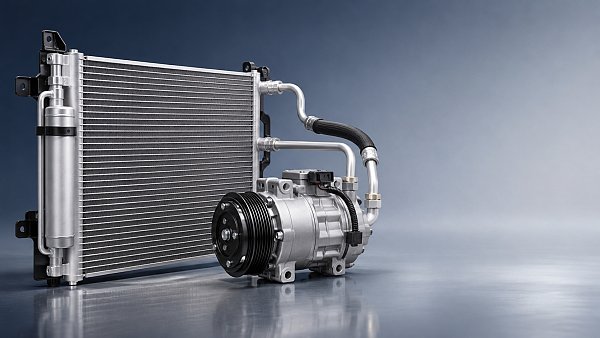
For conventional internal-combustion vehicle air-conditioning programs, swash plate compressors remain an important product category. They are mature, widely understood by service networks, and available in fixed- and variable-displacement configurations for passenger cars, light commercial vehicles, and selected off-road applications. Yet “mature” does not mean low risk. Compressor quality depends on the interaction of precision mechanical parts, lubrication behavior, refrigerant compatibility, clutch or control-valve performance, cleanliness, sealing, and final assembly discipline. A factory may produce a compressor that appears equivalent on a drawing while delivering very different field reliability.
The audit should therefore begin with the intended vehicle program rather than the factory’s catalogue. A replacement-market compressor, an OEM-approved platform part, and a new vehicle development project require different levels of evidence, validation, documentation, and change control. Confusing these categories is one of the most expensive sourcing mistakes.
Start by defining what “acceptable” means for the application
Before entering the plant, establish the technical and commercial baseline against which the supplier will be assessed. This sounds obvious, but many audits become generic factory tours because the evaluation team has not converted vehicle requirements into measurable acceptance criteria.
For a swash plate compressor, the baseline normally includes compressor type, displacement range, operating speed range, refrigerant, lubricant, mounting geometry, pulley and clutch requirements where applicable, suction and discharge port configuration, cooling capacity targets, input power, noise expectations, and durability expectations. For variable-displacement models, control-valve behavior and response under changing load conditions deserve specific attention. The compressor must also be assessed as part of a vehicle A/C loop, not as an isolated component. Condenser capacity, expansion device behavior, refrigerant charge, hose routing, evaporator load, and engine operating conditions all affect field performance.
Refrigerant choice is particularly important. R134a remains relevant in many installed fleets and regional aftermarket programs, while R1234yf is used widely in newer light-vehicle applications in markets where it is required or adopted by OEMs. Compatibility claims should be tied to documented testing for the specific compressor design, oil formulation, seals, desiccant interaction, and service conditions. A general statement that a factory “supports both refrigerants” is not enough.
Commercial requirements should be equally explicit. These include annual volume, ramp-up profile, service-parts demand, packaging standards, warranty responsibilities, required delivery terms, customs documentation, and the expected lead time for engineering changes. A factory that performs well with monthly forecast orders may not have the planning discipline to support volatile service demand or a vehicle launch with tight sequencing requirements.
Audit the manufacturing route, not only the finished compressor
A swash plate compressor is sensitive to cumulative variation. A final inspection station cannot fully compensate for weak control over cylinder bores, pistons, swash plates, shafts, valve plates, bearings, or housings. The most useful plant audit follows the product flow from incoming material to shipment and asks where variation can enter, how it is detected, and whether the response is documented.
Machining capability is a central issue. The factory should be able to explain how it controls critical dimensions, geometric tolerances, surface finish, and burr removal on components that influence compression efficiency, friction, leakage, and wear. It is not necessary for every buyer to inspect individual machining parameters in depth, but the supplier should have a credible control plan, calibrated measurement equipment, gauge-management records, and evidence that process capability is monitored for critical characteristics.
Look carefully at how aluminium housings are sourced or produced. If castings are made externally, the factory’s sub-supplier approval process becomes part of the audit. Porosity, dimensional inconsistency, material variation, and contamination can create leakage or machining problems later. If castings are produced in-house, verify whether foundry controls, lot identification, and incoming chemistry records are connected to the compressor manufacturing record. The point is not to demand vertical integration; it is to understand whether accountability survives across the supply chain.
Cleanliness deserves more scrutiny than it often receives. Metal particles, residual machining fluid, abrasive debris, and moisture can damage control valves, scoring surfaces, bearings, or the wider A/C circuit. A credible factory should define component-cleaning methods, drying procedures, clean assembly areas, contamination limits where required by the customer, and verification practices. A visually clean assembly line is not proof of controlled cleanliness. Ask how contamination is measured, what triggers corrective action, and how filters, washing media, and compressed-air quality are maintained.
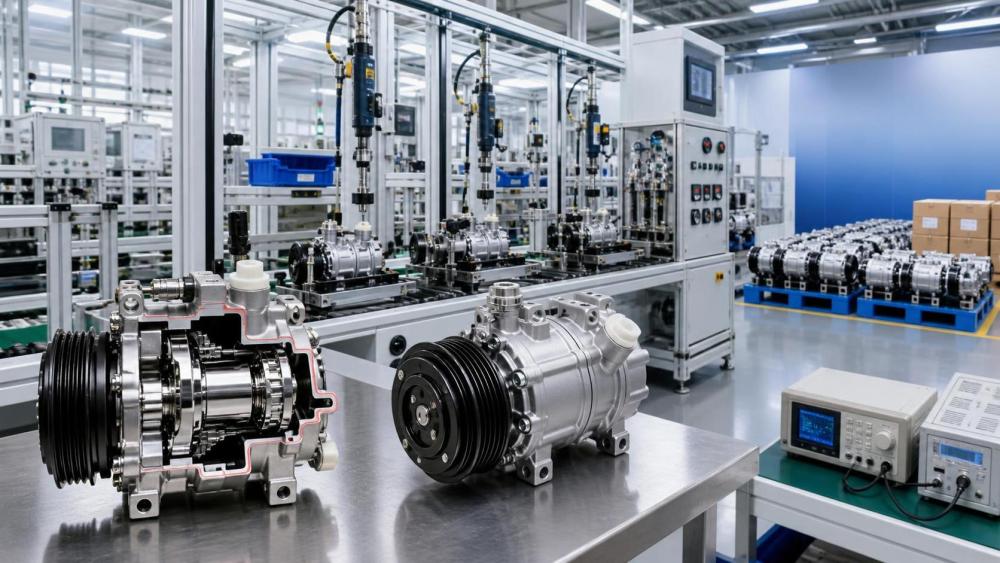
Assembly operations should show error-proofing where failure would create a functional or safety risk. Examples include torque control for critical fasteners, correct orientation of valve plates and seals, oil-fill control, clutch installation, and traceability of electronic control valves. Manual assembly is not automatically a concern, but manual work needs defined instructions, training records, verification points, and a clear reaction plan when abnormal conditions occur.
Do not accept “100% tested” as a complete answer
Most established compressor factories will state that every unit undergoes testing. The more important question is what that test actually proves. A leak test may confirm basic sealing at the end of line, while a running test can indicate abnormal noise, clutch engagement, pressure behavior, or displacement control response. Neither necessarily demonstrates long-term durability or performance across the full operating envelope.
Ask to see the end-of-line test specification, sample records, reject criteria, calibration status, and the method used to link test results to each serial number or production lot. Test data should be retained in a form that can support later warranty analysis. If a batch issue emerges in one export market, the factory should be able to identify related production quickly rather than rely on broad assumptions.
The validation laboratory also needs a separate review. Useful equipment may include performance calorimeters, endurance benches, pressure pulsation and noise test capability, thermal cycling equipment, corrosion test access, vibration fixtures, and refrigerant-handling systems appropriate to the products under development. Not every facility needs every test in-house. Outsourced testing is common and can be entirely acceptable. What matters is whether the supplier has defined validation plans, competent engineering ownership, qualified external laboratories where used, and full access to raw reports rather than only summary certificates.
For an OEM or Tier supply program, review how design verification and production validation are managed. IATF 16949 certification can be relevant where automotive quality-system requirements apply, but the certificate alone does not prove compressor competence. It should be treated as an entry point for further questions: Are APQP activities conducted in practice? Are PFMEAs living documents or static files prepared for an audit? Are control plans updated after quality events? Can the plant demonstrate PPAP discipline when a customer requires it? Are customer-specific requirements incorporated into production controls?
For aftermarket sourcing, ISO 9001 may be more common than IATF 16949. That does not automatically disqualify the source. However, the absence of automotive-specific systems should be reflected in the level of incoming inspection, batch qualification, warranty reserve, and supplier-development effort required.
Examine engineering ownership and change control
One of the highest hidden risks in a swash plate compressor factory is unclear design authority. Some factories manufacture their own established designs. Others produce under licence, assemble customer-owned designs, or supply products reverse-engineered from market samples. These situations carry very different intellectual-property, validation, serviceability, and long-term supply implications.
The factory should be able to identify who owns the drawings, bills of materials, test specifications, tooling, and product-change approval process. If the program uses customer tooling, clarify maintenance responsibilities, tool-life monitoring, insurance, storage conditions, and ownership marking. If the supplier proposes an “equivalent” compressor, require a precise statement of equivalence: dimensions, capacity, clutch characteristics, electrical connections, refrigerant and oil compatibility, and validation scope.
Change control is more important than the initial sample approval. In compressor production, a changed bearing source, seal compound, piston coating, casting supplier, control valve, oil brand, or machining tool can influence performance or durability. A robust supplier does not make such substitutions solely because a part is available or cheaper. It has a documented process for internal review, customer notification where required, revalidation, and segregation of old and new material.
During the audit, ask for examples of recent engineering or supplier changes. The quality of the answer is revealing. A mature operation can show the trigger, risk assessment, approval path, test evidence, implementation date, and traceability. A weak operation will describe change control as a policy but cannot provide an actual case.
Assess supplier control beyond the factory gate
The compressor plant is only as reliable as its critical suppliers. Bearings, seals, reed valves, electromagnetic clutches, control valves, castings, machined shafts, aluminium material, coatings, and packaging materials can all affect quality and delivery. A factory audit should identify which parts are single-sourced, which are imported, and which have long replenishment cycles.
Single sourcing is not inherently unacceptable. In fact, a qualified specialist supplier may offer better consistency than multiple loosely managed alternatives. The risk lies in a single source without inventory strategy, alternate qualification plans, financial monitoring, or visibility into sub-tier capacity. Recent disruptions in shipping, electronic components, and specialty materials have shown that nominal production capacity is less useful than confirmed material availability.
Review the factory’s supplier scorecards, incoming inspection results, supplier corrective-action process, and the proportion of critical parts covered by approved alternates. Also ask whether raw-material cost movements are governed by a transparent mechanism. Aluminium, steel, copper-bearing clutch materials, and freight can affect pricing, but a vague “market adjustment” clause can turn a low initial quotation into an unstable cost position.
Calculate landed cost and warranty exposure, not merely ex-works price
Price comparisons frequently fail because quotations are placed side by side without normalizing what is included. A lower unit price may exclude clutch assemblies, control valves, oil charge, protective caps, customized packaging, test reports, engineering support, or warranty handling. It may also depend on a minimum order quantity that does not match actual demand.
A meaningful cost comparison should include unit price, tooling amortization, development charges, test and approval costs, packaging, inland logistics, ocean or air freight assumptions, duties and taxes where applicable, inventory carrying cost, payment terms, service-part obligations, and expected warranty exposure. For imported compressors, packaging quality is not a minor detail. Damaged ports, pulley corrosion, missing caps, moisture ingress, and inadequate palletization can create claims before the product reaches the vehicle or distribution network.
Warranty risk should be evaluated with technical context. Compressor failures may originate in system contamination, incorrect refrigerant charge, inadequate lubrication, condenser blockage, installation error, or a defective compressor. A supplier that rejects every claim as “system-related” creates a serious commercial burden. The audit should establish how returned units are analyzed, what data is requested from the field, how root cause is determined, and how containment is implemented when a genuine manufacturing issue is confirmed.
Verify export readiness through evidence, not declarations
Export capability is more than having a sales team that communicates in English. The factory should demonstrate experience with commercial invoices, packing lists, certificates of origin when needed, HS-code consistency, dangerous-goods considerations where relevant, customs packing rules, and destination-market labelling. Product documentation should be controlled so that installation instructions, warranty terms, technical data sheets, and markings match the delivered configuration.
Where a program is linked to regulated vehicle applications, applicable regional requirements should be reviewed with the vehicle manufacturer, importer, or responsible compliance party. A compressor factory should not make broad compliance claims without specifying the product version, market, test basis, and responsible entity. This is especially important when components are sold into different vehicle platforms or through mixed OEM and aftermarket channels.
Lead-time claims also need to be tested against real production evidence. Review order history, on-time delivery performance, finished-goods inventory policy, production planning frequency, container-loading procedures, and disruption response. A plant may have unused assembly capacity but still miss deliveries because it lacks control over a purchased clutch, valve, bearing, or casting.
Turn the audit into a sourcing decision, not a visit report
The final assessment should separate critical risks from manageable gaps. A missing cosmetic standard or an incomplete dashboard may be correctable. Uncontrolled design changes, unreliable leak-test records, unclear product ownership, weak traceability, or unvalidated refrigerant compatibility are more fundamental concerns. These should not be diluted by a high score for a modern building or an impressive production line.
For each major gap, define the required corrective action, evidence of closure, owner, deadline, and whether a production order can proceed before completion. Conditional approval can be appropriate when risks are contained through enhanced inspection, pilot production, third-party testing, or limited-volume releases. It is rarely wise to resolve structural quality concerns by negotiating a lower price.
The strongest swash plate compressor factory is not necessarily the largest facility or the lowest-cost bidder. It is the one that can show repeatable control over critical processes, transparent engineering responsibility, disciplined change management, dependable sub-tier supply, and credible support when field issues occur. In a component where a single failure can disable the vehicle’s cooling system and trigger costly service activity, that evidence is worth more than a quotation that looks attractive only at the start of the program.
Have questions about this sector analysis, or seeking best practices specific to your niche? Drop us a line below and let the senior consultants at GAC assist you.
“We respect your privacy. Your information is strictly confidential.”
Related News
- 00
0000-00
How to assess a smart cockpit electronics manufacturer's integration capability - 00
0000-00
How does a shielded HSD cable reduce interference in vehicles? - 00
0000-00
What drives demand for scroll compressors in the automotive market? - 00
0000-00
Does AEC-Q200 apply to flexible printed circuits? - 00
0000-00
How does production volume affect automotive flexible electronics costs?
Weekly Insights
Stay ahead with our curated technology reports delivered every Monday.
Recommended News
 How to assess a smart cockpit electronics manufacturer's integration capabilityAssess a smart cockpit electronics manufacturer's integration capability with practical checks for interfaces, testing, safety, cybersecurity and supplier support.Author:Time:Nov 18, 2026
 How does a shielded HSD cable reduce interference in vehicles?Discover how a shielded HSD cable reduces vehicle interference, and learn why connector design, routing, and testing matter for reliable high-speed data links.Author:Time:Nov 17, 2026
 What drives demand for scroll compressors in the automotive market?Explore the scroll compressor for automobile market and discover how EV adoption, heat pumps, efficiency, and supplier capabilities shape demand.Author:Time:Nov 16, 2026
 Does AEC-Q200 apply to flexible printed circuits?Flexible Printed Circuit AEC-Q200 requirements explained: discover which components qualify and how to assess automotive FPC reliability.Author:Time:Nov 15, 2026
 How does production volume affect automotive flexible electronics costs?Explore how production volume affects automotive flexible electronics cost, from tooling and yield to testing. Compare quotes and negotiate smarter.Author:Time:Nov 14, 2026
 How much does an in-vehicle infotainment system cost to replace?Explore in-vehicle infotainment cost, from affordable repairs to factory replacements. Compare options, installation fees, and compatibility before you buy.Author:Time:Nov 13, 2026
 How does condenser efficiency affect heat pump performance?Discover how condenser high efficiency can improve heat pump performance, reduce compressor power, and boost heating COP—plus the trade-offs to watch.Author:Time:Nov 12, 2026
 What does each FAKRA cable color code mean?FAKRA cable color code explained: Explore common connector colors, typical uses and key compatibility checks before choosing a replacement.Author:Time:Nov 11, 2026
 How to compare noise ratings for battery coolant pumpsCompare coolant pump low noise ratings with confidence. Learn how test conditions, hydraulic duty, tonal noise and installation affect your choice.Author:Time:Nov 10, 2026
 How bright should automotive display systems be in sunlight?Automotive Display Systems need more than brightness to stay readable in sunlight. Discover why 1,000 nits is a starting point and how to evaluate glare and heat.Author:Time:Nov 09, 2026
 How heat pumps improve the efficiency of EV thermal systemsEV Thermal Systems use heat pumps to reduce heating energy demand. Explore how they work, where they excel, and what limits efficiency in cold weather.Author:Time:Nov 08, 2026
 Can a smart cockpit platform support multiple displays?Can a smart cockpit platform support multiple displays? Explore key requirements for performance, safety, connectivity, and supplier evaluation.Author:Time:Nov 07, 2026
 How is automotive connector vibration resistance tested?Automotive connector vibration resistance testing reveals hidden contact failures. Explore test profiles, continuity monitoring and pass criteria.Author:Time:Nov 06, 2026
 How heat pumps save energy in automotive cabin climate systemsAutomotive Cabin Climate Systems energy saving starts with smarter heat pump design. Explore real-world efficiency, cold-weather trade-offs, and testing tips.Author:Time:Nov 05, 2026
 Is an EV heat pump worth it for winter driving range?Is a heat pump worth using in a cold-climate EV? Discover how it affects winter range, when it pays off, and what to check before buying.Author:Time:Nov 04, 2026
 When should you use 50-ohm coaxial cable instead of 75-ohm?Coaxial cable 50 ohm or 75 ohm? Learn when to use each, avoid impedance mismatches, and choose the right cable for reliable RF and video performance.Author:Time:Nov 03, 2026
 How to select a high temperature motor harness for an EVChoose the right high temperature motor harness for your EV. Compare thermal limits, current capacity, shielding, routing, and validation evidence.Author:Time:Nov 02, 2026
 How much does electric power steering replacement cost?Electric power steering price typically ranges from $1,000 to $3,000 for major replacements. Discover cost factors, repair options, and tips for comparing quotes.Author:Time:Nov 01, 2026
 How to size an EV A/C compressor for the required cooling capacitySize an EV A/C Compressor with confidence. Explore cooling loads, performance maps and power limits to select the right compressor for your vehicle.Author:Time:Oct 31, 2026
 How to choose the right pitch for an FPC board connectorFPC board connector pitch affects space, assembly and reliability. Learn how to compare options and select the best fit for your design.Author:Time:Oct 30, 2026
 How zonal design affects harness routing in high-voltage EV architecturesExplore high-voltage electrical architecture zonal design and its impact on EV harness routing. Discover key trade-offs in cable length, safety, thermal performance, and service access.Author:Time:Oct 29, 2026
 How tariffs affect costs in global automotive parts supply chainsNavigate tariffs in the global automotive parts trade supply chain. Learn to compare landed costs, manage duty exposure, and uncover smarter sourcing strategies to protect your margins.Author:Time:Oct 28, 2026
 How to assess vendor lock-in in a software-defined vehicle platformAssess Software-Defined Vehicle platform lock-in with practical tests for API portability, data access, update control, and exit costs. Learn how to choose a platform with a proven exit path.Author:Time:Oct 27, 2026
 How ISO 26262 guides functional safety in steer-by-wire systemsExplore steering systems functional safety through ISO 26262. Learn how hazard analysis, fault-tolerant design, and validation build a stronger steer-by-wire safety case.Author:Time:Oct 26, 2026
 How to evaluate a steering angle sensor manufacturer's accuracy claimsEvaluate steering angle sensor manufacturer accuracy claims with practical checks on calibration, latency, and test evidence. Compare suppliers confidently and avoid costly selection mistakes.Author:Time:Oct 25, 2026
 How to diagnose CAN bus faults in a hybrid vehicle control unitDiagnose Hybrid Vehicle Systems control unit CAN bus faults with step-by-step power, wiring, and waveform checks. Find the root cause and avoid unnecessary replacement.Author:Time:Oct 24, 2026
 How does battery cooling pipe diameter affect coolant pressure drop?Battery Cooling Pipe diameter affects coolant pressure drop and pump power. Explore sizing calculations and practical tips to optimize EV battery cooling and compare options with confidence.Author:Time:Oct 23, 2026
 How to assess PPAP readiness of automotive sensor system manufacturersAssess Automotive Sensor Systems manufacturers for PPAP readiness. Learn to verify production evidence, measurement capability, validation, and traceability to reduce sourcing risks.Author:Time:Oct 22, 2026
 What to ask an FPC connector manufacturer about reliability testingChoosing an FPC Connector manufacturer? Learn what to ask about reliability testing, failure limits, and traceable results to reduce design risks and select with confidence.Author:Time:Oct 21, 2026
 How to verify vehicle fitment for an aftermarket AC evaporatorNavigating the evaporator aftermarket? Verify vehicle fitment with VIN data, OE numbers, and physical interface checks. Use this guide to avoid costly mismatches and order confidently.Author:Time:Oct 20, 2026